Monday, July 24, 2017

Book Review: Playboy Laughs: The Comedy, Comedians, and Cartoons of Playboy


“Since the launch of Playboy magazine in 1953, two elements have been remarkably consistent: the first is the celebration of nubile, female flesh and the second is Playboy’s involvement in the music scene.  The Playboy experience was never just about sex but about lifestyle, and music—particularly the finest jazz, a personal passion of Hefner’s—has always been an essential component of that lifestyle.”  So states the biography of author Patty Farmer, acknowledged to be the expert on the entertainment side (performers, television, etc.) of the legendary magazine that introduced the phrase “I only read it for the articles” into the American lexicon.  Farmer chronicled “the rise, history, and cultural impact of the Playboy empire, including the magazine, clubs, music festivals, and television shows” in her book Playboy Swings—published in 2015 after the success of The Persian Room Presents (2013), a history of the Plaza Hotel’s famed nightclub.

Lenny Bruce
Patty’s follow-up to Swings—which will be released August 3—is Playboy Laughs, a book that concentrates on the comedic side of Hefner’s empire.  (You don’t need to be familiar with the earlier book to enjoy Laughs, because there are some stories repeated here.)  I should be honest—when I requested a review copy (many thanks to my Facebook compadre Jeff Abraham at Jonas PR, who slipped me the freebie) of this book I thought it was going to be a little out of my wheelhouse at Thrilling Days of Yesteryear.  I’m pleased to admit that I was stupendously wrong, for Farmer’s exhaustive history of the funny men who entertained appreciative audiences since the first Playboy Club opened in Chicago in February of 1960 is crammed with wonderful anecdotes about such comedy greats like Joe E. Lewis and Lenny Bruce, and first-hand accounts from stand-up practitioners as Professor Irwin Corey, Phyllis Diller, Tom Dreesen, Jackie Gayle, Shecky Greene, Dick Gregory, Joan Rivers, and Larry Storch.  Laughs is one of the best books I’ve read on stand-up since devouring my pal Kliph Nesteroff’s amazing The Comedians: Drunks, Thieves, Scoundrels and the History of American Comedy.

Milton Berle
Playboy Laughs is one of those books where you want to keep a notepad nearby while reading it so you can jot down anecdotes and relay them back to like-minded friends interested in the history of laughter.  One of the anecdotes that leapt out at me concerns “The Thief of Bad Gags” himself, Milton Berle—who had a bit of a reputation of being a putz where his contemporaries were concerned.  Comedian Lou Alexander relates that when he was just starting out in the business, “Uncle Miltie” took an interest in him and his act, telling him: “I’m going to come to your show once a week and I’m going to heckle you, but before the show I’ll go to your dressing room and tell you what I’m going to say.  This way you can think of things to say back to top me.”

That’s what this great man did for me.  He came in once a week and heckled me, and I’d have all the toppers—the comebacks—and I’d kill him.  He’d put on this act: “Look at this kid, he’s got me again.”  And after a while, maybe two months, it was all over town that there’s some schmucky kid killing Milton Berle at the Interlude.  I loved him.  I loved Berle.  We became very good friends. He was a great guy, a very kind, sweet man.

The Vagabonds
Another memorable passage from the book that has a tenuous connection to a recent post here at TDOY concerns the comedic vocal group known as The Vagabonds, who certainly made their presence known in the 1946 feature film People are Funny.  I’m not quite as enthusiastic as Farmer about the aggregation (she describes their People antics as “scene-stealing”—we’ll just have to agree to disagree on this one) but she did provide me with some information with which I was not aware, in that the quartet were favorites on the nightclub circuit (they even owned and operated nightspots in Frisco and Miami) and made quite a few appearances on shows telecast during the medium’s Golden Age (The Colgate Comedy Hour, Ed Sullivan, etc.).  “With the Vagabonds, even tempo was funny,” she writes.  “Sometimes they’d go so fast they left the audience breathless; other times, they’d drag out a song at such a snail’s pace that listeners would sweat with suspense.  It was as if they were comic masters, always carefully calibrating their punch lines.  And of course, that is exactly what they were.”

Jack Cole's famous comic book creation
Farmer’s wonderful stories about the people and personalities that either started their careers at the Playboy Clubs or benefited from those venues after already establishing themselves comprises a goodly portion of Playboy Laughs…but there are also chapters dedicated to those artists who created the cartoons that dotted the pages of the magazine.  One of particular interest to me was a nice little history on Jack Cole—which I’ll need to set up here.  I knew of Cole because I owned a copy of Jules Feiffer’s The Great Comic Book Heroes as a kid (coincidentally, Feiffer also contributed cartoons to the magazine and has some wonderful stories in Laughs) as a kid and knew Jack as the creator of Plastic Man.  My father, on the other hand, was more familiar with Cole’s post-Plastic Man career as—you guessed it—a prolific contributor to Playboy.  (I admit—my opinion of the old man gained a few points that day after finding out he used to read the mag.)  Other cartoonists discussed in the pages of Patty’s book include Doug Sneyd, Shel Silverstein, Dean Yeagle, Arnold Roth (whose work I knew from TV Guide—his stories about assisting Harvey Kurtzman and Will Elder on Little Annie Fanny are priceless), and Al Jaffee (the legendary MAD artist was a contributor, too).

Hugh Hefner and author Patty Farmer
Farmer does a bit of a sidetracking with histories on Playboy artists like (Alberto) Vargas and Olivia (De Berardinis); a little beyond the scope of a book on both humor and cartoons, in my opinion…but it won’t detract from your enjoyment—and it’s always nice learning about something you didn’t previously know.  As someone who actually did read Playboy for the articles (I had a subscription while I was in college—born to be mild, baby) I enjoyed Patty’s concluding take on Hugh Hefner (an informative history on the man and his pajamas) because anyone who put as much time, money, and effort to restore the Basil Rathbone-Nigel Bruce Sherlock Holmes films my mother loves to watch is aces in my book.  Classic movie fans might get a kick out of this observation of Hef in Playboy Laughs: “At ninety, he carries on the tradition he started decades ago of hosting weekly dinners followed by movies.  One night a week is set aside for a current film, another for a classic film noir, and sometimes a third is added for one of his favorite Chaplin movies.”  Gooble, gobble, one of us!

Friday, July 21, 2017

Crime Does Not Pay #10: “It May Happen to You” (06/05/37)


This week’s Crime Does Not Pay outing has been discussed previously at Thrilling Days of Yesteryear…but since our Friday excursions into MGM’s popular series of shorts allow me to go into a bit more comprehensive detail I’ll apologize in advance for the rehash.  CDNP not only provided work for character veterans, it also served as a showcase for future stars like Robert Taylor (starring in Buried Loot), Barry Nelson, and Cameron Mitchell.  The big name in It May Happen to You (1937) straddles the cinematic worlds of stardom and smaller character actor fame—it’s “that celebrated actor,” J. Carrol Naish, a two-time Academy Award nominee for his supporting performances in Sahara (1943) and A Medal for Benny (1945).  I use the term “celebrated actor” in a tongue-in-cheek manner because that’s how announcer Bob Lemond always introduced him in his starring role on radio’s Life with Luigi (like how I reverently refer to Mister John Dehner in recognition of his billing on radio’s Have Gun – Will Travel).


Philip Trent—last seen as “the MGM Crime Reporter” in The Public Pays (1936)—is back for this entry, but he doesn’t do much outside of introducing this week’s faux law enforcement official, Captain John Mallory—“chief of the larceny squad of the Metropolitan Police Force.”  Mallory is portrayed by character veteran Guy Usher, who appeared in a couple of chapters of The Green Hornet (1940) as an odious criminal type named “Lynch” (nice to see Trent and Usher together in this short, by the way).  Usher’s credited work includes such films as Penguin Pool Murder (1932), This Day and Age (1933), It’s a Gift (1934), and The Spanish Cape Mystery (1935—an Ellery Queen film where he plays Inspector Queen).


MALLORY: Police and the city health department often have to work close together to smash the activities of vicious racketeers…human rats worse than the carriers of bubonic plague…

Hey…hey…there’s no need for name-calling here.

MALLORY: If you think that criminals live in another world that can’t affect you, consider this case…recently, the state highway patrol was fighting a wave of truck hijackings…


There’s a whip-pan to a truck tooling down the road, with “Lathrop Canning Co.” displayed on the back.  (“When…it…says…Lathrop’s, Lathrop’s, Lathrop’s/On the label, label, label/You will like it, like it, like it/On your table, table, table…”)  A car follows the truck, and inside the vehicle are a gang of no-goodniks comprised of Bunco (Emmett Vogan), Torpedo (Eddie Marr), Musclebound (Dick Rich) …and our “celebrated actor” as their fearless leader, J. Carrol Naish as “Moxie.”  (“Make Mine Moxie!”)  Moxie instructs Bunco (who’s at the wheel) to “kill the lights,” then to pull up beside the truck as Torpedo gets out on the running board, smashes the truck’s passenger window, and orders the driver to turn off onto a side road.  Fortunately for the Lathrop employee, a couple of uniformed motorcycle patrolmen are nearby to witness what will surely be some major criminal activity…and after coasting down to where Moxie and his stooges have positioned the truck, shine their headlights to scatter the mob like cockroaches reacting to turned-on lights in the kitchen.  There’s a bit of gunfire exchanged, and Bunco takes some shrapnel before the crooks beat a hasty retreat.

A scene shift, and Moxie is at a pay phone talking with this gent:


Yes, it’s character legend Clarence Hummel Wilson—the beloved hatchet-faced thespian who’s been in countless shorts and features…but around Rancho Yesteryear, we remember him for roles in several Hal Roach-produced comedies (Our Gang’s Shrimps for a Day [1933], Charley Chase’s Public Ghost #1 [1935], etc.).  This is Wilson’s last CDNP outing (he was previously seen in Alibi Racket), and while we are unquestionably saddened by this he gets a great showcase here as the “brains” of the operation, Van Buren “Pop” Sheafor.

MOXIE: Bad news, Sheafor…that job fell through tonight…
SHEAFOR: Fell through?  How come? (Pause) All right—meet me at the warehouse in one hour…
MOXIE: Right…

As he hangs up the phone and exits the phone booth, we see that Moxie phoned “Pop” from a gymnasium…and that his fellow goons are whiling away their copious crook time watching a pair of amateur pugilists have at it for a few rounds.  Torpedo tells his boss that Bunco’s “slug went through his hand—but he’ll be okay.”

MOXIE: From now on we lay off the highways—those state cops are gettin’ too smart…we gotta figure out a new way to work…
TORPEDO: Gettin’ so a man can’t earn his livin’ no more…

Nice little laugh line from Marr—who had a most prolific acting career on radio (The Lux Radio Theatre, Suspense) in addition to motion pictures.  Moxie’s gang takes delight at watching an amateur (Arthur Rankin) display his unique boxing style, which consists of him hitting the other fighter’s glove repeatedly with his face, then falling to the mat.  Musclebound jokingly refers to him as “Horizontal Eddie.”


MOXIE: Why…that guy don’t look like a fighter…
MUSCLEBOUND: He ain’t!  He works for a livin’…checks out trucks at the Cassidy Meat Packin’ Company…
MOXIE: Meat packin’ company?
MUSCLEBOUND: Yeah…


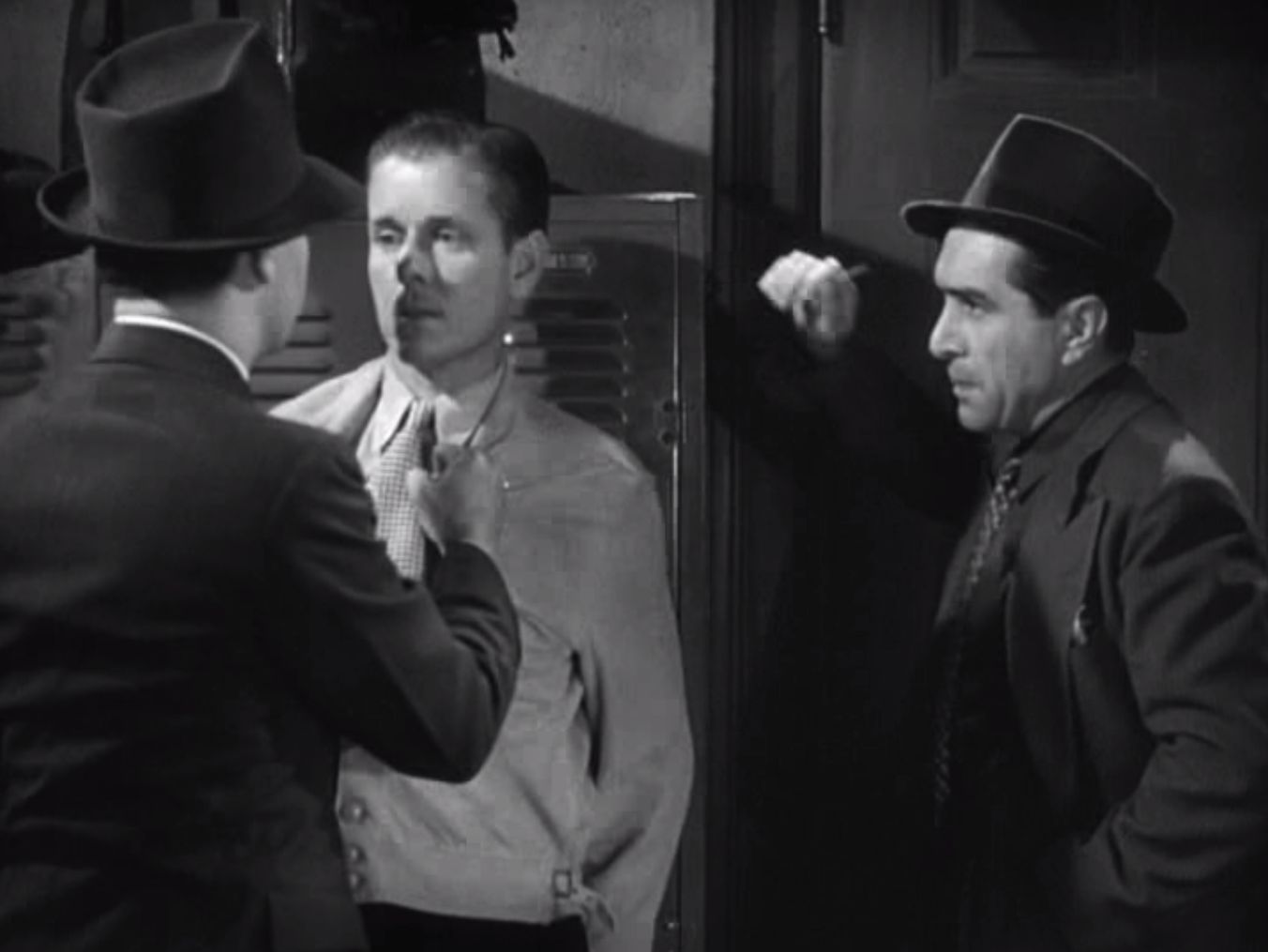
You can almost see the wheels a-turnin’ inside Moxie’s cranium as he begins to devise an eevillll scheme…he then visits young Edward in one of the locker rooms at the gym…

MOXIE: That’s a wicked left you got, kid…
EDDIE: Thanks…
MOXIE: I’m Moxie…
EDDIE: Yeah—I heard about you…

“Don’t get any ideas about my sister, though—she’s off-limits!”


MOXIE: Whaddya trainin’ for?
EDDIE: Oh…I just need to make a little extra money…
MOXIE: Well, you sure picked yourself a tough way to get ten bucks…

Moxie knows all about Eddie’s job at the meat packing company, of course—but he’s coy about it until Eddie brings it up.  The racketeer then goes to work on his mark’s financial insecurity: “Those joints never pay anything—even when you work up to somethin’.”  He’s got a little proposition for the money-minded young lad, and while there’s a fade-out as Moxie goes into the details, we get the gist of what he discussed with Edward in a conversation with “Pop” Sheafor.


MOXIE: …every morning he helps load those big refrigerator trucks and sees that they’re locked before they leave the plant…kid’s workin’ for peanuts—crazy about dough…it’s the perfect setup…
SHEAFOR: Hijack meat?
MOXIE: Why not?  Hah!  There’s big dough in fresh registered beef…
SHEAFOR: How are you gonna work it?
MOXIE: Never mind about that…if I get the stuff…can you sell it?
SHEAFOR: Sure!  I got several sellers on the east side who’d be glad to get some cheap…

Moxie asks Sheafor if he wants it brought to his hideout, and “Pop” is adamant about scotching that scheme.  “The health department inspectors are always nosing around the warehouse,” he explains.  Not a problem—Moxie will just need to take it to “the old garage” and “pile it up—throw some ice on it.”  I suppose I don’t need to tell those of you who don’t have extensive experience in food storage why this is not going to end well (there’s a reason why sides of beef are always stored in freezers, kids).  But I’m getting ahead of the short.

The next morning, Moxie is waiting for Eddie as the enterprising young soul leaves his modest apartment on his way to an early shift at the plant.  Eddie has given Moxie’s proposal a lot of thought, and he’s in—all he’ll need to do is slip Moxie the key to the lock on the truck headed for the nearby burg of Gardenia, and provide the proper info on what route that truck will be taking.  Eddie does have some misgivings, though:

EDDIE: Suppose they miss the key at the plant?
MOXIE: Well, they won’t for ten minutes…and that’s all I’ll need it for—I’ll get copies made by a guy I can trust… (Eddie hesitates) Now—what’s the matter?  You said you were interested in easy dough…
EDDIE: Well, I don’t know…I…
MOXIE: All right…forget about it…you’re the kind of a sucker who likes to work for a livin’…


Don’t you just hate those guys?  Moxie starts to walk off…but Eddie asks him to wait a minute, then gives him a big grin.  Looks like Eddie’s going to be kicking in on the tolls dotting the road to perdition.


The Great Beef Robbery goes according to plan.  As the driver (Jack Pennick) complies with a stop sign, Musclebound emerges from some bushes to puncture two of the truck’s tires, leaving the driver flat.  (I make leetle joke.)  Bunco then pulls up in a sedan, and when Driver explains the situation to him he offers to give him a lift to a phone so he can contact a tow truck.  As Bunco’s car drives off, Moxie, Torpedo, and Musclebound pull up in a truck of their own and help themselves to that sweet, sweet Cassidy beef once Musclebound unlocks the refrigerated section with that duplicate key.  There is then a scene shift to the plant, where the driver is being questioned by Cap’n Mallory as to the details of the theft.

DRIVER: …and when I got to Gardenia and opened the truck—it was empty…
MALLORY: Were the doors locked when you got there?
DRIVER: Yes, sir…
MALLORY (to the plant manager): You sure that truck didn’t go out empty?
MANAGER: These men loaded it…

He leads Mallory over to where a couple of plant employees are standing—Eddie is in the vicinity as well, seated at a desk.


MALLORY (to Eddie): What’s your job?
EDDIE: I check the load…and see that the doors are locked…and that the driver gets the invoice…
MALLORY: Were the doors locked?
EDDIE: Yes, sir…

Well, he was honest—he just left out the part about “…and then I gave the key to some greaseball hood who made himself a copy.”  Mallory is baffled by this case.  All the men at the plant have good records.  There are no discernible fingerprints on the truck (what prints do exist are all smeared) and “no jimmie marks on the locking devices.”  “Most hijacking is done at gunpoint or by violence,” muses Mallory.  He surmises that it must be an inside job, and he tells his man Reed (William Royle) to pore through the employees’ records with a fine-tooth comb.  A “Dr. Rexford” (Frank Dae) at the Health Department should also be contacted.

As the scene changes, a grocer (Rollo Lloyd) who answers to “Joe Mollock” is on the horn with Sheafor—salivating at the prospect of buying some cheap beef:


MOLLOCK: Three cents better than market?
SHEAFOR: Cash deal…and quick dough for both of us…
MOLLOCK: Quick dough, huh?  Okay—send me fifteen sides!

Getting off the phone with Mollock, Sheafor is one happy black marketer—crowing “Oh, what a racket!” and making me choke on my beverage.


MOXIE: It’s a pipe, isn’t it?
SHEAFOR: And easy to sell!  I’ve got orders for half that load already!
MOXIE: Where’d ya peddle it?
SHEAFOR: Outside of Joe Mollock, I’ve got three jobbers on the east
side I can trust—Ward, Wesley, and Britton…only they don’t want delivery before Thursday…so we’ll have to hold it for them before then…hope that stuff keeps in the garage for a couple of days…

“Torpedo!  Head out to the 7-11 for another bag of ice!”  Sheafor tells Moxie that he could use another load next week, and he asks his chief henchie if he can trust Eddie.  “I don’t trust him…I just keep an eye on him—he’ll do what I say” is his reply.  Sheafor suggests that Eddie pilfer some invoices from the Cassidy company—that way they can give them out to the “jobbers” and everything will be legit.

A scene dissolve, and Moxie and Torpedo are paying Eddie off at the gym…where Moxie asks the young criminal-in-training to score some “billheads.”

MOXIE (handing him $100): Bet that’s the easiest century that ever came your way, huh?
EDDIE: You said it!  It’s going right down on a yellow sport roadster…

You’re not even in the crime business a day, Eddie…and you’ve forgotten about sending some money home to your poor, gray-haired old mother.  Bad Eddie.  No hotrod.

MOXIE: Take it easy, kid—you don’t wanna start lookin’ too flush…we’re pullin’ another haul next week…
EDDIE: Sure…anytime… (He laughs) Simple…the cops don’t know where to start…


Rut roh, Raggy.  You see, Edward neglected to tell his hoodlum friends that the gendarmes paid the Cassidy people a visit after the meat robbery and started asking a lot of questions…this does not sit well with Moxie, though it’s Torpedo who grabs the little mook by the lapels, slamming him up against the lockers.

MOXIE: What did they say to you, Eddie…?
EDDIE: Oh, they just asked me a couple of routine questions…was the truck locked when it left?  I told them yes…and they asked me what I did…they questioned several other guys at the plant, too…don’t worry about it!
MOXIE: We’re not worried about it, kid…only watch your step…go on, beat it…


Well, we’re at the halfway point here and as you can tell by the newspaper headline—a couple of bags of ice is insufficient to keep meat from going bad.  Dr. Rexford informs Cap’n Mallory in one of the hospital wards that there’s been close to 200 cases of ptomaine—with four deaths—from “bad beef.”  “Forty-seven butcher shops and seven restaurants…had some of that spoiled beef,” he intones, adding that that’s why he’s called Mallory in on the case.  The three “jobbers” that handle Cassidy beef—Ward, Wesley, and Britton—have been vouched for (ha!) by Cassidy, and the plant has received a clean bill of health after being thoroughly inspected.


A distraught woman bursts out in tears as she is led out of the ward by an intern—sounds like she received some bad news.  “We’ve got to find the rest of that poisoned beef before it gets to any more people,” declares Rexford firmly.  “There’s no time to lose.”  What started out as a simple case of hijacking has turned into “a death threat.”  Mallory is still convinced that it’s an inside job…but since he’s had no luck with the leads, he turns to the Fourth Estate to flush the miscreants out.  Meanwhile—back at the hideout:

BUNCO: It’s no use…I can’t get rid of any more of that beef…the Health Department’s got the jobbers buffaloed…
MOXIE: How can the beef be bad—we got ice on it, haven’t we?

“Damn it, Jim—I’m a hoodlum, not a nutritionist!”


MUSCLEBOUND: Yeah…them headlines is just a copper’s gag…
BUNCO: We better drop it…maybe it is spoiled…
MOXIE: Now, listen—we got dough tied up in this!  Plenty!
SHEAFOR: That’s right…and we’re gonna sell it!  (To Moxie) We’ll make that beef look fresh with some chemicals…then we’ll re-stamp it with the Maxim Company stamp!
BUNCO (sarcastic): Oh—will that make it good?
MOXIE: Well, what’s the difference…as long as we get our dough!

Strategy session in a major corporation or powwow amongst the criminal element?  You make the call!  Moxie orders Musclebound to get his ass over to the garage and start preparing the beef… but he’s interrupted by the arrival of Torpedo, who produces this cherce headline:


“When that kid sees how bad it is…he’s gonna spill all over what he knows all over headquarters!” wails Sheafor.  “That’s what I’m thinkin’,” confirms Moxie.  Besides, Eddie has violated the “code” by buying that car after explicitly being told not to.  Ordinarily, an infraction like this would result in loss of supper and detention in one’s room the rest of the evening.  But the Moxie Gang plays for bigger marbles, and Moxie orders Bunco to grab a taxi and collect Eddie, who’s due off from work in twenty minutes.  “Tell ‘em we’re gonna let him in on a big job,” Moxie explains…then he adds “The heat’s on.”

Because Cap’n Mallory has also learned that Eddie’s become quite the plunger of late, he’s had the kid shadowed by Reed—he’s on the job observing that Bunco is waiting for Eddie in Eddie’s car when the whistle blows.


BUNCO: Moxie wants to see you…
EDDIE: Hey—what for?
BUNCO: He wants you to meet the Big Boss…they’re gonna bring you in on a real job…

“Gloriosky!  That sounds neat-o keen!”  Bunco has Eddie drive to Sheafor’s, where the kid can hardly contain his excitement that his friends will be taking him for a ride.  Moxie holds back to tell Bunco: “Take the kid’s car to the Dutchman…get what you can for it, and tell him to break it up…today.”  Reed can’t help but notice that Bunco drives off in Eddie’s car and so he follows the henchman…sadly, in taking his eye off Eddie he can do nothing when Torpedo later sends the kid to The Happy Hunting Ground while the hoods drive along a country road.

Eddie did not die in vain.  (It was more like in B.F.E.)  Since Reed told Mallory about the kid and Bunco arriving at Sheafor’s, it’s given the police a vital lead in that they leap into action to question those individuals who do business with “Pop” …and that leads them to the weaselly Joe Mollock, who “handled fifteen more sides of beef than his refrigeration allowed last week.”

REXFORD: You handled more meat than your refrigerators can take care of…
MOLLOCK: All right…I’ll pay the fine…
MALLORY (enraged): Say—you can’t settle this with a fine

“Who do you think you are—Goldman-Sachs?”


MALLORY: …two hundred people have been sick, four have died, and one was murdered because of the hijacking of some poisoned beef—and you handled fifteen sides of Cassidy’s beef that you can’t account for!
MOLLOCK: None of my meat poisoned anybody!  I never got a kickback!
MALLORY: No, but the health department did…you’re in a spot, Mollock…
MOLLOCK: I tell you that beef was okay!
MALLORY: Yeah?  Say, maybe we’ll slap a manslaughter charge on ya…we’re gonna close all your stores and hold you for investigation…

B-b-b-bad to the bone.

“Only if I don’t sing like a canary…and I’m going to do some warming up exercises right now!”  Mollock comes clean and confesses to the cops that he got the beef from Sheafor—still insisting the meat, however, was perfectly okay.  It’s all over but the shouting, cartooners—Moxie and the boys make separate deliveries to all three of Mollock’s stores (he won’t take the beef otherwise) and at each establishment, the cops are waiting to collar them (even Sheafor).  It’s all terribly anti-climactic, though I did chortle when they rounded up Bunco because he remarks “I had a hunch this was coming!” as he’s being slapped into handcuffs.  (Mama said there’d be days like this.)  When they arrest Musclebound at the same store, Rexford removes the tarpaulin from his truck and remarks of the beef: “Enough to kill a city…okay, pour the kerosene over it.”  (Yes, I was kind of surprised by this—I half-expected them to dole out the food out to the poor.)

Take us home, Mallory my man!


MALLORY: Moxie was right…the criminal can’t win…Bunco turned states’ evidence…Moxie and Musclebound went to the chair for Eddie’s murder…

I should point out that it was Torpedo who popped a cap in Eddie…but he was gunned down as the cops swarmed in on him at one of the stores.  (“He asked for it.”)

MALLORY: …Sheafor drew fifty years to life…and Eddie the working boy—who wanted to run with the so-called big shot gangsters—did not live long enough to find out that crime does not pay…thank you…


No…thank you, Captain Mallory.  Next time: a short with a title that’s just plain irresistible to a left-wing scalawag like me—Soak the Poor (1937)!  G’bye now!

Wednesday, July 19, 2017

Adventures in Blu-ray: Abbott & Costello Rarities


Thunderbean Animation has firmly established itself in the Blu-ray/DVD field as the go-to label for classic cartoon releases, ranging from the oeuvre of Willie Whopper and Cubby Bear to their current project of restoring all 27 shorts from the Van Beuren Studio’s Rainbow Parade series (1934-35).  It’s a labor of love for Thunderbean CEO Steve Stanchfield, a cartoon historian and film preservationist dedicated to hunting up the best existing 16mm/35mm materials for these outstanding sets.  In May, Thunderbean’s long-anticipated Abbott & Costello Rarities—an outstanding collection of odds and ends spotlighting the great comedy duo—finally hit the streets, and if you’re as big a fan of Bud and Lou as your humble narrator, you need to track this down with all deliberate speed.

Lou, Bud, and Kate
I’ve had to cut back on the significant amount of DVD-age purchased for the dusty Thrilling Days of Yesteryear archives of late, so I was most fortunate to score a free copy of the Rarities Blu-ray/DVD combo from a longstanding member of the TDOY faithful (he asked me to keep his identity secret so as not to interfere with his sideline of bringing maniacal supervillains to justice).  There’s something for everyone in this collection…but I’ll come clean and admit that my favorite features were those of the audio variety.  Rarities includes a March 10, 1938 excerpt from The Kate Smith Hour (the boys do a variation of the “betting parlor” routine that was later recycled in 1943’s It Ain’t Hay) and the July 3 premiere broadcast of their 1940 summer stint as replacements for Fred Allen’s show (I was only aware of one other It’s Time to Smile program in collector’s hands).  Another uncirculated broadcast is from November 4, 1943—the night that Lou returned to radio after he recovered from rheumatic fever…and the same night he learned of the drowning death of his infant son “Butch” earlier that day; Lana Turner is the guest, and Bud informs the audience of Lou’s tragedy at the end of the broadcast.  A rare recording of their Saturday morning series (The Abbott & Costello Children’s Show from June 20, 1948) is also included among the audio gems (audience warm-ups, actualities, etc.).

Bud and Jerry Lewis
The Rarities collection includes trailers from some of Bud and Lou’s classic film comedies (Buck Privates, In the Navy, etc.) and “blowups” (bloopers) from others like Pardon My Sarong and Little Giant (I really got a kick out of seeing the outtakes from Abbott & Costello Meet Frankenstein, my favorite A&C vehicle).  There are newsreel clips, excerpts from Lou’s home movies, and an amazing collection of footage (Kodachrome) from the team’s 1943 war bond tour (where they sold nearly $85 million worth of bonds).  A favorite highlight of mine is an unearthed November 1, 1953 telecast of The Colgate Comedy Hour, in which Bud must work solo in Lou’s absence (Costello is ill) with an assist from Dean Martin & Jerry Lewis.  The program includes clips from previous Colgate shows featuring Lou—one their famous “Rubdown” sketch (with stooges Sid Fields and Bobby Barber) and another hilarious skit where the duo goes to great lengths to get rid of a stolen necklace (the two men have difficulty keeping it together before the finish).  In addition to Dino’s singing (both solo and comedy songs accompanied by Jer’s clowning with Al Goodman’s orchestra), Peggy Lee does a few numbers (including the Halo shampoo jingle) and Gene Nelson dances (I kind of fast-forwarded through this).

Another favorite from this set: Lou, Bud, and Charles Laughton (as Bud's chauffeur!) make a plea for Christmas Seals.
Chris Costello, whose outstanding biography of her father (Lou’s on First) was written up for the blog in October of last year, provided much of the material for this release…and I’ll admit, the content more than surpassed my expectations (I was expecting a lot of the public domain A&C filler that’s been previously released).  At the risk of sounding like a parrot…this is a collection that Abbott & Costello fans will want for their bookshelf—a more-than-justified reward for those who have waited patiently all these years to see it come to fruition.

Friday, July 14, 2017

Crime Does Not Pay #9: “Torture Money” (01/02/37)


Torture Money (1937), the ninth short in MGM’s Crime Does Not Pay franchise, would win the studio back-to-back Academy Awards for Best Short Subject (Two-Reel) …and while the CDNP folks would garner five additional nominations in that category before the series ended in 1947, I’m not convinced I would have been so willing to hand over a statuette for this entry (1939’s Drunk Driving, another nominee, is a much better short…and a more deserving winner, IMO, than Warner Brothers’ sappy Sons of Liberty, which took home the prize that year).  The man responsible for the previous CDNP Oscar winner, The Public Pays, also wrote the story and screenplay for Money—John C. Higgins.  Oh, and Torture Money does have this little mash note at the beginning contributed by James Edgar “Two-Gun” Davis (though he signs it without the “Two-Gun”), the L.A. Chief of Police at the time of Money’s release:


Aww…wasn’t that sweet of him?  Before you break out the stationery for an RSVP to accompany your candy and flowers, leave us look at Chief Davis’ entry on Wikipedia: “Under Davis, the LAPD developed its lasting reputation as an organization that relied on brute force to enforce public order.  It also became very publicly entangled in corruption.  Members of the LAPD were revealed to have undertaken a campaign of brutal harassment, including the bombings of political reformers who had incurred the wrath of the department and the civic administration.”  Bad cop.  No donut.

I can’t be 100% on this, but I believe this is the first CDNP entry in which the narrator identifies himself as “the MGM Crime Reporter” (he just goes by “the MGM reporter” in previous shorts).  He is not, sadly, identified at the [always reliable] IMDb so if you know the actor—operators in the comments section are standing by.


REPORTER: Once again, as the MGM Crime Reporter, it is my privilege to bring you another episode in our “Crime Does Not Pay” series…may I present—Captain Michael Karnahan, chief of the Bunco and Pickpocket detail of the Metropolitan Police Force…


Great Caesar’s Ghost!  That’s John Hamilton (nice soup strainer, Johnny!), the veteran character actor fondly remembered as Daily Planet Editor Perry White on TV’s The Adventures of Superman…which is why the “Great Caesar’s Ghost” gag will get quite a workout here at TDOY, since this will not be the last time we see Hamilton portraying faux law enforcement officials (Torture Money is his CDNP debut).  (I mean, seriously—what is up with this “Metropolitan Police Force” nonsense?)

KARNAHAN: Criminals devote all their time and cleverness to devising new ways of making a living through terrorism and fraud…

Well, really—if you don’t innovate, how are you supposed to stay ahead of the competition?

KARNAHAN: The average citizen stands idly by…shrugs his shoulders…is totally indifferent…”What of it?” he says…”As long as they don’t touch my family or my property it isn’t my problem…they’re not getting anything out of me” …

I was completely unaware the “Me decade” began back in 1936.

KARNAHAN: Don’t fool yourself, my friends…whether your home is robbed or your neighbor’s—you pay for it!

Cap’n Karnahan is referring to “one of the most cruel rackets in America”—insurance fraud—and in showing us “the inner workings,” we are whisked away to a traffic accident involving this unconscious man:


That’s character veteran Murray Alper, whose cinematic resume includes such movies as Seven Keys to Baldpate (1935) and The Milky Way (1936)—chances were if there was a cab driver in a movie, it’s even money Murray was playing him—but is best remembered here at Rancho Yesteryear as the truck driver who gives fugitive Bob Cummings an assist in Alfred Hitchcock’s Saboteur (1942—I love his monologue about his wife’s fondness for new hats and “moon pitchers”).  Alper’s character is “Little Davie Barkell,” who’s the “victim” in this phony accident (there’s also a guy who claims to have broken his nose on the taxicab’s meter) engineered by this unscrupulous representative of the legal profession:


Meet Milton Beecher (spelled “Beacher” at the IMDb—but my spelling is confirmed in the short), a shyster who’s having to commit insurance fraud on a phenomenal scale because television hasn’t yet been invented to continually showcase his annoying ads during noon newscasts on WSB-TV.  Beecher is portrayed by character great Edwin Maxwell, who will also be a recurring player in the CDNP series.  (Around Rancho Yesteryear, we know Maxwell as “Dr. Egelhoffer” in His Girl Friday [1940]—Edwin’s also in the Ernst Lubitsch-directed Ninotchka [1939] and The Shop Around the Corner [1940].)

BEECHER: I think that $5000 for a fractured skull, bad bruises, and a broken arm is little enough, Mr. Carmathy…and a $1000 for the cab passenger who suffered a broken nose…


Milt is doing some good old-fashioned haggling with Alex Carmathy (Jason Robards, Sr.)—claim manager for the Universal Accident Insurance Company.  When Carmathy’s counteroffer for damages is rebuffed by Beecher, the insurance man remarks that perhaps this matter would best be settled in court—particularly since “We have a witness who reported that it looked as if the victim threw himself in front of the cab.”  Beecher seems most reluctant to pursue that remedy…and so he revises his earlier offer, which satisfies Carmathy.

CARMATHY: Very well…soon as I get a release from your clients…
BEECHER: Oh, that’s all right—I have complete authority to handle everything

"Beecher."
Beecher hands Carmathy a document that Barkell signed granting him power of attorney…which means Beecher is either a most efficient little legal eagle, or there’s something screwy in St. Louis.  We find out it’s the latter in a following scene, as we see Miltie counting out a wad of cash:


BEECHER: I always like those Universal Accident Company checks…the bank never turns them down…here you are, kid—you did a good job…

Beecher hands some money to the cab driver (Roger Moore—not the guy who played James Bond), who starts to protest because he was promised a C-note and he’s only been given fifty bucks.  “Fifty’s what you get—take or leave it,” Beecher snarls, threatening him with being fired from the cab company and tossed in the sneezer if he squawks.  “Whaddya think of that—he’s got larceny in his soul and he squawks like a sucker,” Milt complains as he hands the Broken Nose Guy his cut.  (Evil help is so hard to find these days.)  Beecher also ladles out payment to the “witnesses,” of which a female witness remarks “Any time at all, Mr. Beecher.”  See—some employees are grateful for what they get.

One of Beecher’s henchmen, Red (Mel Ruick), asks how “Little Davie” is doing…and Beecher responds that Barkell is still in the hospital.  The two of them enter a side room where another goon, Doc (Norman Willis), is praised by his boss for his “work” on Little Davie.

DOC: Well…these “accidents” have to be real…
RED: Ah, nobody’ll ever get onto this…too smart a set-up…
BEECHER: I know, I know—I wouldn’t be in this racket if I didn’t leave all the exits open…

You’ve seen enough movies to witness that when supervillains start to boast, sooner or later the hero brings about their downfall and sanity returns to the world.  In fact, Mr. Carmathy is tattling to Karnahan about his latest experience with attorney Beecher while the bad guys are high-fiving themselves:


CARMATHY: All of Beecher’s cases against us were unbeatable—he’s collected over $100,000 from Universal alone…
KARNAHAN: Well, your investigators and doctors verified the claims, of course…
CARMATHY: Yes…here is a chart prepared by the Insurance Index Bureau…

We don’t need to look at no steenkin’ charts to see this Beecher guy is a menace to capitalism—having run this sweet, sweet racket in Salt Lake City, Denver, St. Louis and Chicago—and he must be stopped!

CARMATHY: …and in almost every case, the driver involved had taken out insurance a few days or a week before the accident…Beecher always has plenty of witnesses…yet when his last claim in Salt Lake was denied, he didn’t take it into court…instead, he moved to Denver…he collected many claims there…his last was denied…still, he refused to take it into court…he had several witnesses against us in this taxicab accident…but when I suggested fighting it out in court, he backed down…why?

Could be cowardice.  Or that he’s a sh*tty lawyer.  It’s all rhetorical, of course, because the District Attorney has taken an interest in all this…and the man who’ll be doing the investigating is Larry Morgan (identified as “Martin” at the…well, you know), played by (Peter) George Lynn (Charlie Chan at Monte Carlo, Adventures of Captain Marvel).  The write-up for Money at the IMDb suggests that Lar is some sort of reporter—which is how Leonard Maltin identifies him in his entry in Selected Short Subjects.  I kind of got the impression that Morgan was more of an undercover cop, though Cap’n Karnahan does tell Larry as he heads out “I can guarantee you the full assistance of the police department.”  Could he be a Fed?  Quien sabe?


First step in his investigation—confirming that “Little Davie’s” injuries are real.  A Dr. Kelsey (Charles Trowbridge—last seen in Alibi Racket) confirms that Barkell isn’t “shamming” the company, so Larry asks if it would be possible for him to see Barkell “without him seeing me.”  Since they just doped Davie up a few minutes ago, a Nurse Barry (Mary Howard) takes Morgan into Barkell’s room…and Larry removes a drinking glass from the nightstand.  A fingerprint check reveals that “Little Davie” is not an individual of particularly sterling character:


In a following scene, Nurse Barry and an orderly bandage up Larry for the purpose of placing him in Barkell’s room so he can spy on him.  The doc explains that Mr. Morgan “has been struck by a hit-and-run driver…and knocked unconscious” and that they are to “place no other patients in there.”


LARRY: If my roommate has any questions, why…just shake your head and act serious…and when I give three rings on the call bell, come in with the operating stretcher and wheel me out…

When the orderly gets a little carried away and starts to bandage Morgan’s ears he gets a sharp rebuke: “Don’t cover up my ears—they’re not unconscious.”  (No, but your sense of humor is.)

The playing-possum Morgan is wheeled into Barkell’s room, where Little Davie has been perusing a gossip magazine.


BARKELL: Whatsa matter with the guy?
NURSE: Hit-and-run driver…he’s been unconscious for several days—we had to move him up here from another ward…
BARKELL: Unconscious, eh?  Tough…


Peek-a-boo!  There’s a dissolve, and when Nurse Barry returns to Little Davie’s room he says to her: “You better check that guy—he never moves.”  Barry assures Barkell that the “patient” is still breathing, but Davie would like a transfer—“He gives me the creeps.”  “Mr. Barkell” is interrupted by visitors—Beecher and his mugs have stopped by—and though his guests are concerned about the bandaged Morgan, Davie assures him he’s out like a match.  “Talk to this unconscious guy when he comes to,” Milton tells Barkell, always drumming up bidness in true lawyer-style—“We might make a case out of it.”

BEECHER: Brought you some money, kid…
BARKELL: Cashed in already, eh?
RED: Sure…he settled out of court…
BARKELL: That old fracture of mine sure fooled ‘em again!
BEECHER: Shut up—you talk too much…leave a message at my office if you want me…

“Or you can find him at my place,” Doc chimes in as the trio prepare to hit the gift shop.  With the departure of Beecher and Company, it looks as if Larry has the goods on those evildoers…and so he rings the call button thrice to signal to Nurse Barry she needs to rescue him with the operating stretcher.  But there is still more work to do as the crack medical team liberates Morgan from his bandaged prison.


LARRY: Now I’ve just died on the operating table…tomorrow I’m coming to life as a hospital orderly… (To Barry) Now you hint around to Little Davie that I’m a jailbird…that I have a police record…and that I’ve served time in another state…can you act mysterious about it?

“It’s the role I was born to play!”  The scene shifts to some nice gentlemen enjoying a leisurely game of craps.  At least that’s what it looks like at first glance—it’s actually the method that Milton Beecher, Shyster at Law uses to select the individual who will be portraying the “victim” in the firm’s next insurance scam.  A luckless Joe rolls “boxcars”…


…and is told by Beecher he’s going to be the next pats…er, hero.  This gentleman is played by character veteran Raymond Hatton—previously seen in Desert Death—but he’s not particularly jazzed about the assignment:


RAYMOND: But, Boss…I gotta…I gotta weak heart…
BEECHER: A weak heart’s better than one that’s stopped altogether…I don’t allow anyone that’s yellow to work for me…come on, boys—take him there…this isn’t the bridge club…
RAYMOND (as Doc and Red drag him off): No!  On the level…I tell ya, I can’t take it…

His pleas for help are soon cut off by the sound of a sap hitting his skull, and with a dissolve he’s deposited at a street corner by Doc and Red as the car speeds off.  But the car is simply making a trip around the block so that it can return with full force (Ray’s looking a little disheveled and covered in contusions).


Beecher’s criminal enterprise hadn’t counted on a lovely little girl who’s wandered into the scenario—carrying a single loaf of bread to take home to her 12 brothers and 11 sisters, no doubt.  (Well, it’s MGM—gotta put a little heart into this.)  She says to Hatton: “Oh, gee—you’re hurt.”  Ray motions for the little sprat to get out of the way…but the driver comes barreling down the street like a bat out of Heck and…


RAYMOND: Look!  You hit the kid!
DRIVER: Lie down, you fool!

He lays Hatton out with a haymaker, and then he kneels in front of the car as the camera pans over to slices of bread all over the street.  RIP, Little Bread Girl.

The scene shifts to Little Davie’s hospital room, as he interrogates Larry the Orderly as to the whereabouts of his little unconscious bandaged friend.  “He kicked off a couple of days ago,” Morgan tells him.


BARKELL: …the nurse was tellin’ me about you…
LARRY: Yeah…what’d she say?
BARKELL: Ah, it’s nothin’…don’t worry about it…everybody gets in jams…
LARRY: Yeah…

Barkell gives him a drag off his cigarette, then asks Larry if he’ll give him a shave later—“I’m gettin’ out of this morgue today.”  Nurse Barry interrupts their conversation by telling him the hospital superintendent wants to see him…but he’s really been summoned by a phone call from Cap’n Karnahan.

KARNAHAN: There were three more bad smash-ups last night…the drivers are going to be questioned by the accident investigation bureau…just how much longer do you intend looking them over?
LARRY: Till one of that gang shows up…


Larry moseys on down to police headquarters, where he spots Red in another office and identifies him as one of the gang.  “He ran down a man and a little girl,” Karnahan informs him.  “She’s badly hurt…if she dies, we’ll slap a second-degree murder charge on him.”

But not now, argues Larry—Red must be turned loose lest the rest of the mob get suspicious.  Karnahan reluctantly agrees, and Red gets a visit from his attorney:

BEECHER: The kid died this morning…
RED: Ah…I figured she’d seen too much…maybe she’d squawk…
BEECHER: Well, forget it…she’s dead…

“F*ck it, Dude—let’s go bowling…”

BEECHER: …I’m handling the case for her mother, and we’re going to collect plenty on it…
RED: Yeah, but what about me?  I’m not takin’ any manslaughter rap…
BEECHER: You won’t…you won’t…the coroner’s inquest will clear you…now, remember…the police think it was just an ordinary accident…and I’m here to get your deposition on how it happened…

I’m no legal expert…but that sounds a little like conflict of interest to me.  Beecher is shrewd enough to operate his insurance racket outside the confines of his legitimate office.  Larry wants to learn the location of his lair, and he explains to Karnahan that he’s going to cozy up to Little Davie (he knows Barkell hangs out in a pool hall) and see if he can infiltrate Beecher’s mob.  He waves off Karnahan’s insistence on having one of his men “shadow” Larry, but of course cops are by their nature a little slow on the uptake:


KARNAHAN: Well…Little Davie…workin’ the ol’ pickpocket gag with a bandaged arm, eh?
BARKELL: It’s busted…on the level…I just came from the hospital… (Pointing to Larry) Ask this guy!
LARRY: That’s right…copper…I work in the same hospital…

Okay, technically that’s a teensy fib—since Larry has moved on, arranging to have himself “fired” to join the Beecher outfit.

KARNAHAN: Okay…I just want you to keep straight, Little Davie… (He leaves)
BARKELL: How did you know he was a flatfoot?
LARRY: Eh, I can smell ‘em a mile off…

“It’s the tantalizing aroma of…bacon…”

BARKELL: Good cop…that guy…
LARRY: Yeah, all the good cops are in coffins

Larry’s decidedly anti-police stance is later relayed by Little Davie to Beecher; Barkell points Morgan out as the two men stroll past the pool hall.  Learning that “he has a police record and he hates cops,” Beecher tells his stooge to “send him around.”

Beecher’s mob gathers around for another round of “craps” as Little Davie explains to Larry that they roll to see who the next “hero” will be.  We witness a bit of chicanery as Red switches the dice on Larry…


…and he rolls the dreaded “boxcars”.  Larry is told to “come into the office,” and then there is a brief cutaway to Karnahan at headquarters, where he worries himself that Morgan hasn’t reported back in.  Back in Beecher’s hideout, he explains to Larry and a woman (Bernadene Hayes) identified at the IMDb as “Debbie” that the pair of them will be the accident victims—and that there’s no fear of really getting plowed down, because the driver “can stop on a dime and still make change.”  Debbie decides she wants out—so Beecher threatens her into compliance by telling her he’ll “wire the Nevada police—you know they’re very anxious to find Daisy.”  (Whether “Daisy” is an alias used by Debbie or maybe her child goes unexplained.)


BEECHER (to Larry): You’re not turnin’ yellow, too—are you?
LARRY: No…I need the dough too bad…

Maybe this guy really is a reporter.  Beecher will have a couple of his men planted as witnesses, and all Larry and Debbie will have to do is be ambulanced to the hospital—he’ll take care of the rest.  Beecher has the two sign the power of attorney statements, and after doing so Debbie asks “Well—what time should I come back?”

“You’re not leaving,” Beecher answers her.  “Go into that room—both of you.”  Once inside, Debbie cries out in terror…for it’s in Doc’s “office” that we see some of the interesting devices he utilizes to simulate injuries:

This goon observes: "This makes a great bruisin' machine!"


 In the other room, Little Davie turns on the radio and cranks the volume to drown out the expected screams while Doc orders Debbie over to a table to get “a few abrasions” with the help of a cheese grater.  We got a taste of this in the previously reviewed Accidents Will Happen (1939) when the insurance scammers had to break our pal Clinton Rosemond’s arm to insure reality…but this is some pretty cold-blooded stuff for a two-reel short.

When the job is done, Milton is once again filled with admiration for Doc’s “good night’s work.”  “Anything to help a couple of kids get along,” he replies modestly.  “Remember on this accident—we take two ways: we take the city for big damages, and we take the insurance company,” his boss reminds him.


“That’s what the city gets for being careless,” Doc editorializes.  The plan is to stage an accident near Sunrise and Garland, where the unnamed metropolis has dug up some of the street—the bad guys will wreck an automobile at the site, and then Larry and Debbie will place themselves in the excavation, crying “Lawsuit!”  But despite his injuries (he looks like those gorillas broke his arm), Larry manages to get to a telephone he spotted earlier and contact Karnahan (after subduing Red with a knock to the noggin), who’s ready to swoop in with some men before the “accident” can commence.  (I liked the presence of men with cameras, taking pictures with flash bulbs popping.)  Karnahan takes charge of rounding up the rest of the mob in Beecher’s hangout—as a barely conscious Red is dragged out, he barks at the henchman “We want you for murder!”


KARNAHAN: Larry Morgan’s testimony secured an all-around conviction…the sentences of this mob totaled more than 200 years…consider thatif you think crime pays!


Okay, take a victory lap, Michael me boyo—I guess you earned it.  Next time: It May Happen to You (1937)—with that “celebrated actor,” J. Carrol Naish!  G’bye now!