Showing posts with label Blogathons. Show all posts

Wednesday, May 17, 2017

Underseen and Underrated: Afraid to Talk (1932)


The following essay is Thrilling Days of Yesteryear’s contribution to Underseen and Underrated: The Classic Movie Blog Association’s Spring 2017 Blogathon, underway this week from May 15-19.  For a complete list of the participants and the films discussed, click here.

From May 13 to June 15 in 2016, The Museum of Modern Art hosted Universal Pictures: Restorations and Rediscoveries, 1928–1937—a collection of films from the period when that studio was run by Carl Laemmle, Jr., son of Universal founder Carl, Sr.  (Certainly, not the first nor last case of nepotism in Tinsel Town, but the younger Laemmle rarely got any respect—wags derisively referred to him as “Junior” Laemmle—and he often found himself the butt of jokey observations like “the son also rises.”)  The MoMa schedule included some movies that make the occasional rounds of The Greatest Cable Channel Known to Mankind™ (The Good Fairy, Show Boat [the 1936 version]) and some that I personally have not seen since the days when AMC literally stood for “American Movie Classics” (Air Mail).  The event was a classic movie lover’s dream come true, and one of the offerings was Afraid to Talk (1932)—which, as of this point in 2017, is the best “new” classic film I’ve seen all year.  (Afraid was also unspooled at MoMa’s To Save and Project festival in 2011.)

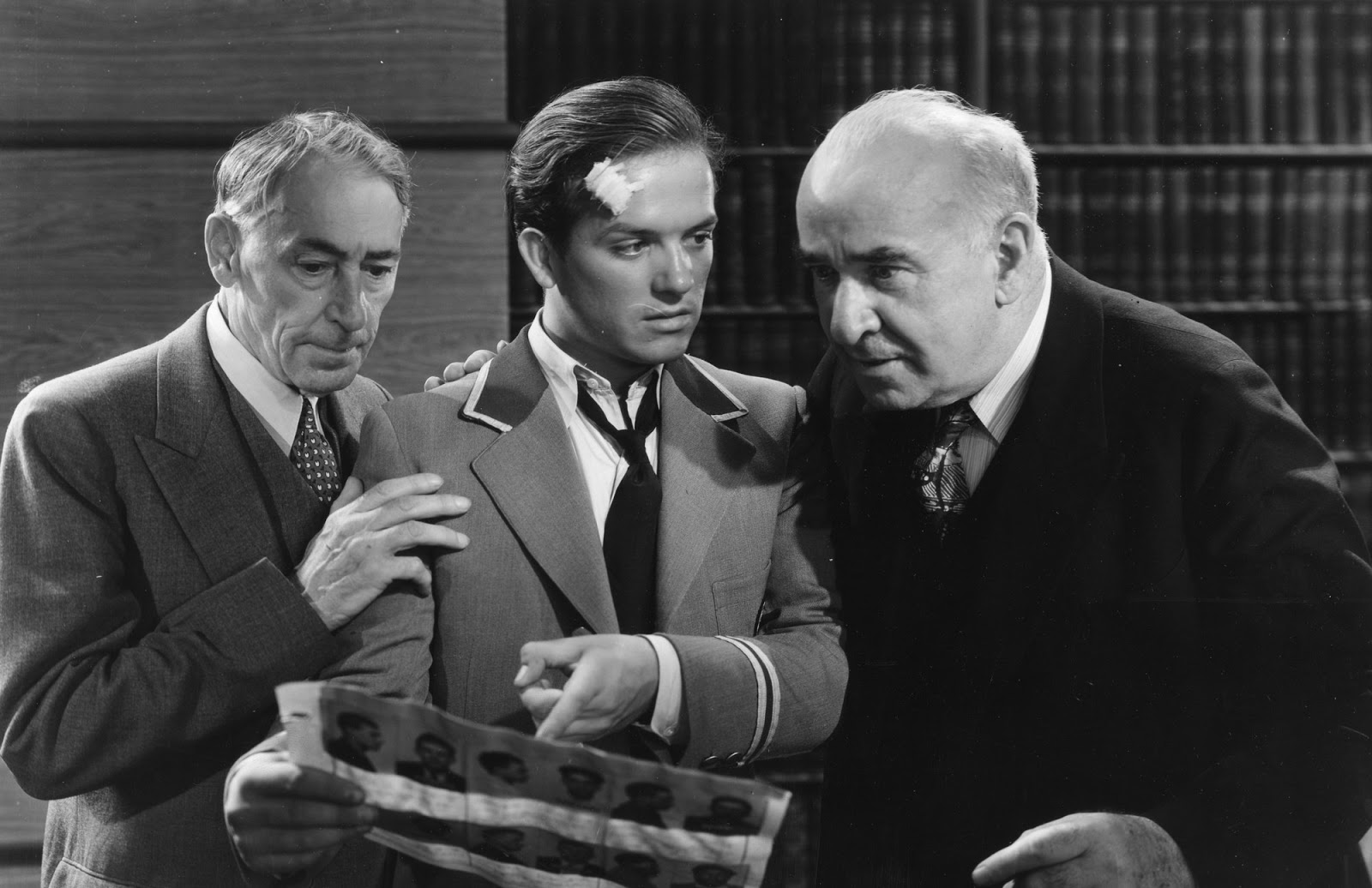
Tully Marshall, Eric Linden, Frank Sheridan
Racketeer Jake Stranskey (Robert Warwick) is gunned down in a Chicago hotel room…but fortunately for the Windy City police, there was a witness to the killing: bellhop Eddie Martin (Eric Linden), who is initially reluctant to finger the trigger man (snitches get stitches, you know).  Police Commissioner Garvey (Frank Sheridan) gives him the usual line of “civic duty” crap, and Eddie finally picks out Jig Skelli’s (Edward Arnold) ugly face from a mug sheet.  However, if Martin had known that a confederate of Jig’s threatened his wife Peggy (Sidney Fox) while she made her way to police headquarters to check on her spouse, he might have continued to maintain his code of omerta.

Albert Maltz
The corrupt powers-that-be—headed up by police chief Frank Hyers (Ian Maclaren), who also moonlights as one of the party bosses—reluctantly accept the fact that they’re going to have to prosecute Skelli…but they didn’t count on Jig’s ace in the hole: he found a sheath of documents on Stranskey’s corpse that detail the many payoffs collected by Mayor William “Billy” Manning (Berton Churchill), District Attorney Anderson (Tully Marshall), and other party ward heelers.  If they send him up for the murder, Skelli will make it snow with the blackmail.  Forced to let Jig skate, the PTB need a fall guy for the Stranskey hit—and choose as their patsy the bellhop who witnessed the killing in the first place.

Afraid to Talk was based on Merry-Go-Round, a controversial play written by George Sklar and future Hollywood Ten blacklistee Albert Maltz (the movie’s screenplay was adapted by Tom Reed).  When you think of hard-hitting social dramas in the films of the '30s, you usually associate that material with Warner Brothers—yet Afraid can hold its own against any film featuring the likes of Jimmy Cagney or Edward G. Robinson, and in many respects, surpasses a lot of the Warner’s product.  The amoral universe of Afraid—where everyone appears to be on the grift and honest individuals are few and far between—is most reminiscent of the brief cinematic oeuvre of writer-director Rowland Brown, responsible for such pre-Code flicks as Quick Millions (1931), Hell’s Highway (1932), and my favorite of them all, Blood Money (1933).

Edward L. Cahn
The Brown-like director of Afraid to Talk is Edward L. Cahn, a name usually associated with motion pictures like Creature with the Atom Brain (1955) and It! The Terror from Outer Space (1958—acknowledged as the inspiration for Alien [1979]).  Cahn began his career at Universal as an editor (his brother Philip also worked in the cutting room) and his exemplary work doing last-minute cuts on All Quiet on the Western Front (1930) got him a promotion to the director’s chair, working on crime pictures and comedies.  Before his fertile career as a director of second features in the 1950s, Ed worked as a journeyman in the MGM shorts department, notably entries in the studio’s “Crime Does Not Pay” franchise (last Friday’s CDNP on the blog, A Thrill for Thelma [1935], was directed by Cahn).  I noticed a preview of Cahn’s CDNP style in Afraid in one scene when the party bosses decide to make Chief Hyers’ soused nephew Lenny (George Meeker) the new magistrate after the only honest adjudicator (Reginald Barlow) refuses to have anything to do with the release of Skelli.  As Lenny slurs an acceptance speech, there’s a whip-pan to a bust of Abraham Lincoln, comically commenting on the absurdity of how relatives rise through the ranks of government.

Edward Arnold, Mayo Methot
Edward Arnold had a fairly prolific acting career in the silent era but his Joe Skelli is a blueprint for the later “big boss/fat cat businessman” roles he’d play throughout the talkies (The Glass Key [the 1935 version], Mr. Smith Goes to Washington, Meet John Doe), and with Louis Calhern as the contemptible assistant D.A. (who never lets his suave menace and complete lack of conscience falter for a second), the acting talent in Afraid to Talk may very well be the finest that director Cahn ever worked with.  Also on hand are Mayo Methot (the third Mrs. Humphrey Bogart) as Arnold’s moll and Matt McHugh (Frank’s bro) as his giggling brother, with silent movie villain Gustav von Seyffertitz in a heroic turn as the lawyer hired to help bellboy Martin out of his predicament.  I also got a chuckle spotting Joyce Compton and Dorothy Granger as the two “party girls” at Joe Skelli’s “get out of jail” celebration, and seeing favorites like George Chandler (as a fellow bellhop) and Arthur Housman (as a drunk—who’da thunk?).

There’s a pervasively bleak atmosphere that shrouds Afraid to Talk—those individuals chosen by the people to represent them do nothing of the sort, and instead live high off the hog from graft and kickbacks, never batting an eyelash at the horrific notion of framing Eddie for a crime he didn’t commit.  (Commissioner Garvey is the only official who won’t go against his conscience, though this is provoked more by Skelli’s mob gunning down children in the streets during a heated moment in a gang war.)  It’s a riveting pre-Code picture because you’re never quite certain where it’s headed and the cynicism that runs rampant throughout (I love the Greek chorus of “bystanders” who comment on the action as they watch developments on an overhead news ticker) appeals to the disillusioned person that I have become late in life (one of the film’s most unforgettable sequences is the interrogation of Linden’s Eddie, which gradually gets physical as Calhern’s goons work him over to extract a confession).  It’s not an easy movie to track down, and though I’m a little red-faced to resort to shilling in the blogathon I obtained a very nice copy (it’s from a VHS recording—there’s a little tracking trouble at one point, but overall I was most impressed with the print) from my friend Martin Grams, Jr. at Finders KeepersAfraid to Talk is a fourteen-carat gem.

Tuesday, May 16, 2017

Rain delay


My mad scheme was to have up on Monday and Tuesday reviews of two movies that I recently watched off my Hopper (Dish’s cute nick for their DVR…though the one in my room is technically a “Joey”) …and then that plan quickly went south.  I’m still trying to tame the dusty Thrilling Days of Yesteryear archives (I seem to have accumulated a lot of DVDs over the years) by cataloging my holdings (every time I do this, I find a movie or two I missed previously) and because I set Sunday aside to do that, my Monday post never materialized.  Monday, I spent three hours of my life that I’ll never get back journeying to the doc’s for an appointment (I wouldn’t mind the wait so much but the chairs in the endocrinologist’s waiting room appear to be leftover furniture from The Flintstones) and then after lunch, I agreed to go with Mom to Kroger Nation to get some things she needed.  For reasons that I can only attribute to my stupidity, I lifted a few cases of water from one section of the store to my cart (the water was in the area where you walk in, and I didn’t want to set off any alarms in the store since I had already placed items in the cart), then picked them up to put them in the trunk of the car…and then picked them up to set down on the carport.  That left me kind of stove-up, and I decided to just continue with Operation DVD Reorganization.

Artist's depiction of the waiting room at NAED.
Because I have committed to the current Classic Movie Blog Association blogathon, there will be an “Overlooked Films” entry tomorrow (that’s the blogathon theme), and (knock wood) normal posting will resume on Thursday and Friday (Crime Does Not Pay!).  (I splurged on a metric butt-ton of DVDs from Oldies.com since I had a little jingle in my pocket, and I’ll be reviewing some of my acquisitions in the coming month and June.)

Monday, October 31, 2016

Terror TV Blogathon: “The Bellero Shield” – The Outer Limits


The following essay is Thrilling Days of Yesteryear’s entry in The Terror TV Blogathon, hosted by The Classic TV Blog Association and currently in progress from October 29-31.  For further information on the participants and topics discussed, click here.


There is nothing wrong with your television set.  Do not attempt to adjust the picture.  We are controlling transmission.  If we wish to make it louder, we will bring up the volume.  If we wish to make it softer, we will tune it to a whisper.  We will control the horizontal.  We will control the vertical.  We can roll the image, make it flutter.  We can change the focus to a soft blur or sharpen it to crystal clarity.  For the next hour, sit quietly and we will control all that you see and hear.  We repeat: there is nothing wrong with your television set.  You are about to participate in a great adventure.  You are about to experience the awe and mystery which reaches from the inner mind to…The Outer Limits!

No less a horror authority than author Stephen King described The Outer Limits as “the best program of its type ever to run on network TV.” (Though to be honest, he also made a similar statement about Boris Karloff’s Thriller.) Which you’ll have to admit: that’s heady praise for a program that couldn’t quite make it across the finish line in its second season.  (I’m talking about its original 1963-65 run; the revival that began in 1995 had a bit more success, sticking around on small screens on Showtime and the Sci-Fi Channel until 2002.)  Outer Limits most assuredly deserves its cult reputation, however; though there are a few clinkers in its catalog (“The Hundred Days of the Dragon,” “Tourist Attraction”) its best episodes can stand up to anything cranked out by Thriller or The Twilight Zone any day of the week.

In fact, I’ve often discussed OL episodes with my geek friends in the past…and if I had a nickel for every time one of them remarked “Was that on Outer Limits?  I could have sworn that was a Twilight Zone!” I would be so wealthy as to be completely inaccessible to you “proles.”  (I’m just kidding you.  I wouldn’t change.  Much.)  It’s easy to confuse the two shows (although TZ was only an hour-long presentation in its fourth season): both used its horror/sci-fi elements as commentary on the human condition, and both frequently employed the “twist ending” as a plot device.  But there was something a bit more sinister about OL episodes as a rule, defined by its dark, textured cinematography (with echoes of German expressionism and the film style later defined as noir).  And then…there was “the bear.”

“The bear” was the nickname bestowed upon the monsters/creatures featured in Outer Limits installments, an element insisted upon by both ABC and producer Joseph Stefano to heighten fear and suspense.  (When Stefano vacated the producer’s chair in the show’s second season, “the bear” went with him—though there were episode exceptions.)  OL was created by Leslie Stevens, whose previous series Stoney Burke (an underrated Western program starring Jack Lord) has been cancelled by ABC after a solitary season.  Stevens sold the network on a show he called Please Stand By, but when ABC insisted that the title of the series be changed, The Outer Limits became the substitute.  September 16, 1963 marked the debut of OL with “The Galaxy Being,” a slightly-tweaked version of the Please Stand By pilot.

Like The Twilight Zone devotees, fans of The Outer Limits cherish their favorite episodes.  Some of the best-remembered include “The Architects of Fear,” “The Sixth Finger,” “The Zanti Misfits” (TV Guide gave this one the #98 spot on its “100 Greatest Episodes of All Time” in 1997), “Nightmare,” and “Demon with a Glass Hand” (#78 on TV Guide’s revised “Greatest Episode List” in 2009).  Our fearless leader and founder of the Classic TV Blog Association, Rick of the Classic Film and TV Café, even got into the act with a post listing his five favorites in 2012 (he includes “Zzzzz” and “The Inheritors”).  My own personal preferences include “It Crawled Out of the Woodwork,” “Don’t Open Till Doomsday” …and the episode that I shall take as my text for this blogathon: “The Bellero Shield.”

"There is a passion in the human heart which is called aspiration.  It flares with the noble flame, and by its light Man has traveled from the caves of darkness to the darkness of outer space.  But when this passion becomes lust, when its flame is fanned by greed and private hunger, then aspiration becomes ambition—by which sin the angels fell."

Scientist Richard Bellero (Martin Landau), who has longed for the approval of his father (Neil Hamilton) throughout his entire life, has been experimenting with a laser device that he hopes will convince the senior Bellero to hand over control of his company upon his retirement.  Richard, Sr., however, is not impressed; this infuriates Bellero’s ambitious wife Judith (Sally Kellerman), who takes out her frustration on a bottle of champagne with her husband’s laser gun.  This action produces a visit from a glowing extraterrestrial (John Hoyt), who explains that he hails from a world that “hovers just above the ceiling of your universe” and has ridden Bellero’s laser “bridge” down to earth.

The alien is equipped with a device capable of generating an impenetrable shield, protecting him from the human nature hostility of Judith (fear caused her to point that same laser gun at the being).  While an astonished Richard welcomes the alien visitor, and converses with him at great length about Earth’s scientific advances (science!), Judith schemes to obtain the device for her and Richard’s personal enrichment and acclaim.  She gets her chance when the alien momentarily lets down his defenses (the shield) and she puts a bullet in his brainpan.  With the help of her loyal housekeeper, Mrs. Dame (Chita Rivera), she drags the dead alien down into the cellar for a later dirt nap.

Having relieved the dead E.T. of his device, Judith demonstrates to Richard, Sr. its amazing properties (the senior Bellero is a bit of a peacenik, and is averse to using such a knick-knack for purposes of war) with the help of Mrs. Dame.  The problem is—she can’t deactivate it.  Judith’s salvation arrives when Mrs. Dame discovers (after introducing Richard, Sr. to the business end of a blunt object) that the alien hasn’t yet rung down the choir invisible; with his dying breath, he rescues Judith with his alien blood (the prime ingredient in activating the shield).  But there’s a price to pay: Judith is convinced that she’s still trapped in the shield, a prisoner of her madness.

Normally, I’d state that any resemblance between “The Bellero Shield” and the Shakespearean work known in the the-ah-tah as “the Scottish play” is purely coincidental…but that would be a fat stinky fib.  There’s no mistaking the parallel between “Shield” and Macbeth, particularly in the Lady Macbeth-like Judith Bellero, who’s every bit as ruthless as her literary counterpart.  To make certain we don’t miss the connection, both women go “a little funny in the head” at the end of their dramas, and both are plagued by a “damn’d spot” of blood on their hand (a physical manifestation of their guilt).  (Even the narration—by “Control Voice” Vic Perrin—paraphrases lines from Shakespeare’s play.)  Sally Kellerman’s performance as Judith will blow the first-time viewer away, and I’d argue that it’s one of the best things she’s ever done.

Martin Landau’s Richard, though a pliable sort, isn’t quite as bloodthirsty as Macbeth (so the comparison kind of falters in that respect), but he nevertheless gives a solid performance as the scientist suffering from some “daddy” issues.  The rest of the cast—Hamilton (a couple of years away from his signature role in Batman), Hoyt, and particularly Rivera (her character goes without shoes for unexplained reasons, and so we detect her hovering presence with eerie close-ups of her bare feet)—acquit themselves admirably as well.  Written by OL producer Stefano, “The Bellero Shield” owes its moody, claustrophobic atmosphere to the first-rate direction of John Brahm (The Lodger, Hangover Square) and most effective cinematography by three-time Academy Award-winner Conrad Hall.  (Okay, I will admit that the first time I saw “Shield”—during my Marshall University days, watching WVAH-TV—I asked out loud of Hall’s low-key lighting: “This guy’s a wealthy scientist and he can’t even keep the lights in his house on?”)

In The Outer Limits’ second season, ABC decided to put what one author called its “child prodigy” up against Jackie Gleason on CBS (talk about a suicide mission); it’s believed that this is why Joseph Stefano hung up his producer shingle and the chores were handed off to Ben Brady.  OL came to an end on January 16, 1965…but its forty-nine episodes collected a generous pension in The Old Syndication Home, and they’ve been released to home video on a number of occasions (I started to sweat when I couldn’t get my disc to play; fortunately I had made a back-up copy the last time this happened) in addition to being available online at Hulu.  I now return control of this blog to you.  Until the next blogathon, when the control voice will take you to…The Outer Limits.

Friday, September 23, 2016

Adventures in Blu-ray: Johnny Guitar (1954)


This past Tuesday (September 20), Olive Films rolled out their “Olive Signature” series with a re-release of the 1952 classic High Noon…but what distinguishes this Blu-ray (and DVD) from past incarnations is its amazing new video/audio transfer, not to mention some bodacious bonuses and extras to enhance the home video experience.  In addition to High Noon, the company has afforded the same blue ribbon treatment to another oater that’s held in high esteem here in the House of Yesteryear: Johnny Guitar (1954), which director Bernardo Bertolucci once described as “the first of the baroque westerns.”

Danny Peary’s essay on Guitar in Cult Movies inarguably whetted my appetite to initially see this film, and my first opportunity arrived when it turned up on Cinemax in the 1990s (along with Pursued and Force of Evil), where it was introduced by director/movie buff Martin Scorsese.  (Scorsese’s introduction to Guitar is one of several extras on the Olive Signature Blu-ray.)  It’s a Western unlike any other, loaded with subversive, radical content (it’s even more of an indictment of the political climate in Hollywood than High Noon) and sexual imagery that gives it a most contemporary feel.  Guitar is also an example of what critic Andrew Sarris labeled “Freudian feminism”; it’s unavoidable noticing that the two female characters in the movie are far more “tougher” than their male counterparts.

The plot involves a saloonkeeper named Vienna (Joan Crawford), who is not held in particularly high regard by her fellow townsfolk, a mob headed up by Emma Small (Mercedes McCambridge) and wealthy rancher John McIvers (Ward Bond).  Emma condemns Vienna for consorting with a group of outlaws led by “The Dancin’ Kid” (Scott Brady), a man for whom she secretly has strong feelings herself.  This alleged collusion with the Kid and his gang is really just a smokescreen for the fact that Vienna’s establishment lies in close proximity to a transcontinental railroad being constructed in the area; if Vienna goes through with her plans to build a rail station she will be a very wealthy woman indeed.

Conflict arises when Vienna hires an old flame (Sterling Hayden) who calls himself “Johnny Guitar” to protect her interests; unbeknownst to anyone else, Johnny is actually an ex-gunslinger named Johnny Logan.  During the course of the movie, Vienna finds herself accused of helping the Kid stage a bank robbery (one of the Kid’s minions lies about her participation in a futile attempt to escape a lynch mob) and is forced to take it “on the lam” with Johnny.  Johnny Guitar concludes with the anticipated showdown between Vienna and Emma, and presumably Vienna and her Guitar man will be free to pursue a life of marital fulfillment.

My enthusiasm for Johnny Guitar is such that I selected it as the topic of my sermon during the Classic Movie Blog Association’s Fabulous Films of the 50s blogathon in May of 2014…so if you want a more thorough examination of this fascinating film, I implore you to click here.  It’s a movie that without question demands multiple viewings in order to take in all of its sly subtext (for example, the way the various characters’ wardrobe colors comment on their motivations).  It also helps to know the fascinating production history of the film; sure, Joan Crawford’s Vienna and Mercedes McCambridge’s Emma square off against one another in Guitar…but the two actresses tangled off-screen as well (Joanie was jealous of her younger co-star—a sentiment expressed to any ingénue who appeared in a movie with Joan).  There was no love lost between the male (Hayden) and female (La Joan) stars, either: “There’s is not enough money in Hollywood to lure me into making another picture with Joan Crawford,” Hayden purportedly remarked after his experience.  “And I like money.”

Because Johnny Guitar was filmed in what Republic Pictures labeled “Trucolor”—a more economical alternative to Technicolor—the movie was the victim of severe fading over the years until it underwent significant repair in the 1990s.  The new 4k restoration featured on the Olive Signature Blu-ray only highlights the film’s dazzling color scheme, making it sparkly as all get out.  Accompanying the disc is a first-rate essay (“Johnny Guitar: The First Existential Western”) contributed by film critic/author Jonathan Rosenbaum (who included Guitar on his list of the 100 best American films in a 1998 Chicago Reader column in response to the American Film Institute’s Top 100), and an audio commentary track from Geoff Andrew (author of The Films of Nicholas Ray).

Of the Blu-ray’s supplementary material, my fascination with movies that either deal directly or indirectly with the Hollywood blacklist made me gravitate toward “Tell Us She Was One of You: The Blacklist History of Johnny Guitar.”  Historian Larry Ceplair and blacklisted screenwriter Walter Bernstein (The Front) encore on this (they do a similar mini-feature for High Noon).  Film critics Miriam Bale, Kent Jones, Joe McElhaney, and B. Ruby Rich are featured on “Johnny Guitar: A Western Like No Other” (an overview of the movie) and “Is Johnny Guitar a Feminist Western?”—which offers some lively give-and-take on “questioning the canon.”  Rounding out the bonuses are reminiscences from Tom Farrell and Chris Sievernich on working with director Ray (“My Friend, the American Friend”—which references the 1977 Wim Wenders movie) and another one I enjoyed (I only wish it had been longer), “Free Republic: The Story of Herbert J. Yates and Republic Pictures,” from archivist Marc Wanamaker (author of Early Poverty Row Studios).

“Coveted editions of the films you know and love, Olive Signature is our gift to the many fans, aficionados, and cinephiles who hold these films near and dear,” a press release from Olive Films boldly states.  In the case of both Johnny Guitar and High Noon, they are among my favorite films and most worthy of rediscovery time and time again.  (Many thanks to Bradley Powell at Olive Films for providing Thrilling Days of Yesteryear with the Johnny Guitar screener.)

Thursday, September 22, 2016

Adventures in Blu-ray: High Noon (1952)


This past Tuesday (September 20), Olive Films officially introduced its “Olive Signature” series on Blu-ray and DVD.  “Highlighting cult favorites, time-honored classics, and under-appreciated gems,” the company states in a press release, “each Olive Signature edition boasts a pristine audio and video transfer, newly designed cover art, and an abundance of exciting bonus material.”  (Think of it as a second Criterion for the classic movie fan.)

The inaugural Olive Signature release is High Noon (1952), the Oscar-winning Western (including a second Best Actor trophy for star Gary Cooper and Best Original Song for High Noon [Do Not Forsake Me, Oh My Darlin’]) that has been a longtime favorite here at Thrilling Days of Yesteryear (Noon was my contribution to The Chaney Blogathon back in 2013, celebrating the cinematic achievements of Lon, Sr. and Lon, Jr.).  Why, I hear you ask?  (At least…I hope that’s you, and not the little voices returning to cavort inside my head…)  Well, I’ve long had an affinity for those oaters that turn what is an admittedly conservative film genre (rugged individualism, strict adherence to a strong moral code, etc.) on its head with a bit of subversive tongue-in-cheek.  Carl Foreman, who penned Noon’s screenplay, never made any bones about the fact that the movie served as an allegory about Hollywood and the motion picture industry (Foreman would later fall victim to the blacklist) and the result so infuriated director Howard Hawks that he purportedly made Rio Bravo (1959) in response to Fred Zinnemann’s film.  (Bravo’s star, John Wayne, stated in his infamous 1971 interview with Playboy that Noon was “the most un-American thing I’ve ever seen in my whole life.”)

You know the story by heart: on the day of his wedding to Quaker Amy Fowler (Grace Kelly), ex-Hadleyville marshal Will Kane (Cooper) receives word that convict Frank Miller (Ian MacDonald) has been paroled and is headed his way…and he’s not bringing a fondue set.  No, Will sent Miller up on a murder charge five years earlier, but apparently Frank has slipped through the cracks of the justice system and is returning to Hadleyville to settle the score.

As his gang (Sheb Wooley, Lee Van Cleef, Robert J. Wilke) wait at the depot for the train to arrive at noon, Will attempts to round up a posse to help him take care of Miller upon his return.  Kane doesn’t have to do this—and he’s told that by several townspeople, including judge Percy Mettrick (Otto Kruger), who’s already high-tailing it out of town, and mayor Jonas Henderson (Thomas Mitchell).  But Will Kane is a man bound by his sense of duty…and besides, what’s the point of running away?  Miller has all the time in the world to track him down in whatever town he and Mrs. Kane decide to settle.  Deputy Harvey Pell (Lloyd Bridges) is of no use—he’s upset that Kane didn’t recommend him for Will’s job—and one by one, the townspeople reveal their true colors: they’re either deathly afraid of Miller (and more than a few are worried that the confrontation will give the town a bad name) or welcoming him back (many Hadleyville businesses enjoyed having Frank and Company around—it was good for the economy).

The underlying plot of High Noon—there’s a psychotic killer headed for town and its inhabitants can’t or won’t do anything to stop him—has been one that has fascinated me since the first time I sat down and watched the movie with my father.  (I’ve logged any number of visits with the movie since.)  No one expresses this inaction in the film better than the character of Martin Howe (Lon Chaney, Jr.), the man who was marshal of Hadleyville before Will, and who recommended him for the job.  Howe wants nothing more to help Will in his time of crisis, but reasons that Will would be so worried about protecting him in the fight (Howe’s lawman career has left him with “busted knuckles” and arthritis) that Will would wind up getting killed.  As for the rest of the town?  “It’s all happenin’ too sudden,” observes Martin.  “People gotta talk themselves into law and order before they do anything about it.   Maybe because down deep…they don’t care…they just don’t care.”  It’s a powerful political message that is still frighteningly relevant today.

The Olive Signature transfer of High Noon (mastered from a new 4K restoration) looks razor-sharp and positively pristine—it’s the best I’ve seen this film looking in years.  The bonus materials are abundant and most entertaining; I never noticed that cinematographer Floyd Crosby paid homage to a shot of a swinging clock pendulum from Noon in his later work on Roger Corman’s Pit and the Pendulum (1961)—a feature with a considerably larger pendulum—until film editor Mark Goldblatt (The Terminator) pointed it out in “The Ticking Clock.”  “Oscars and Ulcers: The Production History of High Noon” is a nice overall look at the making of the film narrated by Anton Yelchin, and I particularly enjoyed “Imitation of Life: The Blacklist History of High Noon,” which features historian Larry Ceplair and Walter Bernstein, the blacklisted scribe who wrote one of my favorite films on the subject, The Front (1976).

I’ll admit a little bias and confess that my favorite feature on the Noon Signature Blu-ray is “A Stanley Kramer Production,” because my good friend (and Facebook amigo) Michael Schlesinger holds forth on the career of the producer-director.  Because I was watching this with my mother, I said to her: “Mike is going to proclaim It’s a Mad Mad Mad Mad World the greatest movie of all time at some point during this.”  (He did not disappoint.)  There's also an accompanying original essay, "Uncitizened Kane," contributed by Sight and Sound editor Nick James.

Something else that will not disappoint: a purchase of this Blu-ray for your classic film library.  I know it’s been released several times before, but the transfer in this edition is worth the price of admission; it’s that breathtakingly beautiful.  Tomorrow in this space: I’ll look at the other Olive Signature release from this week—and not coincidentally, another one of my very favorite Westerns.

Many thanks to Bradley Powell at Olive Films for providing Thrilling Days of Yesteryear with the High Noon screener.

Tuesday, November 17, 2015

A Very Merry MeTV Blogathon: Christmas with the Gillis Family


The following essay is Thrilling Days of Yesteryear’s contribution to A Very Merry MeTV Blogathon, an event sponsored by The Classic Television Blog Association to promote MeTV’s stellar lineup of Yuletide programming airing from November 16th to December 25th (Christmas Day).  For a list of participating blogs and the shows and episodes covered, click here.


Since 1959, TV’s The Many Loves of Dobie Gillis has been making fans both old and new laugh uproariously at the misadventures of a bewildered teenager (played by Dwayne Hickman) as he stumbles and fumbles his way through this wacky thing we call life.  Many of Dobie Gillis’ episodes focused on the conflicts in his family (parents courtesy of Frank Faylen and Florida Friebus) and amongst his circle of friends; unconventional beatnik Maynard G. Krebs (Bob Denver), snooty millionaire Chatsworth Osborne, Jr. (Steve Franken)…and the two most important women in his life: greedy, grasping Thalia Menninger (Tuesday Weld) and plain, practical Zelda Gilroy (Sheila James Kuehl).

Dobie Gillis always had a bite to its humor…but it also possessed a strong sentimental streak—as Maynard would often say as he dabbed his wet eyes on the cut-off sleeve of his sweatshirt: “Gee, Dob…I’m gettin’ all misty.”  Nowhere is this more evident than in the four episodes the series telecast to celebrate the spirit of Christmas (one for each season).  Three of these installments will be included in MeTV’s holiday celebration of Yuletide and Thanksgiving programming from November 16-December 25, 2015.

The first time Dobie and his family invited us to spend Christmas occurs in the first season (natch), with “Deck the Halls”—which originally aired December 22, 1959.  (This episode didn’t make the MeTV Holiday Programming cut—if the poor quality print of the episode on the Shout! Factory Dobie set is any indication, it’s no surprise they nixed it—still, I thought we’d get it out of the way.)  We find the family patriarch, Herbert T. Gillis, sitting forlornly on Christmas Eve in a cell in what I like to call The Gray Bar Hotel…and even though the police chief (Jack Albertson) and presiding judge (Milton Frome) have told him he’s free to go, Mr. Gillis is determined to stay put until Christmas is over.

Herbert's fellow lockup denizen is played by Alan Carney, best remembered as one-half (the other being Wally Brown) of RKO's attempt to create an Abbott-and-Costello-type comedy team in the 1940s.

JUDGE: Gillis…be reasonable…look at it this way…you’re not really mad at me
HERBERT: No?
JUDGE (clapping him on the back): Or the chief here…
HERBERT: No…
JUDGE: You’re really mad at Christmas!
HERBERT: No!
JUDGE: What was that?
HERBERT: I am not mad at Christmas…I am mad at people!  People at Christmas!

So who are these “people” with whom Mr. Gillis is frustrated?  Well, his wife Winifred is dithering over who should receive a Christmas card from the Gillis’ grocery store.  Son Dobie, in a rare burst of enthusiasm, offers to help out in the store…though soon revealing his motive for doing so is to cadge five bucks from his father so that he can get his girl a Christmas gift: baton-twirling lessons.  The Gillis’ elder son Davey (Darryl Hickman), home from college, also needs a little spending money for the holidays—fifty dollars in order to tip “the help” at an exclusive resort at which he’s vacationing with a college chum.  Mr. Gillis is even agitated at Dobie’s friend Maynard—though it doesn’t take much effort for Mr. Krebs to get on Herbert’s bad side—when he leaves an inflatable raft he bought at the Army-Navy Surplus (a gift for the senior Krebs) and it’s activated inside Gillis’ store.

Dwayne Hickman's brother Darryl in the second of his three outings as Dobie's older brother Davey.  Davey would later succumb to the same fate that befell such boob tube siblings as Chuck Cunningham, Eugene Barkley and Mike Douglas (not the talk show host...the older brother on My Three Sons).

But the individuals who really get on Herbert T.’s wick are his loyal grocery patrons—and having worked in customer service in the past, I sympathize with the man.  Mrs. Muller orders the same salami at Gillis’ Grocery every week of the year, but on Christmas she insists on having one gift-wrapped as a present for her sister-in-law in Detroit (the old dame really just wants to score some free wrapping paper).  Mrs. Kenney has ordered a gi-normous candy cane for her husband to commemorate the first Christmas the couple spent together long ago…only she paid $1.50 for it then, and can’t understand why the price is now $3.00 (to add insult to injury, Herbert even had to have it made special).  But it’s Mrs. Lapping (Verna Felton) who really takes the cake: she won’t need the turkey she bought for Christmas because she’ll be spending the holiday out-of-town with family…so she insists Gillis take back the bird he previously sold her.  She also contends that he’s short-changing her by refunding her the forty-nine-cents-a-pound she paid for the turkey in June (when they were on sale)—why, the sign outside says sixty-nine cents!  Mad as hell, and not willing to take it anymore, Mr. Gillis heaves the turkey through the store’s plate-glass window as a startled Mrs. Lapping begins to shout out loud for the police.

Herbert’s mind is made up: he’s going to channel his inner hermit during Christmas, because he’s fed up with humanity.  But he hadn’t counted on his family—Winnie, Dobie and Davey—showing up to be with him in jail on Christmas Eve; even though the boys had other plans, they insisted on cancelling them to help Winnie with the store.  Herbert realizes that Christmas is all about family, and quietly tells his clan they’re going home.  Later, while trimming the tree inside the grocery, the Gillises are serenaded outside by a group of carolers: the police chief, the judge, Mrs. Kenney and Mrs. Lapping.

In Season Two, Dobie Gillis reworked Charles Dickens’ classic short story A Christmas Carol into “Jangle Bells” (originally telecast December 20, 1960); in fact, the episode begins with Dobie, Zelda and Chatsworth re-enacting the story (Chatsworth is Scrooge, appropriately enough) in front of the class taught by the kids’ favorite schoolteacher, Leander Pomfritt (William Schallert) (“That, my young gluttons-for-punishment, was Charles Dickens’ A Christmas Carol…forgive us, Charlie…”):


POMFRITT: Class, as you have seen…Dickens ingeniously employs ghostly spirits to show Ebenezer Scrooge just how lonely his future Christmases will be unless he changes his ways…now tell me—how would you describe the character of Scrooge at the beginning of the story?
ZELDA: A pitiful creature!
CHATSWORTH: A wretched clod
DOBIE: A miserable wreck…
MAYNARD (entering the classroom): You rang?!!

Honest to my grandma...it never gets old.
By the time Maynard takes off several layers of clothing, class is through for the day (Pomfritt: “Somewhere between the second muffler and the mackinaw”).  Once again, Maynard plays the fool—but Mr. P is going to give him some advice on how to turn it all around:

POMFRITT: Now look, Maynard my boy…has it ever occurred to you that perhaps you’re trying too hard to please everybody by being a clown…a Pagliacci?
MAYNARD: Polly-who?
POMFRITT: Pagliacci…he was a character in an…never mind…what I’m trying to say, Maynard, is that you don’t have to attract attention to yourself by being odd and different…why not just try to be one of the gang?
MAYNARD: How can I do that, Mr. Pomfritt?  I mean…they go out on dates…and they go to dances…and they throw parties and that…I couldn’t do none of them things…
POMFRITT: Who said you can’t?
MAYNARD: Me!  I just said it—didn’t you hear me?
POMFRITT: Maynard…I mean…what’s to prevent you from, say, uh…giving a party…inviting your friends over…giving them some refreshments?  Show them that you, Maynard G. Krebs, are just as good as the next fellow!
MAYNARD: Me?  Maynard G. Krebs throw a party?  Yeah…I could do it!  A swingin’ Christmas party, with popcorn…and a tree…and like (Sings) “Deck the Halls”…and bobbin’ for apples and settin’ off firecrackers…and…and…
POMFRITT: Firecrackers?  At Christmas?
MAYNARD: Yeah…that’s Halloween

So the groundwork on Maynard’s Yuletide bash is underway…but there’s one small problem.  His best friend, Dobie, has been invited to a shindig at Chatsworth’s (Chatsworth: “You know, we aristocratic Osbornes traditionally rub elbows with the peasantry once a year at this outing—something to do with democracy, or some such”) and while his loyalty is with Maynard, Zelda insists the two of them attend the Osborne soiree so that Dobie can make those all-important contacts.

ZELDA: Are you a scholar?  No…are you a businessman?  No…are you talented?  No…are you ever going to be a whopping success?
DOBIE (dejectedly): No…
ZELDA: Yes!
DOBIE: Yes?
ZELDA: Yes!  Because you have one hidden quality—people like you!
DOBIE: They do?
ZELDA: I do…and I’m highly perceptive!  Together we will turn Dobie Gillis—the formless blob of mediocrity—into Dobie Gillis…the whopping success!

This means Dobie is going to have to bail on Maynard’s rager, which is being held in his garage.  (Maynard: “I talked to my father…it’s the only part of the house he’ll let me have.”)  Dobie tries to break it gently to his pal, but Maynard is so jazzed about his party that he’s not really listening to anything his buddy is saying.  Dobie’s dilemma: friendship or establishing solid contacts for his future?  He asks his father what he should do, but Father Gillis is of no help, merely spouting forth empty platitudes and clichés.

Like...boo!

Taking a nap before the Osborne affair, Dobie is visited by a ghost who looks strangely like Maynard.  As the Spirit of Christmas Past, the Maynard-like apparition shows his friend a distant memory of when they spent Christmas together when they were only four-years-old.  As the Spirit of Christmas Future, the ghost offers up a hilarious peek at Dobie’s future: he’s married to Zelda and the two of them are filthy, stinking rich.  The couple are seated at each end of a comically long dining table, and at one point in their conversation Zelda does her patented nose-wrinkle at Dobie, hoping he’ll reciprocate—but since he’s too far away to see it, she has to send their butler, Tremblay (David Bond), to the other end to nose-wrinkle.  (Actor Bond played “Tremblay” in several episodes of Dobie Gillis…though he was usually in the service of the Osbornes.)  Outside, a pathetic wretch (Maynard) scratches at the window and asks to come in…but the warped Dobie (who cares about nothing but money) has the butler send Maynard away.

Against his better judgement, Dobie goes with Zelda to the Christmas party…while lonely Maynard is forced to entertain himself in his garage…with only an alley cat for company.  Dobie keeps seeing Maynard’s miserable mug on the various party guests (he even see Maynard-as-Zelda, wearing a party dress) and finally decides he won’t sell his soul for a mess of pottage; Zelda also realizes she was wrong to advise Dobie not to go to Maynard’s wingding, and leaves with him.  The two of them—along with Mr. and Mrs. Gillis—turn up at Maynard’s…and then the throng from Chatsworth’s shows up as well.  “You observe how the Christmas spirit overwhelms the average citizen,” Chatsworth explains to Dobie.  “So you can imagine the shattering effect when it strikes an Osborne!”

“Jangle Bells” is probably my favorite of the Yuletide Dobie Gillises, only because I have a tendency to gravitate towards those episodes that feature the entire Dobie cast (I love the characters, and enjoy watching them interact).  There’s only a tiny hiccup: to promote his Capitol Records LP Dobie, Hickman warbles I Pass Your House…and let’s not beat about the bush: the man simply could not sing.  (Granted, this didn’t stop Shelley “Johnny Angel” Fabares…or Paul “My Dad” Petersen, now that I think about it.)  MeTV will air “Bells” on Sunday, November 29th at 5am EST…with an encore performance on Sunday, December 20th at 5:30am EST.

“Have Reindeer, Will Travel”—a punny title inspired by the TV western Have Gun – Will Travel—was Dobie Gillis’ third season Christmas show, originally telecast on December 19, 1961.  It features a simple premise: Maynard, in his capacity as treasurer, is transporting $55.78 raised by his fellow classmates for a school dance…which he proceeds to hand off to a little Mexican boy (Michael Davis) who’s barely eking out an existence shining shoes in the streets of Central City.  Now—I know what you’re thinking: for this episode to work, we have to believe that the students in Dobie and Zelda’s class at S. Peter Pryor Junior College have experienced temporary insanity in electing Maynard the Manchild treasurer.  I spotted this logical flaw right off the bat, but in their defense it is addressed in the episode:

WALTER: How much money do we have in the fund to spend on the dance?
DOBIE: Er…we’ll know the exact money as soon as the treasurer for the Christmas fund gets here…
WALTER: Who’s the treasurer?
DOBIE: Uh…Maynard G. Krebs…and now then…on…
WALTER: I move we get a new treasurer!
ZELDA: Dobie—you appointed Maynard to be treasurer?
DOBIE: Yes—by virtue of the power vested in me as chairman…
WALTER: Well, I move we get a new chairman!
(The group murmurs in agreement)
DOBIE: Now just a minute…
ZELDA: Yeah, just a darn minute…you kids ought to be ashamed of yourselves!  Now, look—we all voted to make Dobie chairman…now let’s stand behind him and back him up instead of picking on him!
DOBIE: That’s right—I’m doing my darndest to do a good job!
ZELDA: And you’re succeeding, Poopsie—you’re doing a fine job…
DOBIE: Thank you, Zelda…
ZELDA: So how come you pulled a lame brained stunt like appointing Maynard treasurer?
DOBIE: Because Maynard’s changed, that’s why!  Now that he’s a college man, he’s mature…grown-up…and resourceful…and self-reliant…and…am I really talking about…
ZELDA (finishing his sentence): Talking about our Maynard…no…

Maynard returns to a hearty welcome from his fellow matriculators…and that’s when they learn he doesn’t have the dough.  Now you and I—because we were not raised in a sitcom—would immediately ring up the gendarmes to have Mr. Krebs detained for theft…but the class gives Maynard a break on that score (Walter: “Of course he didn’t steal the money—he’s too stupid to be a crook”).  What goes unexplained is why Maynard won’t reveal to his best friend—or anyone else, for the matter—what’s happened to the missing cabbage; surely he shouldn’t be embarrassed that he was struck with a sudden case of altruism?  Dobie’s bright idea is for Maynard to secure a part-time job in order to earn the money needed to replace what’s missing…and the first person he thinks of who might employ young Krebs is a man not known for his unselfishness:

HERBERT: Look…he couldn’t carry fifty-five dollars and seventy-eight cents for the class dance across the street without losing it—and you want me to trust my hard-earned cash to him?  You gotta be kidding me…
MAYNARD: Yeah, Dob…you gotta be kidding…
DOBIE: Maynard…
WINNIE: Herbert, I’m ashamed of the way you’ve been talking about Maynard…
HERBERT: So am I—but with a lady present, it was the best I could do…
WINNIE: Dobie…as I understand it, Maynard has done something to let you down…and now he wants to make up for it…
DOBIE: That’s right, Mom…
WINNIE: Well then, Herbert—how can we possibly refuse to help him?
HERBERT: Easy!  (She gives him The Look) Winnie…I hope you understand what you’re letting us in for…it means that Maynard will be here in the store…with us…hour after hour…day after day…week after week…
WINNIE: I understand that perfectly and Dobie—isn’t there some other way that we could possibly help Maynard?

Maynard’s career as an associate with Gillis Mart is a brief one; he does a funny bit of physical comedy where he falls off a ladder and on top of Herbert, but what really tanks his career is that the same Latino shoeshine boy shows up to buy groceries with twelve dollars…and when the bill comes to $11.45, Maynard feels guilty that the little urchin will have nothing with which to purchase Christmas presents.  So he makes the groceries a present, but is oblivious to the fact that his supervisor is watching:

HERBERT: Maynard?!!
MAYNARD: Present…uh-oh…
HERBERT: What’s my name?
MAYNARD: Your name is Herbert T. Gillis, and you’re a veteran of WW2…
HERBERT: Right! Not J.P. Morgan…not John D. Rockefeller…not the Aga Khan…just plain, everyday Herbert T. Gillis…your former employer…

Bloodied but not bowed, Maynard finds another job—more suitable for a man Dobie describes as “a warm-hearted, lovable, human being.”

Like...ho ho ho!

Yes, Mr. Krebs gets a job as a department store Santa and demonstrates that he’s perfect for the job, particularly when he presents a little girl (Debbie Megowan) and her mother (Edith Loder) with some gifts (teddy bear, dollhouse) they don’t have to pay for.  (I think it goes without saying a person like that would be the most popular Santa ever—whether or not this comes out of Maynard’s paycheck is never addressed.)  On Maynard’s last day, Dobie and Zelda arrive to make sure the money doesn’t disappear a second time…and that’s when “Pepe” shows up.  Maynard hands him his paycheck even though the kid is clearly telling him “I don’t want your money” in Spanish (hey, nice to know I retained something from all that Spanish I took in college).  Maynard takes off in the store to elude his friends, and that’s when Dobie and Zelda encounter Pepe:

Maynard in Toyland.
DOBIE: Who are you?
ZELDA: What are you doing here?
PEPE: Por favor, señorita…no comprendo…
DOBIE: Wait…wait…did you see a thin fellow with a beard run past here?
(Pepe looks at him puzzledly)
ZELDA: Dobie, I think he only speaks Spanish…
DOBIE: Yeah…uh…el señor…skinny…avec le beard…?
ZELDA: I said Spanish—not gibberish

Fortunately for the purposes of quickly wrapping up the plot, Zelda speaks Spanish (“Pure Castilian—none of those regional dialects”) and she’s able to communicate with Pepe…bringing The Case of the Captured Coinage to an end.  Dobie, Zelda and Maynard wind up at the home of Pepe’s family, where his mother (Argentina Brunetti) explains that while the family may be down on their uppers they don’t need the class dance money.  Dobie insists that she take it: “I’m a very stubborn caballero—I don’t hear a word you say.”  The dance does go on as planned—it’s held in the same classroom where the kids were holding their meeting earlier, and the soiree is catered by Herbert T. Gillis, “your friendly neighborhood grocer.”  The Latino family also arrive, bringing with them musical instruments to play so that all those WASP kids can get down with their bad selves.  “Have Reindeer, Will Travel” airs tonight (November 17) on MeTV at 9pm EST.

By the time of the fourth and final Dobie Gillis Christmas caper—“Will the Real Santa Claus Please Come Down the Chimney?” (12/19/62)—the show had added a new character in Duncan “Dunky” Gillis, Dobie’s younger cousin.  (Dunky was played by Bobby Diamond, who did a pretty good job as the kid hero of the series Fury…but sadly, possessed none of Dwayne Hickman’s first-rate comedic timing.)  “Real Santa Claus” finds Dunky and his “Uncle Herbie” filled with the Christmas spirit as they sing “Deck the Halls” while trimming the tree.  But Winifred Gillis—the kindly, lovable mother who served as the series’ supportive center—has a simple message for the season: “Christmas? Bah humbug!”

How did the gentle, compassionate Mrs. G reach this sorry state?  Well, it all begins with Maynard as the show’s resident manchild stops by the grocery store:

WINNIE: …why don’t you tell us why you’re here before Mr. Gillis forgets he’s filled with holiday cheer…
MAYNARD: I brung you a letter from my mother…
WINNIE: Oh?  From your mother? (She takes a slip of paper from him)
MAYNARD: Or my father…I forget which…they both look alike
HERBERT: Winnie…you do me an injustice…with all this Christmas spirit in the world…forget… (Scoffs) I’m filled with holiday cheer!
WINNIE (after reading the note): Maynard is moving in with us!
HERBERT: I just got unfilled… (Threatening) Maynard…
WINNIE: His folks would like to know if we can take care of him while they’re visiting relatives in Cleveland…
MAYNARD: See how they love me?
HERBERT: They love you?
MAYNARD: Sure!  This is the first time they told me the name of a real place—always before they made ‘em up so I couldn’t find them…ain’t that heartwarmin’?
HERBERT: Oh, that’s just what it is, heartwarming—but you ain’t stayin’ here, boy…
MAYNARD: Name me one good reason…
HERBERT: Because I couldn’t stand to see you around the house…
MAYNARD: Name me two good reasons…
WINNIE: Herbert, dear…be generous…what would be so terrible about having Maynard around with us for a few days?  Joining in the family fun…eating with us…talking to us all day…and all night…Maynard, I just had a wonderful idea—why don’t you go to Cleveland with your folks?

Despite Mrs. Gillis’ reservations, Maynard ends up being a guest at the Gillises—and that’s when the episode’s plot is set into motion: Maynard—despite being free, white, and 21—still stubbornly clings to the belief that Santa Claus is real:

WINNIE: Maynard dear…we all believe in Santa Claus just as you do…we believe in him as a symbol, as a warm, wonderful example of goodness and kindness and goodwill to everyone…
MAYNARD: Santa believes in them things, too!
(Herbert rolls his eyes)
DUNKY: Let me take a stab at straightening the boy out…Maynard—you’ve seen the Santas in all the department stores, haven’t you?

I would hope so—he previously played one in “Have Reindeer, Will Travel”…

DUNKY: He’s just a man dressed in a Santa Claus suit—right?
MAYNARD: Right!  Didn’t you know that—a kid your age?  Dunky, the man in the suit is one of Santa’s helpers…I mean, Santa himself can’t be everywhere…so Santa’s helpers give kids laps to sit on…next question?

Maynard has an explanation for all the Santas on the street corners and in the movies, and for the Santa that showed up at school (Maynard knows that’s Dean Magruder, the major domo at S. Peter Pryor Junior College played on occasion by Raymond “Milburn Drysdale” Bailey).  But as for the real Saint Nick—well...

WINNIE: Then you have never seen the real Santa Claus—true?
MAYNARD: True!  But then I never seen the real Marshal Dillon, neither—and I know he’s real…of course…I’m not too sure about Chester…

Poor Dobie.  He's reduced to being the narrator of his own self-titled sitcom...and modeling terrible Christmas sweaters.
Despite his substantial lack of evidence for the existence of Kris Kringle, Maynard is unshakable in his faith—so much so that he arranges for a construction crew to come in and put in the pipes needed for a new automatic washer and dryer, because he knows Santa is going to bring that for Mrs. Gillis as a present.  (They also work upstairs on a surface suitable for Dobie’s new ping-pong table.)  Herbert is livid, and he wants to introduce Maynard to his pal Louis…short for Louisville Slugger.  But Dobie—who finally turns up in this episode, by the way—convinces his dad that a Plan B is in order.  Herbert will dress up as Santa, come down the chimney and plant Maynard in his lap.  After Maynard tells the old gent what he wants for Christmas, Mr. G will rip off the beard to reveal his true self…and Maynard will be so shocked he’ll stop with the Santa Claus nonsense.

For Herbert to play Santa, there must first be rehearsals down the Gillis chimney…


…well, that could have happened to anybody.  Herbert winds up stuck, and finds himself coughing up more dinero to make the chimney bigger and wider so his ruse to fool Maynard will be a success.  On Christmas Eve, Mr. G successfully navigates the new chimney and Maynard, clad in footy pajamas, hops up on his lap to tell him what he wants for Christmas:

MAYNARD: First…I want a ping-pong table for Dobie…he’s that fellow over there…the one who’s flabby and has a weak chin…I know he don’t look like much, but he’s my good and best buddy…and whatever will make him happy will make me happy, too…and then I want a brand-new sports jacket for Dunky…he’s the little one over there with the weak chin…I know he don’t look like much, too—but somebody he’s going to grow up and be as sweet and lovable and flabby as Dobie…
HERBERT: But what do you want for you?
MAYNARD: An automatic washer and an automatic dryer…
HERBERT: For you?
MAYNARD: No…for Mrs. G…sloshing around in those suds and dirty water all day, the poor old thing…
HERBERT: All right—I’ve got it all now…except…what do you want?
MAYNARD: A fishing rod…
HERBERT: A-ha!  A fishing rod!
MAYNARD: For Mr. G…you know him, don’t you?  He’s that loudmouthed fellow who’s all the time screamin’ and hollarin’…
HERBERT (interrupting): I know him, I know him…
MAYNARD: …but underneath that mean inside there’s a good outside…and maybe if he had a fishing rod he’d take a couple days off from work…and he wouldn’t be so mean no more…
HERBERT (quietly): You know…maybe you got a point there, Maynard…but what do you want?

Maynard wants for nothing, explaining:  “I’m one of them lucky fellows—I got everything I want!  I got the biggest ball of tinfoil in town…I got a petrified frog…and I got a stuffed owl, all paid for and clear!  I also got the best friends in the whole wide world…or anyplace else…so you can skip me this year—but you’re true blue for asking.”

Mr. Gillis is so taken aback that he just can’t shatter Maynard’s illusions—but his family presses him to do it, reminding him it’s for Maynard’s own good.  It doesn’t matter anyway—Maynard knew it was Mr. G the entire time…and as he snuggles into bed, he runs over to the window to see a silhouette of the jolly old guy hisself and his reindeer:

So why was Mrs. Gillis acting like a female Scrooge at the beginning of the episode?  Well, it turns out her husband spent so much money on the renovations to the home and chimney and the presents that he decided to cut his losses by allowing the neighborhood women to use Winnie’s new washer and dryer…for a nominal fee, of course.

“Will the Real Santa Claus Please Come Down the Chimney?” airs on MeTV Sunday, November 29th at 5:30am…with an encore performance on Sunday, December 20th at 5am.  It’s all part of the network’s A Very Merry TV, which will feature such TDOY favorites as The Andy Griffith Show, The Beverly Hillbillies, Our Miss Brooks, Petticoat Junction and many, many more!