In the history of the motion picture industry, the term
“state’s rights” was used to describe many of the independent movie companies;
these outfits would sell their releases to local/regional film exchanges for a
predetermined price, and outside of the major studios or national theatre
franchises, it was often the best way for an independent to make certain their
movies were seen throughout the country.
There were a buttload of these companies in operation since the dawn of
cinema, and one of the most prolific (and profitable) was Weiss
Brothers/Artclass Pictures, which began producing motion pictures in 1915. (The Weiss bros were a trio—Adolph, Max, and
Louie; Louie was Vice-President in charge of production, so he handled most of
the creative end.)
A good picture...not a great picture.
The first Weiss Bros. release was It May Be Your Daughter (1916), an exploitation film that dealt
with white slavery, and from that inauspicious beginning the company would produce
feature films, short subjects, and serials up until the late 1930s. (The company kept chugging along in various
incarnations until 1984; film historian/friend of the blog Richard M. Roberts
notes that “Weiss-Global Enterprises” lasted longer than MGM! I remember seeing the Weiss-Global logo at
the end of several of the late-night sitcoms I watched on CBN back in the
1980s.) I became familiar with the
Brothers Weiss’ contributions to the art of the two-reel comedy when Kit Parker
Films/VCI released Weiss-O-Rama to DVD in 2007—a collection of shorts featuring
the likes of Ben Turpin, ‘Snub’ Pollard, and Poodles Hannaford. (I think the review I wrote was at the blog’s
former Salon Blogs home, now blown to smithereenies. The collection is still available, I hasten
to add, through The Sprocket Vault and Amazon.)
I was not, however, well-acquainted with any of their cliffhanger
serials…but that situation was rectified last week when Kit Parker sent me a
screener for The Mysterious Airman
(1928)—a Super Chapter Play of the Air!
James Joyce (Chris Allen)—not the author of Ulysses, by the way—is an inventor who’s
designed a device known as the Aerometer, “which minimizes the danger of flying
in fog and storm and makes night aviation practicable.” Aviation companies would quite naturally give
their eyeteeth for such an invention, but it’s Baker Aircraft who’s the
beneficiary of Joyce’s hard work…and I’m almost positive that it’s not because the
firm’s president, Frank Baker (Walter Miller), is the fiancé of the inventor’s
daughter Shirley (Eugenia Gilbert).
Baker’s use of the Aerometer has made his company the target of a series
of attacks on his planes by “a daring band of mysterious airmen,” under the
supervision of a secretive masked aviator known only as “Pilot X.” (Please…let’s not have any Speed
Racer jokes in the audience.)
Who is “Pilot X”? The Mysterious Airman has no shortage
of suspects—it could be Barney Madden (James Fitzgerald), a loyal pilot at
Baker Aircraft. Or Albert Orren (Eugene
Burr), the company’s superintendent and stockholder. It could be forces outside the outfit—like
competitor William Craft (Robert Walker), general manager of Globe Air, or
Craft’s girlfriend Fawn Nesbit (Dorothy Talcott), “an aviatrix who seeks the
fame as the first woman round-the-world flier.”
(Until I looked it up, I thought “aviatrix” was a wingless bird with
hairy feathers…and then I remembered that’s an “apteryx”—from the comic strip B.C.)
There’s even Perkins (Arthur Morrison), a sinister butler who always
seems to be in the vicinity (arranging flowers) whenever serious matters are
being discussed and…nah, he’s a little too
obvious. All is revealed after ten
exciting chapters of this “thrilling and death defying” photo-play, according
to the serial’s promotional art.
The Mysterious Airman
was the last silent serial to emerge from the Weiss Brothers’ film factory, and
one of the final chapter plays from the silent era in general. Its resurrection through Kit Parker Films and
The Sprocket Vault is a marvel to classic movie fans, because while it’s not
impossible it is a rarity for serials from that time to have survived
intact. (And even Airman has a small blemish—the first reel of Chapter 9, “The Hidden
Hangar,” is lost to decomposition.) Film
archivist Jeff Joseph is the individual who should sit in the middle chair at the celebratory dais, supplying an original (and tinted) 35mm nitrate print
that looks positively amazing, even when you consider that this was a
projection print (so it ran through a projector more than a few times) and that
there is some occasional mottling with regards to the tinting. (Overall, it looks damn good for an
89-year-old production.)
Eugenia Gilbert, Walter Miller
Richard M. Roberts contributes a fascinating commentary track
for Airman’s DVD presentation—and I
mean throughout the entire serial; we’re talking 190 minutes non-stop, and so
does he. (Roberts even has a little fun
when it comes to the serial’s missing reel, pretending his commentary for that
reel vanished, too.) An author and movie
historian to whom I am most grateful for keeping me honest when there’s a
glaring error on the blog, Rich illustrates in meticulous detail the history of
Weiss Brothers-Artclass (identifying it as one of the most important “Poverty
Row” factories) and filling out background on the movie’s main players, Miller
and Gilbert (I’ve seen Gilbert in shorts with Harry Langdon and Charley Chase,
so it was nice to get the additional skinny), as well as the supporting cast,
director Harry Revier, and basically everyone involved in the production (and
those who enjoyed a long association with the Weiss Brothers—because despite
their low-budget moviemaking, they were most generous and loyal to their
employees).
Richard M. Roberts
If you’ve been scratching your head at the title for this
post…it’s because at one point in this stirring saga, a monkey is employed to
spy on activities at Baker Aircraft, prompting Richard to utter that phrase
when the chimp makes a return appearance in a later chapter. (Richard eventually settles on “henchmanzee.”) I enjoy his commentaries because of moments
like this (in one chapter, as the Frank Baker character is being held hostage
in a barn, Roberts notes that the structure is liable to collapse before he can
escape), and because I share with Richard the belief that movies should be a
fun and entertaining experience (he has a disdain for those people who
rhapsodize over classics like Napoleon
and The Passion of Joan of Arc,
because it’s productions like Mysterious
Airman that made sure there was dinner on the table every night—there’s a
reason why “business” is in the phrase “movie business”). Roberts also takes special pains to let the
viewer know that “no airplanes were harmed in the making of this serial.” (It’s true; they just didn’t have the money
in the budget for real plane crashes, so they had to improvise with cardboard
models and scratches on the film emulsion—and yet they make it work.)
Truth be told, I ran Mysterious
Airman a second time just so I could enjoy the score by Dr. Andrew Simpson—the
main accompanist at Culpepper, VA Packard Campus of the Library of
Congress. Honestly, this is a DVD that
goes above and beyond in its presentation, with bonus material spotlighting
original posters and lobby cards…and a two-reel short from 1928 entitled Flying Cadets, featuring extensive
aviation footage shot at Brooks Field in Texas.
(I didn’t see it mentioned at the [always reliable] IMDb; Rich told me
in an e-mail that he believes the Kodascope release originated with the Army or
some governmental outfit.) Members of
the TDOY faithful know that two of my
classic film passions are silent movies and serials, and because The Mysterious Airman is literally the
best of both worlds I won’t hesitate to recommend this DVD to like-minded
individuals. (It's available exclusively at Amazon; Ivan Bob says check it
out!)
I’ve mentioned a time or two on the ol’ blog that much of my
classic movie mania—really, the entire content of Thrilling Days of Yesteryear—sprang forth from the nostalgia craze that
swept the 1970s, which played host to my formative years. Hollywood looked to the past for moviemaking
(Hearts ofthe West, Nickelodeon) and radio stations began rebroadcasting many
of the great shows of Radio’s Golden Age like The Shadow and Fibber
McGee & Molly. One of the
more interesting features to emerge from that period is Brother Can You Spare a Dime?, a 1975 documentary directed by Philippe
Mora and now available on Blu-ray/DVD from the good people at The Sprocket Vault.
Brother presents
a mash-up of clips from classic Hollywood flicks and newsreels in attempt to
chronicle the events of The Great Depression…and to be honest, I’m a little
hesitant to call the film a documentary because it’s really more of a cinematic
mosaic, relying on images, music, and sound bites instead of going the more traditional
doc route. So I’m going to warn you
right now: if you’re hungry for something along the lines of a serious Ken
Burns-like presentation, you might want to move along because there’s nothing
to see here. But that would be premature
(and very, very wrong), because Brother is a
lot of fun: it includes a lot of great songs (a couple of classics from Woody
Guthrie, not to mention contributions from the likes of Cab Calloway and Billie
Holiday) that would make dandy music videos, and it’s most entertaining trying
to identify the film clips included in the movie.
In
his 1975 review of Brother Can You
Spend a Dime? the late Roger Ebert wrote: “We get a great deal more of
Roosevelt than we really need.” Which is kind of silly—FDR was president
throughout that era, so it shouldn’t come as a huge surprise that he figures
prominently in the movie’s content. (Now
you know why I don’t place Rog on the pedestal that others do.) Other personalities that turn up in Brother include Huey Long, Joe Louis, John
Dillinger, Winston Churchill, and Herbert Hoover along with “more stars than there
are in Heaven” via the generous amount of film clips. (James Cagney gets the lion’s share of these,
with nods to vehicles like Taxi!
[1932], Lady Killer [1933], and ‘G’ Men [1935], but there’s also footage
from TDOY faves like Black Legion [1937—a very effective
sequence that blends newsreel footage of the Ku Klux Klan with Bogart’s
character’s initiation] and To Be or Not to Be [1942—“Heil myself!”].)
Brother calls it a
day once the United States decides to enter WW2 after the attack on Pearl
Harbor, and curiously wraps things up with footage of Lee Harvey Oswald and
past presidents like Richard Nixon and Gerald Ford. (Yeah, I didn’t quite understand this
either.) I really think classic movie
mavens will enjoy this one, and to sweeten the presentation The Sprocket Vault
includes some nice bonus material in the form of fifty minutes of newsreels
from Pathe (“On land…on sea…in the air!”).
There’s a lot of great stuff in these time capsules (there’s a notice
before the footage that the company is planning future DVD releases of these newsreel
compilations), featuring celebrities like George M. Cohan (wowing Broadway in I’d Rather Be Right) and James Stewart (his
induction into the service). The old-time
radio fan in me was particularly entertained by the footage of the opening of
the NBC Studios at Rockefeller Plaza (a.k.a. “30 Rock”) and a bit with Lucille
Ball demonstrating Sonovox (the device used to simulate the “talking train”
featured in the Bromo Seltzer commercials of that era). (I could have done without the footage of “movie
czar” Will Hays, though—unless people feel empathy for the charisma-impaired.)
The Sprocket Vault Blu-ray/DVD release of Brother Can You Spare a Dime? has been
digitally restored in high definition, and is available exclusively through Amazon. Many thanks to Kit Parker and
his staff for providing TDOY with both the
screener and a delightful walk down Memory Lane.
State Department official George Eakins (John McGuire),
scheduled to leave for a conference in L.A., receives a sealed envelope
containing his orders by courier. Eakins
will never get on that plane to the Coast, however; a shadowy figure enters the
office and pistol whips him, rendering him quite dead. His secretary, Amy Winthrop (Rochelle
Hudson), immediately emerges as a “person of interest” because her seatmate (Steve
Pendleton) on that plane—identified only as “Mr. Smith”—has told the airline
people he’s Eakins.
"I...am The Whistler..."
Steven Geray
Smith has another confederate on the same flight—foreign
agent Bokejian (Steven Geray), who trades the sealed envelope originally handed
to the real Eakins for five large.
Opening the envelope, Bokejian finds its contents consist of several
blank sheets of State Department stationery…and because he believes “caveat
emptor” to be a steaming pile of bovine excrement, he dispatches his ex-friend
Smith to The Happy Haunting Ground with curare concealed in his fountain
pen. (This is not spoiling anything, by
the way. It’s obvious Bokejian is the
murderer.) Fortunately for the remaining
passengers, there’s a Fed on board—Steve Blair, who takes quick control of the
situation even though he’s played by the same actor (Richard Travis) who was Inspector
Bruger in last week’s movie, Roaring
City (1951).
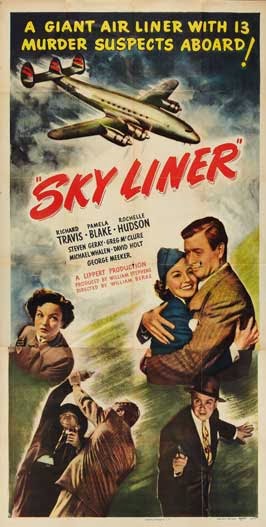
Where to begin with Sky
Liner (1949)? I’ll say this for it—it
makes Motor
Patrol (1950) look like Larègle du jeu (1939). The tagline for this programmer reads “a fast
paced and different kind of mystery thriller,” but there’s nothing remotely “fast
paced” about Liner, and as for “different”—well,
it would be unfair of me to say, “What makes it ‘different’ is that there’s
nothing ‘thrilling’ about it” because it wouldn’t be the first movie I’ve
watched that promised excitement and suspense and delivered neither. It’s a static, talky B that keeps an
unblinking eye on a stopwatch until its 61 minutes is up, and then announces it’s
time for the wrap party.
Even then, the version of Sky Liner on the Forgotten Noir & Crime Collection Vol. 4
set (available at The Sprocket
Vault) is a truncated version of the film, running at 49 minutes (DVD
Talk’s Stuart Galbraith IV speculates it might be either a shorter UK
release version or a TV cut). The info
on the movie at the American Film Institute mentions there’s an “obnoxious
child singer” among the passengers…so it sounds like I lucked out here, because
the kid in the print I watched does no singing.
“Amazingly, Sid Melton isn’t
in this one,” observes Galbraith…but I was so bored watching the thing I kept
hoping Sid would emerge from the plane’s washroom at some point. Speaking of which:
Richard Travis
That washroom is larger than one we have here at
the house. There a lot of familiar Lippert
faces in Sky Liner—Travis,
Pendleton, Pamela Blake (as the stewardess), Michael Whalen, etc. (Margia Dean
must have been furious with her
agent)—and Robert L. stalwart William Berke (or “Wm.,” as it says in the
opening credits) handles the directing chores (with a screenplay by the
ubiquitous Maurice Tombragel). I can’t
in good conscience recommend you stop what you’re doing to sit down with this one,
but if you’re trapped in a waiting room with fifty minutes to kill…you could do
worse.
“Murdered men flock to you like flies around a molasses jug,
O’Brien,” observes San Francisco cop Inspector Bruger (Richard Travis), having
discovered his nemesis, private shamus Dennis “Denny” O’Brien (Hugh Beaumont),
lying beside a man who appears to be in the advanced stages of death. “I could get all the killers in this town by
just sticking to you and waiting for the bodies to drop into your lap.”
“You’d be one up on the way you do things now,” is O’Brien’s
hardboiled reply…and we’re off to the races with Roaring City (1951)—a Robert L. Lippert-produced programmer whose title
seems more fitting for a western than a crime picture.
Hugh Beaumont, Richard Travis
Roaring City is a
B-quickie made up of two unaired television episodes from an attempt to bring
the Jack Webb radio classics Pat Novak…for Hire/Johnny
Madero, Pier 23 to the small screen.
The above dialogue exchange is from the second half of the film; NovakMadero O’Brien is hired by a damsel in distress (Joan Valerie) to pose
as her stepdaughter Sylvia’s (Wanda McKay) spouse for a C-note. It seems that Bill Rafferty (Anthony Warde),
Sylvie’s old beau, is back in town and Syl is worried that Rafferty might do
something terribly dangerous once he finds out about their marriage. The unfortunate shmoe that winds up dead
alongside the unconscious O’Brien was first introduced to Denny as her cousin Steve…but
in his attempt to clear himself of a homicide rap, our hero learns that “Steve”
is in actuality Sylvia’s husband.
Stanley Price
The first story in City
finds O’Brien hired by skeevy fight manager Harry Barton (Stanley Price) to lay
down several $1000 bets on a pugilist named Ham Harper—who’s going to win a fight
against Barton’s fighter, Vic Lundy (Greg McClure), because Lundy is going to
take a dive in the first round. Things
do not go as planned; Lundy ends up winning the bout (Harper was not in
fighting trim…and he had a blood clot near his brain) and is rewarded by being
murdered not long afterward. Like bad
Kabuki theater, Bruger is convinced O’Brien is responsible, necessitating that
Denny follow the clues pointing to a gambler named Ed Gannon (William Tannen).
Hugh Beaumont is not going to play the sap for Rebel Randall; he's slipped some incriminating evidence into her pocket.
DVD
Talk’s Stuart Galbraith IV believesRoaring
City is the worst film in the Forgotten Noir & Crime Collection Vol. 4
set (available from The Sprocket Vault), forgetting that it has formidable
competition with Radar
Secret Service (1950) and Motor
Patrol (1950), both in the same compendium. I’m able to cut City a little more slack because I’m so familiar with its source
material…while in the same breath recognizing that a TV show based on Jack Webb’s
waterfront creations probably wouldn’t have had much success. The dialogue on Novak/Madero is a
hilarious parody of hardboiled detectives…and while City faithfully reproduces this (leafing through a drawer,
Beaumont’s O’Brien finds a calendar featuring models “who posed without telling
their mothers”), visually there’s very little director William Berke can
add to the proceedings. Seriously, you could close your
eyes while this movie is on and miss very little of the action…particularly
since O’Brien’s voice-over narration tells you all you need to know (and in more
than one instance, is repeated again in dialogue with other characters).
Hugh Beaumont is roughed up by henchman Abner Biberman and serials hoodlum Anthony Warde (the poor man's Ted de Corsia).
Ed Brophy has been given his bottle, and he's ready for bed.
Galbraith disses my man Ed Brophy, whom I have applauded in previous
reviews for Danger
Zone (1951) and Pier
23 (1951) for attempting to do something out of his wheelhouse in his portrayal of “Professor”
Frederick Simpson Schicker, O’Brien’s frequently inebriated confidant:
Brophy's character is a real oddity.
The actor had a thick Brooklynese accent that was instantly recognizable; he
was short, bald, and bug-eyed - ideally suited for none-too-bright comic
henchmen parts. But here someone got the bright idea to cast him as an erudite
(if alcoholic) British professor (Red Flag! Red Flag!) who speaks floridly,
gesturing like John Barrymore. Brophy plays it with an English accent, but some
of the woids don't quite come out right. The effect is bizarre: it's like when
Stan Laurel bonked his head in A Chump
at Oxford and started talking like C. Aubrey Smith.
Hey…I’ll admit Brophy is no Tudor Owen—but give the man
props for not being afraid to experiment.
Next week on the blog: I’ll wrap up the “Forgotten Noir” series with Sky Liner (1949). When that’s finished—TDOY will resurrect the long-dormant feature “Crime Does Not Pay
(As Well as It Used To).”
Edmund Dantes (Glenn Langan) has no sooner stepped off a
boat (on which he’s employed as a second mate) docked along San Francisco’s
waterfront when he must come to the rescue of a woman being attacked by a pair
of goon-like gentlemen. The female in
question is Jean Turner (Adele Jergens), an heiress who’s currently receiving
mail at a sanitarium (or “nuthouse,” as Dantes colorfully refers to it) because
her guardian has placed her there to keep her from receiving the substantial
fortune left to her by her father. Jean
cashes in when she’s either married or reaches the age of twenty-five; she
mentions to Edmund that she’s nearly there, age-wise (yes, I knew Jergens was
in her early thirties when this film was produced), but if the two of them were
to tie the knot she could defeat her custodian’s eevill scheme. (It would be a temporary business
arrangement. A three-month merger.)
Glenn Langan, Robert (Bobby) Jordan
So they’re off to “The Biggest Little City in the World”
(Reno), and the morning after, Jean is having second thoughts. When Ed ventures out to get her some
cigarettes, he discovers upon his return that she’s vanished…but the address of
the sanitarium has been scrawled on the mirror in lipstick. (If Jean was abducted…wouldn’t the people
putting the snatch on her notice something like this?) Arriving at Casa del Cuckoo, Dantes hides in an upstairs room in the asylum when a man enters…and is shot by an unseen
assailant. This makes Ed The Amazing
Colossal Patsy (actor Langan is known for his starring role in the 1957
cult sci-fi film The Amazing Colossal
Man), as he’s arrested, tried, and sentenced for the murder of a man he’s
never even met! (Worst. Honeymoon.
Ever.)
Adele Jergens
Despite its clunky title, which would be more fitting for a
swashbuckling epic, Treasure of Monte
Cristo (1949) is a decent noir whose only deficits are flabby pacing (I was
kind of disappointed in director William Berke, who can usually make these little
programmers hum) and uneven performances.
Far be it from me to want to deny actor Glenn Langan a career in show
business…but the guy is in dire need of a charisma transplant (I know, he did
quite a few biggies at Fox, like Forever
Amber [1947] and The Snake Pit
[1948]); a better leading man would have improved this picture enormously, and
I’m only saying this because I have a thing for Adele Jergens. (Adele and Glenn have zero chemistry. Zip.
Nada.)
Margia, Margia, Margia! (Dean, that is.)
“If you love or live in San Francisco, this movie's like a
time machine back to 1949,” observes Stuart Galbraith IV in his review at DVD
Talk…and I think that’s another deficit in Treasure—it’s more of a travelogue at times than movie
thriller. (A narrator at the beginning
even regales us with some Frisco stats before the story gets underway.) Shooting on location is always nice in a film,
but it shouldn’t overshadow the plot…which is conventional to the point of cliché
from the get-go. (There’s even a scene
with a paralyzed victim who must communicate by moving his eyeballs.) I wasn’t quite as taken with the suspense as
Galbraith; truth be told, I had a little trouble staying awake at several points
in the film. (You could argue that the
suspense is generated by “will he be able to keep from nodding off?”)
Steve Brodie
Dead End Kids/East Side Kids/Bowery Boys fans will be amused
at the presence of Bobby Jordan (billed here as Robert), portraying the friend
who helps Langan crash out on his way to San Quentin—I’ve seen Jordan in a
couple of Tales of Wells Fargo episodes of late, and can’t help but be a little wistful at how his adult life turned out (I think Leo Gorcey once
remarked that his friend “didn’t have a guardian angel”). Familiar movie heavy Steve Brodie plays the
bad guy (pro-tip: never hire an attorney sporting a pencil-thin moustache) and
member-of-the-TDOY-faithful b piper
will be overjoyed to see Lippert “good luck charm” Sid Melton (billed as
Sidney) as a henchman (thankfully, he keeps the shtick to a bare minimum).
Heeeeeeeeeeere's Sidney!
There’s a DVD disclaimer at the beginning of this film that
reads: “The original nitrate negative to this picture had decomposed, but
fortunately a master positive survived.
Even after restoration the sound track is not perfect. We hope this imperfection will not affect
your enjoyment of this rare film.” It
did not (though the part about the sound concerned me to where I waited until
the cleaning ladies finished vacuuming), and it just reinforces what has become
a mantra here on the blog: film preservation is most important, because nitrate
won’t wait. You can purchase a copy of Treasure of Monte Cristo on the Forgotten
Noir & Crime Collector’s Set Vol. 4, available at The Sprocket Vault.
The Norris Trucking Company has been the focus of several
unfortunate accidents, thanks to some generous use of stock footage from
Republic serials. But when Henrietta
Norris, heiress to the Norris fortune, meets her demise in an automobile wreck
along the same stretch of California highway that’s claimed so many gearjammers,
her father (Tom Chatterton) and husband Frank Denton (Michael Whalen) sit up
and take notice. (Ms. Denton and the
drivers all perished along Highway 13.
Get it? Because “13” is an unlucky number. Hello?
Bueller?)
Robert Lowery and Dan Seymour
Driver Hank Wilson (Robert Lowery) witnessed Henrietta’s
accident, and he’s soon paired up with apprentice trucker George Montgomery (Steve
Pendleton, billed as “Gaylord”)—who’s really a private investigator looking
into the matter at Denton’s request.
Montgomery is killed in a suspicious truck accident not long after, and
Hank is immediately fingered for the crime.
But Wilson is a right guy; it’s hard to believe he could be capable of
such mayhem; suffice it to say, there’s no shortage of suspects including Norris
personnel manager Mary Hadley (Maris Wrixon) and cantankerous garage/café owner
Bill “Pops” Lacy (Clem Bevans).
No one was more surprised than I when I watched Highway 13 (1949) because this makes
the second “Forgotten Noir” in a row that’s actually a fairly decent little
B-picture. Tooling along at a crisp,
economical 58 minutes, Highway has a
very good cast and was directed by journeyman William Berke (Shoot
to Kill), who demonstrates with confidence that he knows his way around
a programmer (this puppy was shot in three-and-a-half days). Maurice Tombragel (whose contributions
include the serials The Great AlaskanMystery [1944] and Mystery of the Riverboat [1944]) gets
the credit for the screenplay, from a story by John Wilste.
In his write-up for Highway
13 at DVD
Talk, Stuart Galbraith IV is most laudatory—labeling the film “a genuinely
baffling mystery that keeps viewers guessing.”
Steve at the Mystery File blog has a
dissenting opinion: “Most other reviewers of this film rate it a whole lot
higher than I do, but personally I don’t care for crime films in which the
culprit(s) is/are obvious…” I kind of
have to throw in with Steve on this one; the individual(s) responsible does
stick out like a sore thumb (when one of your suspects resembles the Gavin
Elster character from Vertigo—not an
encouraging sign) but despite this (and a finale that’s a teensy bit contrived)
I’d still give the movie high marks (sometimes getting there is half the fun…even
if you have predicted the outcome).
Mary Gordon and Clem Bevans
Most of the time when I’m watching Robert Lowery in a movie
I’m trying to figure out why so many people thought he looked like Clark Gable. (Lowery was in last week’s “Forgotten Noir,” Western
Pacific Agent [1950]—though he didn’t make it past the first
reel.) But props to Bob—he’s very
effective in Highway 13 (I also
liked him in another Robert L. Lippert production reviewed on the blog, Arson,
Inc. [1949]) and his chemistry with Monogram pin-up girl Pamela Blake
(she plays his love interest, a waitress named Doris) is astoundingly good. (Galbraith observes that Lowery resembles
Victor Mature more—I’m with him on this.)
The casting in Highway is one
of its major strengths; it’s filled with old pros like Clem Bevans, Mary Gordon
(“Mrs. Hudson!”), and Lyle Talbot.
Talbot must have had one hell of an agent—he’s barely in the film and
yet he’s mentioned in the opening credits; character veteran Dan Seymour (as an
insurance agent named Kelleher) gets more screen time yet goes unbilled.
Pamela Blake and Robert Lowery
The short running time of Highway 13 is also a plus—it zips by so fast you aren’t afforded
the opportunity to see where the seams show.
Galbraith also notes that “Lippert must have gotten access to the big
diner set from some other movie; it's too elaborate to imagine that it was
constructed for this film.” (I concur,
and thought the “Clover Café” background was very impressive for a
programmer.) Highway 13 has resurfaced on DVD as part of the Forgotten
Noir series now available at The
Sprocket Vault and can also be rented from the new ClassicFlix
Underground. (As to its noir bona
fides—DVD Talk says yay, Mystery File
says nay…proving it to be one of the most elastic of movie definitions.)
Bindlestiff. It’s a
slangy word for a hobo or tramp, and apparently, it’s been out of usage for so
long Microsoft Word is asking me “What the hell, Ivan?” Be that as it may, the expression gets quite
a workout in Western Pacific Agent
(1950); as a train passenger (Jason Robards, Sr.) explains to his lady friend
(Vera Marshe), most bindlestiffs are merely migrant workers…but some of them,
to borrow the nomenclature of our orange Commander-in-Chief, are “bad
hombres.” The gentleman proceeds to tell
the woman (and the movie audience) of one such wicked transient.
Though he’s recognized by his fellow rail-riders under his nom de hobo “The West Coast Kid,” the Kid
is better known to his friends and family in Chester, California as Frank
Wicken (Mickey Knox) …and he’s returned to his hometown to put the bite on his
old man (Morris Carnovsky), who owns and operates the town’s general
store. No dice, Papa Joe tells his son—not
one thin dime until Frank agrees to straighten up and get a J-O-B. The ambitious Frank decides to take a
shortcut and rob railroad agent Bill Stuart (Robert Lowery) of a $50,000 fruit
pickers payroll; in doing so Wicken not only clubs Bill until his brains turn
to guacamole but sticks a shiv in the stationmaster (Anthony Jochim) for good
measure. Fleeing with the cash, Frank
leaves the murder weapon behind…because he isn’t very bright. (I’m no lawyer…but I think Wicken just might
swing for those killings.)
Stuart Galbraith IV at DVDTalk says of the ubiquitous Sid Melton: "He grows on you." (So does kudzu.)
To solve the murders, a special railroad agent named Rod
Kendall (Kent Taylor) is brought in…and you’d think if he was that much of a big deal this movie would
have been titled Western Pacific Special
Agent. Kendall, with the help of the
local sheriff (Dick Elliott) and a stooge played by Sid Melton (because this is
a Lippert film, after all) gets down to cases; the company has had the
foresight to pass out a list of the serial numbers on the bills to local
business so that Frank is unable to spend any of his ill-gotten gains. Oh, the irony! (All we need now is Bill Forman chortling
about how terribly Wicken screwed up like a classic broadcast of The
Whistler.) Frank is ultimately
unable to outrun the long arm of the law because…well, you know the drill—weed of
crime, bitter fruit, yada yada yada.
Unlike a lot of the programmers on these Forgotten
Noir DVDs (available for purchase at The
Sprocket Vault or to rent from the new ClassicFlix
Underground), Western Pacific Agent
is a dandy little B-noir (yes, I think this one qualifies) from director Sam
Newfield (and his producer, brother Sigmund Neufeld) that’s a hell of an
entertaining movie to watch. No less
than an authority than the late John Cocchi—author of one of my favorite film
reference books, Second Feature—spoke
most highly of the film: “One of the brothers’ very best is this crime drama in
which the heroes become secondary to the villain.” I think he pretty much nails it; the top cop
is played by Kent Taylor who, despite his lengthy movie resume, I can never
think beyond TV’s Boston Blackie. Taylor’s
Randall is competent but uninspiring—he seems annoyed by Melton’s comic relief
(I’d gamble he’s not the only one) and his “romance” with Martha Stuart (Sheila
Ryan)—yes, that is the character’s name—is dull stuff.
The top performances in Agent go to Mickey Knox, who would
later enjoy great success in Italian films in the 1960s/1970s (he was a
favorite of director Sergio Leone), and Morris Carnovsky, a respected stage actor
whose movie career was cut off at the knees by the blacklist. Knox is so convincing as an amoral drifter it’s
scary (Stuart Galbraith IV at DVD
Talk notes that Woody Harrelson’s character in Natural BornKillers
[1994] is named “Mickey Knox” and wonders if Oliver Stone ever saw Agent—I’ll bet this was Quentin
Tarantino’s contribution) and the cruel twist of Fred Myton’s screenplay (from
a story by Milton Raison) kind of makes you feel a little sorry for the little
jerk. Carnovsky proves to be the
consummate pro in that he demonstrates despite having to be in this B-picture he’s
going to give 100%.
Dick Elliott is always a welcome presence, and vets like
Frank Richards and Ted Jacques turn in solid performances as two “bindlestiffs”
who become hoboes of interest in Randall’s investigation. (Look quickly and you’ll see our old buddy,
B-western heavy Charles King, with a bindle as well.) I’ll slip into a Stanley R. Sogg impression
and let you know “the ever popular Margia Dean!” has a brief bit as a female hobo…proving
that riding the rails was an equal opportunity occupation. Why Jason Robards, Sr. goes unmentioned while
his female companion gets a nod in the opening credits is a question I can’t
answer…though the cynic in me speculates the actress in question might have
been a friend of the producer, if you know what I mean and I think you do.
Western Pacific Agent
wraps things up with exciting shootouts at an old shack and a bascule bridge that
per the {always reliable) IMDb is the Henry Ford Bridge on Terminal Island
(Long Beach) where Knox’s Wicken meets a memorable end. I only wish they had made a little more use
of the Western Pacific streamliner the Zephyr Vista Dome, which was introduced
in this picture (some of the scenes were shot on the train’s Frisco-to-Chicago
run). Other portions of Agent were lensed at Oroville (their
dam has been in the news lately) in the Feather River country of Northern
California. Great little B-picture, and
one of the stand-outs in the Forgotten Noir collections.