Monday, April 6, 2015

Doris Day(s) #36: “Doris Strikes Out” (11/24/69, prod. no #0403)


I’m just as surprised as you are that I was able to get this week’s Doris Day(s) up on the blog today after kind being kept occupied yesterday—I only hope you’ll forgive me for the delays in the past, and keep in mind that if you send me to Blogosphere Prison there’ll be no one around to keep my parents from killing one another.


Today’s episode, as is the established pattern, opens in the offices of Today’s World (the NOW magazine)…and this amusing image of office busybody Myrna Gibbons (Rose Marie) listening in at the door of the magazine’s major domo, Michael “Nick” Nicholson (McLean Stevenson).  Amusing because as diabolical as Myrna is, I would have assumed that she had already installed a sophisticating bugging system in that joint and would not have to refer to such arcane eavesdropping measures.  Enter her pal, the Widder Martin (Doris).

DORIS: What are you doing?
MYRNA: I’m trying to hear!
DORIS: What?
MYRNA: Doris, I’m so glad you asked me to sit in for you while you went out to lunch…you’ll never guess who’s in Mr. Nicholson’s office—you’ll never guess!
DORIS: Claude LeMaire…
MYRNA: You guessed!

Okay, before you start thinking Doris is a witch and that we’re going to have to burn her, I should point out that she knows who Nick’s visitor is because she made the appointment.

MYRNA: Oh, Doris—he’s adorable…he is so adorable!  And his voice…that voice…when he said (mimicking French accent) “Is Mr. Nicholson in?”  I tell you, I was paralyzed…I just stood there with my mouth open and my pulse racing…
DORIS: Myrna, you’re acting like a silly schoolgirl…he’s just another movie star…

Ohhhh…so that’s what Claude does when he’s not tending bar.  Truth be told, I’m not surprised Doris is a bit jaded by the whole “movie star” thing—after all, once you’ve pretended to sleep with Rock Hudson in three feature films it’s all downhill from there.  Doris’ intercom buzzes, and it’s Nicholson—asking her to bring in a release form for LeMaire to sign.  Myrna begs Dor to let her do it, but it looks like Doris is going to tackle this secretarial task by her lonesome.  “Will you control yourself?” Doris asks her pal.  “You’re losing your cool, girl…” Myrna does make Doris promise to leave Nick’s office door open a crack so she can continue to snoop.

Well, let’s meet this week’s special guest—shall we?


In the role of “Claude LeMaire” is actor Jacques Bergerac, a Frenchman who broke into the motion picture bidness by capitalizing on rather cozy connections: namely, he met Ginger Rogers in France when he was only 26 (Ging was 42), and he left behind a possible career in law to appear with her in 1954’s Twist of Fate.  (Jacques divorced Ginger three years later, and wound up marrying Dorothy Malone.)  Bergerac appeared in two major MGM musicals, Les Girls (1957) and Gigi (1958)—which kind of makes sense, what with the French background and all—but a lot of people probably remember him from the 1960 cult horror classic The Hypnotic Eye.  His TV resume is tres impressive (hey!  I speak French!): The Millionaire, Alfred Hitchcock Presents, The Dick Van Dyke Show, Perry Mason, Get Smart and The Lucy Show, to name a few.  But his appearance in this Doris Day episode would be his show biz swan song, according to both the (always reliable) IMDb and a Variety obituary marking his passing in June of 2014.

LeMaire has turned up in the offices of the NOW magazine because Nick’s arranged a big publicity foofrah for the actor’s newest movie.  Doris, who chided Myrna for being so starry-eyed about Claude earlier, has apparently fallen for LeMaire’s charms because she’s using that soft breathy voice of hers whenever she meets a dude she likes.  Plus LeMaire goes into the whole “Enchanté” routine, including this:


Yes, we’ve got ourselves a hand-kisser.  I will not penalize anyone with demerits if you wish to sneak out of the blog at this time.

NICK: Doris…why don’t you show Mr. LeMaire where to sign?
DORIS: Oh…yes, sir… (Handing him the form) Right there, Monsieur…
CLAUDE: Thank you…
(Pregnant pause)
NICK: Doris…the pen?
DORIS: Oh!  Mr. Nicholson—do you have one?

And it pretty much goes like that from there—while Nick and Claude attempt to work out the details of the publicity junket, Doris stumbles and bumbles around like Lucy Carmichael on meth.  Two things did make me snicker, though: she hands the coffee pot to Nick, who registers a hilarious expression of pain when he takes it in his hands, and then there’s bit:


She collects LeMaire’s still-lit cigar, and then seconds later he looks around the table for the stogie.  That’s when she realizes she removed it prematurely, and when she fishes it out of the container she trills “Oh!  It didn’t go out!”

Finally, Nick yells out “Thank you, Doris!” in the same tone as someone might utter “Nothing to see here—move along, folks!”  Doris Lucys her way out of Nick’s office, unaware her awkwardness has attracted the attention of Monsieur LeMaire:

Sometimes a cigar is just a cigar.
CLAUDE: She’s very charming…
NICK: Yes…well, now—I’ll get in touch with your publicity agent the minute he gets to town and we’ll schedule some…
CLAUDE: Excuse me—is she married?
NICK: Who?
CLAUDE: Your secretary…
NICK: No…no…she’s a widow…

“But if you wait around a couple more seasons, she’ll be on the market!”  After a dissolve, we find Nick escorting LeMaire out of his office, promising to call him at his hotel.  Claude takes a moment to stop at Doris’ desk, for he has—how you say—a proposal:

CLAUDE: Madame…may I thank you again for all your kindness…
DORIS: Oh, it was my pleasure…
CLAUDE: Au revoir…
DORIS: Au revoir…
(Claude walks toward the door, then stops and walks back)
CLAUDE: Madame…tomorrow night they are having the premiere of my…uh…latest picture…
DORIS: Yes…I know…
CLAUDE: I…uh…I know so very few people here in your city, and…I was…uh…wondering if maybe you would do me the honor of…uh…permitting me to escort you…
DORIS: Escort me?
CLAUDE: Yes…to…to my premiere…
DORIS: To your premiere?

What are you, a f**king parrot?  Claude explains that he’s asking Doris for a date, and because it’s been so long—well, two episodes back—she says yes…or “Oui,” in French-talk (though Dor says it as if she’s just got off the Tilt-a-Whirl: “Whee!”).

CLAUDE: I’ll pick you up at seven, huh?  What is your address?
DORIS: Well, I live in Mill Valley…uh, 32 Mill Valley Road…you cross the Golden Gate Bridge…and when you get to the other side, there’s a sign…uh…that says to Mill Valley…it veers to the right…and you go to the right, and you stay on that road…and then you come to a fork in the road…

“Then make a right turn at a big rock that looks like a bear, then make a left turn at a big bear that looks like a rock…if you see a Tastee Freeze on the right—you’ve gone too far!”  Doris decides that since LeMaire is just a-visitin’, perhaps it would be easier if she met him in town, and he is relieved by that suggestion.

"He asked me!"
MYRNA: I don’t believe it!
DORIS: It’s true!  He asked me to go to his premiere!
MYRNA: Oh, why couldn’t it happen to me?!!  Why does my fairy godmother always let me down?!!
DORIS: I still can’t get over it, Myrn—the whole thing is just wild!
MYRNA: Come on, girl…you’re losing your cool!

The celebration comes to a screeching halt, however, when sudden realization kicks in—Doris has nothing to wear.  “Oh, come on, Doris—you’ve got beautiful clothes!” Myrna reminds her chum, which did made me giggle because I have a tendency to question how Doris retains her sartorial flair with two kids to support in a dead-end secretarial job.  Dor’s got a black cocktail dress, but Myrna says that won’t do; she’s also got a beige chiffon with a jeweled top, “it just needs shortening.”  (Break out the Crisco!)  But then Dodo realizes that won’t work, because she lacks the proper accessories.  So it’s settled—she and Myrna will get the necessities tomorrow (bag, gloves, shoes, etc.) because ladies love to shop, amirite?

A dissolve finds Doris pulling into Rancho Webb, which as I have pointed out previously is slightly different from the house featured in the first season…and yet still retains the same basic floor plan inside.  Her father, Laird Buckley Webb (Denver Pyle), is lifting heavy sacks into a pickup truck while her idiot sons Billy (Philip Brown) and Toby (Tod Starke) cut firewood with a sharp, pointy saw.  (What could possibly go wrong with this scenario?)

DORIS: Hey, are those really my kids helping with the chores like that?

Kee-rist, it’s worse than I thought—she’s not supposed to forget she has children until Season Four!

BUCK: Oh, yeah…volunteered right after they got home from school…
DORIS: Volunteered?
BUCK: Uh-huh…
DORIS: My kids?
BUCK: Yep…
DORIS: How much you paying them?
BUCK: Nothing…
DORIS: They’re not my kids…

We may have to call CPS before this dialogue exchange is through.  Buck then explains to his daughter that because he’s umpiring their little league game tomorrow that might have something to do with their desire to sweat and toil.  “They think I’ll throw a few decisions their way,” he chuckles.

“Yep…they’re my kids, all right,” Doris replies.  Crisis averted, everyone!

DORIS (to Billy): Hey—how’s your pitching arm?
BILLY: Okay…
DORIS: Ready for the big game tomorrow?
BILLY: I sure am!
TOBY: I’m ready, too, Mom!
BILLY: You’re only the bat boy…
TOBY: Well, I’m ready…

Toby is going to turn out like Larry Flynt’s brother Jimmy in The People vs. Larry Flynt (1996), always living in his brother’s shadow.  Sad.  So very sad.  So let’s lighten the mood a bit and saddle the old man with a back injury, eh?

DORIS (as she massages his back): I told you not to keep lifting those heavy sacks, Buck!
BUCK: Right there…ooh…
DORIS: That better?
BUCK: That’s it…

Hey, didn’t you people used to have a hand…er, forget I mentioned that.  Buck asks Doris if anything exciting happened to her at the old salt lick, and she tries to remain nonchalant.  “Just another day, you know…dictation and typing…and phone calls…and I met the French movie star, Claude LeMaire…and he asked me to go to the premiere of his movie tomorrow night…not too much.”

“You’re goin’ out with Claude LeMaire…I’m goin’ out with Brigitte Bardot—hey, how’d you like to make a double date?” Buck jokes.  But Doris crosses her heart and swears this is no bullsh*t—she’s really going to the premiere with Monsieur Montage, and Buck is tickled pink.

BUCK: You’re gonna have to get all gussied up, huh?
DORIS: Yeah, I’m all set…Myrna’s going to help me…she’s going to meet me in town tomorrow…
BUCK: Oh, that’s great!
DORIS: Isn’t that groovy?

Far out.  “Well, he’s got good taste,” beams Buck, and we dissolve to a montage of Doris and Myrna shopping for pretty things…which I’m going to skip over for the most part (I wonder if they went back into Frisco for this stuff or did they load up at the Cotina Bon Ton?—I don’t even think Doris refers to it as “Cotina” anymore, she’s always calling it “Mill Valley”) except for this next screen cap.  You may have noticed that Doris is back to her old hair (probably because these filmed shows aired out of sequence), but I got a snicker out of her trying on this dark wig at the hairdresser’s:

"I am...how you say in your language...le strumpet!"
Arriving back in Cotina Mill Valley, Doris sees a gentleman she identifies as “Dr. Parker” coming out of the house…


…Parker is played by a journeyman actor named James Chandler, who played a lot of medicos and sheriffs in his lengthy show bidness career. His main claim to fame was emoting as Lt. Gerard (no relation to the guy what chased after Dr. Kimble on The Fugitive all those years) on Bourbon Street Beat (1959-60), a short-lived ABC crime drama that tried to capitalize on the network’s successful 77 Sunset Strip formula, except it was set in N’awlins.  After Bourbon Street was cancelled, star Richard Long (as Rex Randolph) eventually relocated to 77 Sunset Strip, while another character played by Van Williams (Kenny Madison) made his way to Miami and became a private eye on Surfside 6.

PARKER: Your dad just strained his back…
DORIS: Oh…no kidding…oh, he complained about it yesterday…
PARKER: I told him he’d have to stay in bed at least a day or so…
DORIS: Great…he’ll love that…
PARKER: Well, if you have to, strap him in…and I left some pills…

“Oh, and I prescribed some medication for his back, too.”  Doris goes inside in time to hear her bedridden father pissing and moaning about being bedridden.

DORIS: What’s this about you?
BUCK: Oh, that old quack…all I got’s a little crick in my back and he’s makin’ a big deal out of it…I’m as SPRYYYY…


Doris sits down on the bed, producing a back spasm in Buck and the capitalization of that last word in his dialogue.  Doris will brook no disagreement, though—he’s going to stay in that bed, and that’s non-negotiable…but she wonders if she should cancel her date that evening, since she wouldn’t feel right about leaving her father alone with her two idiot sons.  “I’ll call Mrs. Turpin,” brightens Doris…but her father says no way José: “That biddy?  I don’t know what clacks faster, her mouth or her knitting needles! I don’t want her in my house!”

I’m starting to understand why Doris is constantly looking for excuses to stay in town…hell, I’m even beginning to see why she’s going to cut the old man loose come next season.  But one problem remains: Buck’s got that Little League game obligation, and so Doris is going to have to extricate him from that.  Doris…these two young boys are your children:

DORIS: I want you to be quiet…because Grandpa is trying to rest…
TOBY: Yeah…he hurt his back…
DORIS: Oh—you know about it, then?
BILLY: Yeah…
DORIS: Gee, I’m sorry…it really throws you a curve today, doesn’t it?

Little baseball joke for those of you still with us.

DORIS: Because Grandpa won’t be able to umpire today, honey…not the game this afternoon…
BILLY: That’s all right…we already told our manager we got someone to take his place…
DORIS: Oh, did you?  Oh, that’s good…who’d you get?
BILLY: You!

Sad trombone, line two!  Doris vehemently protests—she can’t umpire no stinking baseball game!  She must prepare herself for that hot date with Monsieur Mise en Scène!  Doris asks why none of the other parents are available for this task, and her son explains to her that they’ve all had their turn—which is why Buck was up in the rotation.  “With Grandpa out, you’re the only parent we’ve got left,” Billy whines as sad music plays in the background.  (This kid is good—he must be taking guilt lessons from my mother!)

As Act Two of “Doris Strikes Out” gets underway, Doris has agreed to call the game because both Billy and Toby have assured her it’ll be over in plenty of time for her to get ready and attend the premiere.  While getting ready for the game, Doris attends to her incapacitated father, who’s crabbing about why it’s taking so long for her to bring him his soup.  She brings a tray into his bedroom.

BUCK: I don’t like being a grouch, but I’m not used to just layin’ around…
DORIS: Well, a little laying around is going to do you a lot of good… (She starts to unfold his napkin)
BUCK: I’m used to takin’ care of myself!  Now I can do this…I don’t want to be a bother…
DORIS (mockingly): That’s all right, Grandpa—I don’t mind…

For someone who doesn’t want to be a bother, he does ask Doris if she’ll go back downstairs and get the latest issue of the Farm Journal.  (Check out that centerfold—yowsah!)  Oh, and she’s brought him the plain crackers…he likes the salted kind.


The screen cap shows that Buck is holding a Town House cracker, which had salt on them the last time I ate a whole box.  I think he’s bitching just to bitch.  So Doris gets the journal and the crackers, and it’s off to the old ball park we go.  (She tells Buck she’ll have plenty of time to get ready for her date.)


The look on Doris’ face here suggests that they may have told a teensy fib…


…and the scoreboard also suggests the crowd’s going to have to settle in, ‘cause it’s gonna be a long one.  (The concession stand people are probably high-fiving the crap out of one another…until they run out of Slim Jims, that is.)  Most of what happens here is some admittedly funny visual comedy, so naturally it’s not going to transition to the blog too well (Doris keeps impatiently telling the kids at the plate to get a move on after they’re walked by the pitcher)—but the highlight is Billy’s getting a hit and Doris calling him out at first…only to see the opposite team player drop the ball, so she has to reverse the call.  She and Billy keep this up all around the bases, it’s pretty hilarious stuff.  We do get the opportunity to introduce the real star of this week’s show…


…none other than character great Gordon Jump, in what is the first of five appearances he’ll make on The Doris Day Show.  I was not aware that Jump was a Kansas State University alumnus (go Wildcats!), by the way; of course, I don’t have to tell you the actor’s TV immortality was cemented playing befuddled station manager Arthur “Big Guy” Carlson on both WKRP in Cincinnati (the good sitcom) and The New WKRP in Cincinnati (the bad sitcom).  (The fact that Gordon was a native of Dayton, Ohio explains a lot of the “Dayton” jokes on those shows.)  But he also had regular roles on such series as That’s My Mama, Lou Grant, Soap and Growing Pains.  (Honest to my grandma—the first show I ever saw Jump in was a horrible Saturday morning offering called McDuff, the Talking Dog.)  Oh, and he took over as the lonely washer-dryer repairman in the Maytag commercials after the death of Jesse White.

Jump plays the manager of the opposing team, and the kid he’s currently got on the mound is so bad Doris dusts off the plate at one point and snidely asks the boy “Can you see it now?”  So Gordon takes some time out to calm his pitcher down with words of managerly advice: “Now just settle down, Joey…just…settle down…”

DORIS: Hey—aren’t you going to take him out?
GORDON: Well, what for?
DORIS: What for?  He can’t get the ball over the plate!
GORDON: This kid just happens to be one of the best natural pitchers you’ll ever find…
DORIS: Oh, yeah?
GORDON: He’s got everything!  Speed, curves, change-ups…heh…fire ‘em in there, Joey!
JOEY: Okay, Dad…

Yeah, an obvious joke—but a funny one.  Finally, Doris has to take the bull by the horns.  She gives Joey a rather liberal “strike zone” and starts calling strikes that aren’t even in the vicinity of the plate.  (Gordon: “That’s gettin’ ‘em over, Joey!”)  When her son Billy protests, she smacks him down with “You’re ahead 62 to 14—what do you want, Billy?”  It doesn’t take too long after Doris makes some questionable calls that her son and his team go after her with some handy bats (“I call ‘em like I see ‘em!” yells Doris).  This game must have been played in the good ol’ days when they allowed kids’ athletic spirits to be crushed by letting a superior team run up the scoreboard to their hearts’ content.


You’ll notice that Doris pulls up to the house…and her kids are not in the back seat.  (Oh my stars—it’s happening again!)  A quick dissolve, and Doris is bounding out of the house and into her ensemble for the evening.  She makes it to the premiere in the nick of time to be on the arm of Monsieur Tournage as they are led to their seats in the theatre.

CLAUDE: There have been so many people around, I haven’t had a chance to tell you how lovely you look…
DORIS: Thank you very much…
CLAUDE: I hope you like the picture…
DORIS: Oh, I’m sure I will… (Stifling a yawn)
CLAUDE: Are you tired?
DORIS: Oh, no…no…I rested all day!  I’m just nervous, I guess…

The lights go down…the picture unspools…and when the lights go back up…
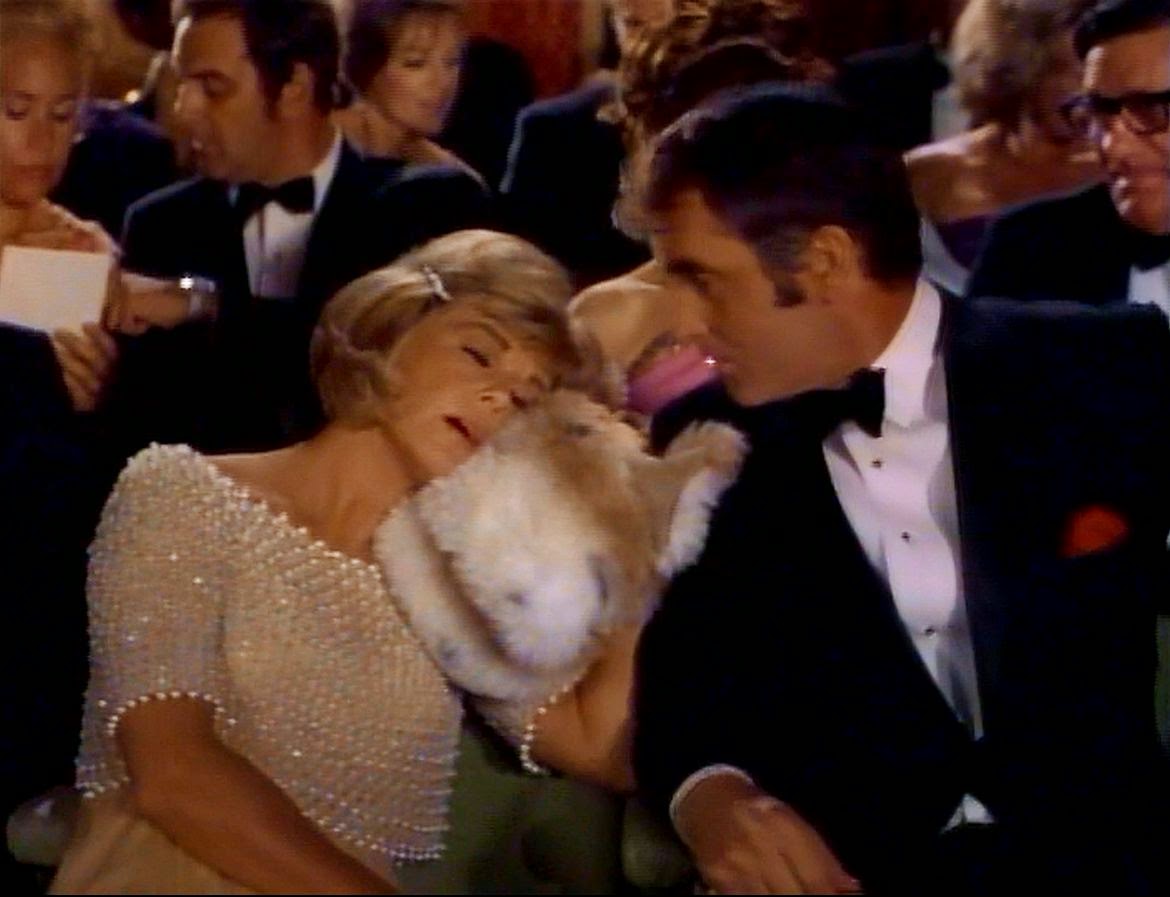

That is a whole lot of nervousness there.  Poor Doris did so much running around and umpiring that she was just plumb tuckered out.  She returns to stately Webb Manor, where her father continues to convalesce in his bed, and she tells him of his embarrassing faux pas.

DORIS: My big evening and I blew it!  Talk about embarrassed…
BUCK: Oh, Doris…
DORIS: Buck, I was so tired from all that happened to me today I couldn’t stay awake for anything!
BUCK: Me and the kids…we ask too much of you…
DORIS: Now don’t go blaming you and the kids…it’s nobody’s fault…it’s just circumstances, that’s all…


Well, that and the fact that you fired all the hired help that used to run the place in Season One.  (Not that I’m complaining, mind you.)  Buck tells her to just get a good night’s rest…but that won’t be happening, my friend: “I slept all evening—I’m wide awake!” she gripes.  So the two of them decide to watch the late movie (ask your parents about it, kids) and demonstrating that irony can be pretty ironic sometimes, the feature is "Strangers No More"…starring Claude LeMaire!  “You’re going to get to spend an evening with Claude LeMaire after all!” crows Buck with a mouthful of popcorn.  (No, I don’t know where he got it if he can’t get out of bed and the boys never came home.  Maybe he keeps it in one of his nightstand drawers.)

The coda finds Doris and Myrna getting ready to do lunch, and Myrna is understandably upset.  “Falling asleep on Claude LeMaire—fainting I can understand…but falling asleep?”  Doris nicely tells Myrn to put a sock in it because she’s tired of hearing about her embarrassing moments, and as the two of them head toward the door, Pepe le Pew enters.

DORIS: Mr. Nicholson isn’t in…he won’t be back until 2:00…
CLAUDE: I did not come to see Mr. Nicholson…I came to see you…
DORIS: Me?  After what happened?
CLAUDE: Oh, please…forget it…you explained and I understood…I came to ask you if…if you would like to come and have lunch with me?
DORIS: Oh, I’d love to…


That’s when Myrna starts tapping Doris on the shoulder as if to say “Hey, what about me, idiot?”  So Doris introduces Myrna to Claude, and timidly asks if it would be all right if she accompanied them to lunch.  Claude is cuke as a coolcumber about it (because he’s down with the ménage a trois), and Myrna cracks: “Hey, Doris—with you around, who needs a fairy godmother?”

Next time on Doris Day(s): I have to confess, it’s been so long since I saw this one I’m not sure if it stinks or not—but the guest star is a TDOY fave best remembered as Ikky Mudd (with two k’s) on Captain Midnight, Charley Halper on Make Room for Daddy and Alf Monroe on Green Acres—so how bad can it be?  (Plus, radio veteran Alice Backes has a small part, as does character fave Michael Lerner.)  It’s reminiscent of a classic Mayberry R.F.D. episode, “Howard, the Swinger”—so join us for “Singles Only” on the next Doris Day(s)!

Saturday, April 4, 2015

The Black Widow (1947) – Chapter 11: Death Dials a Number


Serial Saturdays returns this week with an installment from The Black Widow whose title sounds like it was cribbed from an old-time radio drama (“Today’s thrilling Shadow adventure: ‘Death Dials a Number’!”).  We know, of course, that despite our fervent hopes and dreams, bossy author-amateur criminologist Steven Colt and his automobile were not sucked into the raging torrent stock footage that concluded the last episode (seriously—that water moves like there’s been recent flooding), but instead our hero leaps out of the car at the last minute in true Hal Duncan style (“Hanh?!!”).

Chapter 11 finds Steve conversing with Professor Henry Weston (Sam Flint), who’s been stashed away in an undisclosed location to keep him out of the evil clutches of Sombra, the Black Widow (Carol Forman), and her confederates in crime.  Weston reads aloud from the latest edition of The Daily Clarion—the newspaper, in the interest of full disclosure, that hired Colt to work the Widow case in the first place.


WESTON (reading): “Another strange chapter was written into the Black Widow mystery early yesterday afternoon…the woman, held by the police as The Black Widow, collapsed in her cell and was pronounced dead…” (Putting down the paper) That’s quite a yarn…what do you think of it?

“Sounds like the lamest of serial plots to me.”

STEVE: It’s hard to say…but I’m not convinced The Black Widow is dead…
WESTON: What do you mean?
STEVE: Is it possible for a person to take a drug that would make him appear dead for any length of time?  You know—no pulse or heart action?
WESTON: Yes…there are a few rare cataleptic drugs that would do that…

“Oh…and Flintstones Chewables.”  Weston wants to know why, and that’s when Steve produces the pieces of paper he found in the coffee cup that was on the floor of Sombra’s cell.

WESTON (having a whiff): Strange odor…that could contain a drug!
STEVE: Exactly…if we could analyze that paper, we might confirm my suspicions…
WESTON: What are we waiting for?


“After all—I am the science-making guy!”  After a dissolve, Weston is seen peering into a microscope, then flipping through a book as Steve looks on, contributing nothing.  The professor deduces that the paper has been coated with a made-up drug called “carbobenetrol.”

WESTON: …a rare drug…used in experimental medicine to induce a cataleptic state…developed by Dr. Z.V. Jaffa in 1942…

Ho ho!  The very same Jaffa (I. Stanford Jolley) working for Her Maliciousness!  To Colt, this cinches it—The Black Widow is back in business, baby, and in the ensuing conversation with Weston we learn a little about the Doc’s heinous background:

WESTON: …he was a brilliant organic chemist…during the war, he was convicted of illegal sale of hypnotic drug…while awaiting an appeal…in the federal jail…he died suddenly of a heart attack…

Coincidence?  Not on your test tube, my boy!  “It’s just a hunch,” muses Colt, “but I’m going to check with the authorities on this Jaffa character…”

Weston wishes him good luck, and with another dissolve we’re riding along in the new Coltmobile with Steve and the bane of his existence (and the woman he’ll probably marry), irritating gal reporter Joyce Winters (Virginia Lindley).


JOYCE: All right, Sherlock…so you’ve got a lead to someone who might know about a…Doctor Joshua that Weston told you about…
STEVE: The name is Jaffa…
JOYCE: That’s what I said…

Normally I find Joyce about as funny as painful rectal itch—but there’s just something about the way Lindley delivered that line that made me laugh out loud.

STEVE: Well, anyway…he was a cellmate of a man named Fillmore Hagain…who now owns The Classic Book Shop…

The (always reliable) IMDb spells Fillmore’s last name as “Hagen”…but since serials historian Hans J. Wollstein spells it “Hagain” in his Black Widow chapter recap at allmovie.com, I’m going to assume he’s got access to material I do not and so I’ll follow his lead.  Steve and Joyce greet Hagain at his shop, and the bookstore owner is played by character veteran Stanley Price—yet another one of the many familiar faces you’ll come across in chapter plays and B-Westerns.  In fact, Price played Robert “Doc” Benson in G-Men Never Forget (1948), one of our previous Serial Saturdays presentations—but his main claim to cliffhanger fame was playing “The Phantom Ruler” in the 1950 cult serial The Invisible Menace (1950).  (I keep hearing rumblings in the home video world that Olive Films may release this one to DVD/Blu-ray soon—if this happens, I might have to snag a copy for future Saturdays consideration.  I do know that Price has a part in what will be the next chapter play to be tackled at Thrilling Days of Yesteryear, Zorro’s Black Whip (1944)—provided my Hamilton Book order gets here in time).


STEVE: I’m Steven Colt…
HAGAIN: The writer?
STEVE: That’s right…
HAGAIN: Oh, I’ve read many of your books, Mr. Colt…

“That’s not writing, that’s typing!”

HAGAIN: Were you looking for something special?
STEVE: Yes, some confidential information…I’m doing some investigating on a Doctor Jaffa…he was your…roommate for a while…

You can’t say our boy isn’t tactful about Hagain’s prison record.  Hagain himself delicately references it when he follows up with “But there isn’t much I can tell you…you see, I never saw him before or after my…uh…detention.”

STEVE: Well, it’s my belief that Dr. Jaffa is still alive…and I think I can prove it with your help…
HAGAIN: My help?
STEVE: It’s very simple—all you have to do is put an ad in the personals column…

“Wanted: nubile young teen with milkmaid costume.  Must also provide own cow.”  With Joyce as stenographer, Steve dictates: “To Z.V.J.: Amazing prison disclosure…secret of living death manuscript for sale…write Hagain, Classic Book Shop…”

HAGAIN (after being handed the paper): But I don’t understand…
STEVE: Merely a device that may smoke out Dr. Jaffa…
HAGAIN: Oh, I see…
STEVE: Put it in all the local papers and call me if an answer comes through…

You do like to order people around, don’t you, son?  Steve and Joyce say their goodbyes, and the fact that the camera chooses to linger on Hagain after our heroic couple has exited the shop is a tip-off to the audience that the bookseller is up to no good.  Hagain walks over to a bookshelf, and pulls down a false book façade to reveal a radio transmitter (I thought this was kinda nifty)…which he uses to contact his old cellmate Jaffa.


HAGAIN: Steve Colt was just here…
JAFFA: Colt?  What did he want?
HAGAIN: He suspects you’re alive…he wants me to put an ad in the papers to see whether you’ll bite…
SOMBRA (entering the room and standing over Jaffa): Hagain…I want you to come over here…at once…
HAGAIN: Okay…

By the way—I don’t know why Sombra is always lounging around her hideout clad only in a bathrobe but I imagine if your job involves little more than ordering subordinates around you can enjoy that luxury.  Speaking of which, let’s hear from her pet thug Nick Ward (Anthony Warde):

WARD: Sombra—that mug Colt has got to be rubbed out…
SOMBRA: You put it so crudely…

“Well, then—how about this…please permit me the pleasure of removing him from this realm and sending him straight to H-E-double hockey sticks.”

JAFFA: But quite clearly…it’s our lives or his…Steve Colt is the one person standing in the way of our getting the atomic rocket…
WARD: And like you said—without it, Hitomu can’t work out his plans to become Number One Man of the World!
SOMBRA: An astute observation, Ward…but before we can take action, everything must first be arranged with Hagain…

We fade out, and then back in again as Steve and Joyce return to the Classic Book Shop.

STEVE: Pretty quick answer!
HAGAIN: Yes—I have it here in my desk… (He walks over to the desk and pulls out a piece of paper) And only two days after I placed the ad!
STEVE (reading): “Understand your offer and will be pleased to talk business with you…34 Chestnut Lane today at three…Z.V.J….that’s Jaffa, all right!
DORIS: Oh, it worked!

Steve shakes congratulatory hands with Hagain as he and Joyce scatter, with Joyce picking up a book as they depart (“Hey…you gonna pay for that?”).  The reason for her petty larceny becomes clear in a few: Hagain contacts Jaffa again by bookshelf transmitter to let him know Colt has taken the bait, and when he retires to his desk for a little light reading he gets a return visit from Steve…who informs him that Joyce took the wrong book by mistake, and the reason why:


The old concealed-tape-recorder-in-the-book-trick…and you fell for it!  Which signals that it’s time for the contractual Republic Fist Fight™, made more amusing this time by the fact that the stuntman doing the work of Hagain is clearly noticeable (he has the wrong hair color, for one thing).

Also: the stuntman has lost his permanent wave.
A representative of the constabulary has arrived just as Steve has completed administering Hagain’s beatdown, and like the officious little prick we know and love commands John Law to “take him down to headquarters.”  Outside the book shop, Joyce wants to know why Steve suspected Hagain wasn’t on the up-and-up:

STEVE: You remember the first time I talked to him he said he never saw Jaffa before or after he got out of jail?
JOYCE: So?
STEVE: How could he see him after he got out if he supposedly died in jail?
JOYCE: Now why didn’t I think of that?

“Because you’re a girl, that’s why.”  No, I’m going to have to go with Joycie on this one—there’s nothing dishonest about saying you never saw somebody after they died if they died (and Hagain knew of Jaffa’s heart attack, because Colt as much told him).  The screenwriters kind of fell down here; it would have made more sense if Steve had said “Well, when I didn’t see his personals ad in The Clarion I suspected something was up.”  Or to shorthand it: “The guy was a convicted felon, so I profiled him.  Deal with it.”

This matters precious little in the long run, because a stock shot of the residence at 34 Chestnut Lane…


…reveals a house used in many a Republic serial, and you can bet the ranch, your car and the money you squirreled away for the kids’ further education that this sumbitch is going to be blown to smithereernies before this chapter is finis.  Let’s set the stage for this dwelling to be blowed up real good—we find Ward packing the joint with several boxes clearly marked “explosives,” then he telephones Sombra to dial him back at his number…


…which sets off a spark in the wires, and that presumably will activate said explosives once Ward hooks it up.  He informs Sombra that he’ll contact her when Colt gets there, and with a dissolve and a short scene of an approaching car, Steve and Joyce arrive at their destination.

STEVE: I’ll case the house first…you keep your bright eyes open back here…if it looks like there might be trouble, just blow the horn…
JOYCE: All right, but…I don’t like it…

“Now…which one is the horn again?”  Steve approaches the house, and he’s being watched by Ward from a glen a bit further away.  When Nick closes his car door after entering the vehicle to contact Sombra, there’s a glint reflected off the sun that attracts Joyce’s attention…and so she decides to mosey over and investigate:

Yes, some idiot gave Joyce a gun.  What could possibly go wrong in this scenario?  As it turns out, plenty—while she gets the drop on Nick, eventually he overpowers her as he’s getting out of the car.  Nick informs Sombra by radio that Colt is in the house, and he snarls to Joyce:  “You got here just in time to see your boyfriend blown all over the countryside!”

Wednesday, April 1, 2015

The Pre-Code Blogathon: The Sin of Nora Moran (1933)


The following essay is Thrilling Days of Yesteryear’s contribution to The Pre-Code Blogathon, currently underway from March 31 to April 4 and sponsored by Danny at PreCode.com and Karen at shadowsandsatin.  For a complete list of participants and the films/topics discussion, click here.


Nora Moran (Zita Johann) is a dead woman walking.  I wouldn’t blame you if you got angry at me for not giving you a spoiler warning, but the truth of the matter is: young Nora has been sentenced to die in the electric chair for the murder of her former boss, a brutish circus owner named Paulino (John Miljan).  Adopted by an elderly couple (Otis Harlan, Aggie Herring) as a young girl, Nora pursued a career in dance after the Morans were killed in a tragic automobile accident.  Upon graduating from the academy, Nora was long on determination but short on experience…so she wound up taking a job with Paulino’s circus when she was just about out of money.  The circus gig went swell for a while, until the ruthless Paulino forced his amorous intentions on her one night.  With money gifted to her from one of the other performers, Nora makes her way to the big city and into a nightclub job.

It is there Nora meets an ambitious politician in Dick Crawford (Paul Cavanagh)—though it would be more accurate to say that Dick’s ambition is more in the hands of his brother-in-law, District Attorney John Grant (Alan Dinehart).  Grant and his sister Edith (Claire du Brey) want to see her husband take the oath of office as the state’s governor…and that’s going to be difficult when Nora is seeing the would-be guv on the side.  D.A. Grant confronts the couple one night with their extracurricular romantical activity…and Nora, not wanting to scotch Dick’s political career, pretends that Dick is just one of many in a long line of suitors.  Dick bolts from their domicile, followed by John—yet when John returns, he learns from Nora that the circus is in town…and that’s Paulino lying dead on the floor.  To protect Dick’s reputation, Nora and John concoct a scheme to dispose of the deceased Paulino…but it doesn’t quite work out the way they planned, which takes us back to Paragraph One.

Based on the short story/stage play “Burnt Offering” by Willis Maxwell Goodhue (who co-wrote the screenplay with Francis Hyland), The Sin of Nora Moran (1933) was described by the late, great John Cocchi in his invaluable reference book on B-movies (Second Feature) as “a completely bizarre, fascinating, stream-of-consciousness presentation, the best independent feature of the Thirties.”  It’s why “the great reveal” that I described in the previous paragraphs really won’t take away any of your enjoyment in watching this offbeat picture.  Just when you think you know what’s coming…there’s still a surprise or two up its celluloid sleeve.

Nora Moran was produced at Majestic Pictures, a Poverty Row independent that had a reputation for making better-than-average programmers; one of Majestic’s fondly remembered pictures, The Vampire Bat (1933), was filmed on Universal Studio sets and spotlighted an impressive cast that included Lionel Atwill, Fay Wray and Melvyn Douglas.  Majestic’s modus operandi: cast a few up-and-coming actors along with some past-their-prime veterans and take advantage of location space whenever possible.  (A large portion of Nora Moran was purportedly filmed at the Mack Sennett Studios at Silver Lake in Los Angeles.)

In the director’s chair on The Sin of Nora Moran was Phil Goldstone (the producer of the aforementioned Vampire Bat).  He had a fairly prolific career as a director in the days of silent cinema, but by the time the talkies came roaring in, Goldstone had settled into the role of producer, and even played a part in forming the Independent Motion Pictures Producers Association (IMPPA) in 1932.  MGM hired him to do some production work in the mid-1930s, so he called it quits with his directorial career following the anti-syphilis tract Damaged Goods (1937).  It is a pity that Goldstone abandoned motion picture directing because Nora Moran is proof that the man certainly possessed a style that transcended most independent quickies of that era, in that many are often turgid and dull.  Goldstone, to steal a famous observation that John Landis once made about the legendary Edgar G. Ulmer, “made chicken salad out of chicken shit.”

The strength of Nora Moran lies in its narrative technique: we learn the tragic story of our heroine through flashbacks, told in three separate points-of-view by Nora, Grant (who narrates the bulk of the picture) and Dick (in a letter that Grant reads to Edith).  It’s Nora’s reminiscence of the events that proves most interesting; after being given a sedative hours before she is to be executed (the preparations for which are outlined in a series of fast camera shots focusing on the prison employees who do the grunt work), her life story is replayed in a dreamlike fashion.  But when she thinks back to that time when her circus pal Sadie floated her a C-note so that Nora could escape her situation with Paulino, Sadie is reluctant to give her the money.  After all, if Sadie holds out on the hundred bucks, the wheels set in motion for Nora’s relocation to the big city will come to a screeching halt.

Sadly, Nora is unable to change her destiny with Sadie’s money any more than she is able to stave off the inevitable evening she’s spending with Dick.  Circus music outside reminds her of the tragic events to come, and she pleads with Dick to leave.  Then the doorbell rings, and knowing that it’s Grant at the door, Nora decides not to open it.  Alas and alack, she’s unable to change her destiny.  Dick experiences a similar situation when it’s his turn to recollect what happened to Nora: he has a vision where he and Grant are standing over Nora’s corpse as Father Ryan (Henry B. Walthall) says a prayer.  His attempt to stop Nora’s execution finds him distracted by her disembodied head visiting him in his office, assuring him that everything will be all right.

This innovative flashback technique with multiple narrators was reworked in Citizen Kane (1941), and while it’s been suggested that borrowing it for Kane might have originated with the fact that actress Johann was married to John Houseman at the time Nora Moran was in production, more than a few critics noticed that it was similar to that in The Power and the Glory (1933), a Fox release that came out at about the same time.  The montage work on Nora Moran is also quite impressive, even if they did go a bit heavy on the stock footage from time to time.

While I certainly wouldn’t want to discourage anyone from checking out The Sin of Nora Moran, the film does admittedly have a few weaknesses.  Because of its brief running time (I clocked it at 64 minutes), a lot of the character development had to either be rushed or discarded and I’m convinced that had there been a little more care put into fleshing them out we would have been left with a truly remarkable film.  The acting is sufficient, but save for Zita (best remembered for her leading lady role in 1932’s The Mummy) in her penultimate 1930s turn (she made only one additional movie before going back to the stage) most of the supporting players don’t really stand out all that much.  If anything, the one reason why Nora Moran remains memorable for classic film buffs is this iconic poster (illustrated by Alberto Vargas):


Leonard Maltin notes in his Classic Movie Guide that Nora Moran is “more notable for its ambitions than its achievements,” and I think that’s a pretty fair assessment; it’s a pleasant little jewel that gets an A for effort and a C- for execution.  There are public domain copies of the film floating hither and thither (and it’s also on YouTube) but if you get an opportunity to track down the 2001 Image Entertainment DVD you’ll not only be rewarded with a striking print (it’s the UCLA Film and Television restoration) but it’s paired with another first-rate little B in Prison Train (1938).  (Prison Train stars Linda Winters, who changed her name three years later to Dorothy Comingore and appeared in that Citizen Kane picture I mentioned earlier.  According to Train writer/co-director Shepard Traube, Orson Welles screened the picture prior to casting Kane.)

“It may be true that no one ever set out to make a bad movie,” observes Cocchi in Second Feature, “but quite a few turned out that way.”  That’s the wonderful thing about checking out the fascinating realm of B-programmers: every now and then you’ll find a picture that makes you sit up and take notice, and The Sin of Nora Moran is without a doubt Exhibit A on that score.