Friday, August 26, 2016

Forgotten Noir Fridays: I’ll Get You (1952)


In 2007, VCI Entertainment released the first of several DVDs in a series they chose to dub “Forgotten Noir”; the films featured were for the most part titles furnished by Kit Parker Films after KPF acquired much of the orphaned movie library of Lippert Pictures, an independent motion picture studio that operated between 1945 (when it was originally known as Screen Guild Productions) and 1955.  The movies were produced with an eye toward economy (read: “low-budget”), and while a good many of them rarely rose above programmer status a few releases stand-out; for example, Robert L. Lippert gave novice director Samuel Fuller his first opportunity to sit in the director’s chair with three films Sam also wrote: I Shot Jesse James (1949), The Baron of Arizona (1950), and The Steel Helmet (1951).

The first of VCI’s “Forgotten Noir” releases was a double feature of Portland Exposé (1957) and They Were So Young (1955)—both of which I wrote up in a “Where’s That Been?” column at ClassicFlix.  After the “Forgotten” volumes were released individually, they were then bundled in a series of “Collector’s Sets”—three of which I purchased many, many moons ago and had planned to watch for the blog.  But those collections were eventually sacrificed in what I frequently refer to as The Great DVD Purge before I had the opportunity to free them from their shrink wrap prison.  (Not an uncommon occurrence here in the House of Yesteryear…which is why a lot of the discs that laid down their lives in the Purge were sold as brand-new.)  I later re-purchased Exposé/Young from another vendor around the end of 2014, and when VCI had a “flash sale” on the other “Forgotten” volumes I snapped those up quickly (I think only one of them wasn’t on sale, and I acquired that so as not to break up the sets).

So that’s a longwinded explanation of how TDOY’s newest regular feature came into being.  Our initial entry is I’ll Get You (1952—a.k.a. Escape Route), a cloak-and-dagger mellerdrammer with George Raft as Steve Rossi, one-half of a comedy duo that was quite popular in the 1960s.  No, hang on a sec…I’ve confused him with someone else.  Rossi is an FBI agent investigating the kidnappings of several scientists by a mysterious gang, who ship the eggheads off behind the Iron Curtain.  Rossi travels to Old Blighty to track down a man named Michael Grand (Clifford Evans), who apparently has knowledge of the organization’s activities.

To make certain Grand knows he’s in the country, Rossi slips past immigration upon his arrival at Heathrow, making himself a person of interest where Scotland Yard is concerned.  Rossi eventually comes into contact with British intelligence, who assigns an MI5 agent named Joan Miller (Sally Gray) as his keeper.  While the duo doggedly pursues Grand, they also fall in love…because movies is magic, ma chere.

In my ClassicFlix review of Portland Exposé and They Were So Young, I prefaced the piece by observing that many classic film fans are predisposed to label crime movies as “film noir” regardless of whether they actually conform to that particular style or not.  “Personally, I think the tent is big enough to encompass a wide range of crime films without getting bogged down in a tedious debate,” I wrote.  But I’m not all that convinced that I’ll Get You meets the criteria; I’d be a little more charitable if this film actually lived up to its title card hype (“IT’S LOADED…with searing, screaming, suspense!”).  I get the impression that the reason why George Raft has his mouth agape in surprise is because he’s finally recognized the farce his movie career has become.

I really, really, really wanted to like I’ll Get You.  There’s just one problem: it is dull.  Sweet baby carrots, is it tedious.  The filmmakers should have been brought up on charges of felony ennui…which, to be honest, would have made a much better noir when you think about it.  (And, really—if you can’t make an espionage movie exciting, perhaps you should pursue another line of work.)  The first twenty minutes of this movie literally consists of George Raft’s character stopping by various places and residences looking for the elusive Grand, and the always polite British apologizing that, sorry, they can’t assist him with his inquiries.  (There is a risible moment in the movie’s prologue, however, where the kidnappings of the scientists are filmed in the same fashion as a Monty Python sketch.)  I’ll Get You doesn’t really start to pick up speed until the halfway mark, and by the time you get to a moderately exciting climax with Raft and Evans duking it out on an elevator platform, chances are you’ll have forgotten why Raft was looking for him in the first place.

Star George Raft is mostly the reason why I’ll Get You is so boring.  George had to be one of the luckiest actors in the history of motion pictures.  He wasn’t particularly good at what he did for a living (very wooden and unconvincing), but he did have a knack for playing heavies (his finest hour might be 1939’s Each Dawn I Die) …which he didn’t want to do anymore, and so he left Warner Brothers in the early 40s to freelance.  For every success like Johnny Angel (1945) and Nocturne (1946) there were critical and box office duds like Nob Hill (1945) and Christmas Eve (1947), so by the 50s George’s stock in the film industry had taken quite a dip.  I’ll Get You was the second feature in a three-picture deal he inked with Lippert, preceded by Loan Shark (1952) and followed by The Man from Cairo (1953).  (Both of these movies are on “Forgotten Noir” sets, which means I’ll have to slog through them eventually—the trailer for Loan Shark looks promising, though.)

British actress Sally Gray is the other “big name” in I’ll Get You, best known for appearances in Green for Danger (1946) and The Hidden Room (1949—a.k.a. Obsession).  It’s Sally’s cinematic swan song, and while I’m tempted to speculate that having to fake romantic scenes with Raft (the two honestly have zero chemistry) is what scared her off from future appearances in front of a motion picture camera, she actually made the decision to retire on her own (she married into nobility as the wife of Dominick Geoffrey Edward Browne, the fourth Lord Oranmore).  There’s an unintentionally funny moment in I’ll Get You where Gray pulls a gun on Raft, and Raft tries to disarm her with a bit of malarkey: “You better be careful…you might hurt somebody…I knew of a couple of fellas one time…”

He lunges for the gun, and she quickly executes the old arm-behind-the-back maneuver.  “Go on about your friends, Mr. Rossi,” she says to him.  “What happened?”

“Never mind…it doesn’t matter,” he says in an “I-know-when-I’m-licked-fashion.”  I was hoping against hope that this movie wouldn’t resort to the usual romantic clichés…and in a small way, it really doesn’t since the romance between the two is most unconvincing.

Scripted by John V. Baines (with a dialogue assist from Nicholas Phipps), I’ll Get You was co-directed by Seymour Friedman—a name I recognized from a pair of Boston Blackie movies that I wrote up for the Radio Spirits blog (Trapped by Boston Blackie and Boston Blackie’s Chinese Venture).  We’ll be hearing from Mr. Friedman again at this space, since a number of his efforts listed at the [always reliable] IMDb are also present and accounted for in future “Forgotten Noir” volumes.

Thursday, August 25, 2016

Phat boys


In his book Lame Brains & Lunatics, film historian Steve Massa describes the comedic trio known as A Ton of Fun thusly: “{T]he idea being that if one fat guy was funny, then three would be a riot.”  The corpulent threesome was comprised of Frank “Fatty” Alexander, Hillard “Fatt” Karr, and Bill “Kewpie” Ross, with Alexander and Karr the silent comedy veterans. (Karr had a starring series of “Funny Fat Filbert” comedies for Josh Binney Comedies before moving on to Fox and then Universal; Alexander was a Mack Sennett veteran in addition to stops at Century and Vitagraph.  He then worked as a foil for Larry Semon for nearly a decade.)  From 1925 to 1928, the plus-sized mirthmakers appeared in thirty-six two-reel comedies for producer Joe Rock and his Standard Cinema Corporation.  (That’s why seeing “A Standard Comedy” at the bottom of some of the comedies’ title cards is often funnier than the content in those two-reelers.)

I sampled some of A Ton of Fun’s clowning this week in an Alpha Video Classics release available from Oldies.com entitled Three Fatties (the alternate name for the chubby trio).  The DVD box boasts that it’s an “exclusive collection of nine vintage shorts” which is a bit of an “expedient exaggeration,” to quote Cary Grant’s character from North by Northwest.  I’d seen two of the two-reelers previously in other collections: Heavy Love (1926) is available on the American Slapstick DVD, while Three of a Kind (1926) is among the many comedies spotlighted on Slapstick Encyclopedia.  Fatties does include the first Ton of Fun collaboration, Tailoring (1925)—and while I’ll freely admit I don’t have the inside skinny (sorry about that) on how Alpha decides which shorts will make their DVD’s final cut, they might have wanted to strike this from the list.  The print is in abysmal shape, so bad it’s a chore reading the title cards at times (which is a shame, since they actually provide a few laughs; one describes a character as so cheap he “fired a shot Christmas Eve and told his children Santa Claus committed suicide”).  Tailoring is a pretty incoherent affair with a Katzenjammer Kids vibe; one of the Fatties (the print is so bad I can’t tell which member it is) is made up to look like “The Captain” from that classic comic strip while the other two are dressed like overgrown children.

Massa describes the Ton of Fun comedies as “a clever and fun series” …though I think the jury is still out on the “clever” part.  He further observes that “[t]he usual format for the shorts consisted of putting the Fatties in situations and locations where fat men should fear to tread and then milking all the weight-related gags possible...”  Maybe I’m being a bit too harsh (or maybe I haven’t seen the Fatties at their best) but I didn’t find many of the shorts on the collection particularly outstanding…though they do provide some amusement from time to time.  The aforementioned Heavy Love features the plumpish threesome as carpenters, building a house for Lois Boyd (another Sennett veteran, and a frequent leading lady in their comedies); I examined Boyd during Love, and she didn’t seem to exhibit any signs of mental illness—so why she employed these jamokes in the first place is a complete mystery.  Heavy Love does wrap things up with a funny closing gag involving an eccentric who informs Lois and the boys the house has been built on the wrong lot and will have to be moved.

There are some risible moments in Old Tin Sides (1927)—the porcine trio help out in a general store—including a little old lady who somehow gets a leaping fish down her skirt (it’s a long story) and goes through some hysterical gyrations and leaps courtesy of a stuntman.  The two-reeler also features hilarity as the TOF and their boss flood the cellar with homemade applejack and drunkenly break out in a chorus of “Sweet Adeline.”  In addition, I liked Standing Pat (1928)—the penultimate Ton of Fun comedy—in which our heroes use a miracle cleaner to destroy both suits of clothes and cars of unfortunate customers, then later have to deliver a crated piano to a music professor (one of their earlier victims).  The stunt work featuring the team losing control of their car and then the runaway piano as it meanders down steep hills will appeal to anyone who enjoys physical comedy.

The cleaning fluid plot in Standing is reminiscent of the “Bright-O” gags featured in the Three Stooges short Dizzy Doctors (1937) …and to be honest, much of A Ton of Fun’s shtick is similar to that of the later comedy trio who made a cottage industry out of face-slapping and eye-pokes.  Both teams relied on physical destruction for comedy, and as someone once observed of the Stooges, at times the titles of their shorts were funnier than the finished product (the Ton of Fun comedy The Heavy Parade [1926] is a take-off on the 1925 M-G-M classic The Big Parade.)  Two of TOF’s shorts are titled Three of a Kind and Three Wise Goofs (1925), which could easily be appropriated for Stooges shorts.  (They actually do share one title: A Ton of Fun’s Three Missing Links [1927] features the boys as motorcycle patrolmen…though the Stooges’ similarly-titled comedy in 1939 has Moe, Larry, and Curly loose in the jungle making a movie.)

I did get a kick out of seeing a few familiar names in the credits of these shorts: Tay Garnett, who would later direct films like The Postman Always Rings Twice (1946), is credited with the title cards on Three Wise Goofs, while Raymond McCarey (brother of Leo) and Pinto Colvig are credited as writers on Standing Pat.  Ray would go on to direct such funsters as Laurel & Hardy (Scram!), Our Gang (Free Eats) and the Three Stooges (Three Little Pigskins), while actor-animator Colvig is best known as the voice of Goofy in those classic Walt Disney cartoons.  Harry Sweet was in the director’s chair for Three of a Kind; he also acted in silent films but is perhaps best remembered for starting up the shorts department at R-K-O and helming many of the early Edgar Kennedy two-reelers until his untimely death from a plane crash in 1933.

I picked up Three Fatties during the Oldies.com continuing-in-perpetuity 5 for $25 sale (though I think it’s now 10 for $39.90), and while the print quality isn’t particular sparkly (the screen grabs probably tipped you off to that) the comedies are mostly watchable (Tailoring is the only one that’s really terrible).  If you’re looking for a way to sample the work of a forgotten comedy trio for pennies on the dollar, this is the advisable way to go.

Wednesday, August 24, 2016

B-Western Wednesdays: Revolt at Fort Laramie (1957)


Hey, the last time I did one of these was back in June of 2012…I don’t know how long the second feature oaters will last, but let’s give one a try for old time’s sake.

There are two reasons why I decided to sit down and watch Revolt at Fort Laramie (1957).  First, the one and only MISTER John Dehner receives top billing—something mighty unusual for a thespian who was mostly practiced in the art of character acting.  The second reason was the title; future Perry Mason star Raymond Burr starred in a short-lived radio western entitled Fort Laramie, but the actor who played Burr’s role as Cavalry Captain Lee Quince in the show’s audition was…you guessed it, John Dehner.  So a Western entitled Revolt at Fort Laramie is bound to make me smile; I had a mental picture of Dehner and Burr duking it out in front of a microphone as Harry Bartell, Vic Perrin, and Jack Moyles looked on.

As I have said so often ‘round these parts—I’m simply not that lucky.  In Revolt, Dehner plays Major Seth Bradner—the commander of the titular fort, and a native son of The Old Dominion.  Bradner has pressing issues to deal with: one, he’s trying to negotiate a peace treaty with Sioux chief Red Cloud (Eddie Little Sky).  There is mutual distrust between the two men, and matters aren’t helped when a few of Red Cloud’s warriors attack a supply wagon en route to the fort; Bradner’s second-in-command, Captain James Tenslip (Gregg Palmer), is convinced that Red Cloud wants to steal a gold shipment on the wagon so that Red Cloud can fortify his tribe without having to deal with all that bothersome red tape that accompanies treaties.

But the largest item in Bradner’s inbox is that talk of a war between the North and South is brewing; in fact, during a dance at the fort where the Major is set to announce that his niece Melissa (Frances Helm) will be pledging her troth to Tenslip, he is sidetracked with a bulletin that Fort Sumter has been fired upon.  A number of Johnny Rebs plan to resign their Cavalry commissions to join up with the Confederate cause…and they announce these plans to Major Bradner.  They’d also like to take along that gold shipment and deliver it to a Confederate fort in Texas to ensure the South has adequate capital to fight “the war of Northern aggression.”

The Civil War subplot of Revolt at Fort Laramie is an intriguing one, and I kind of wish writer Robert C. Dennis (who later enjoyed a prolific career scripting small screen fare like Alfred Hitchcock Presents, 77 Sunset Strip, and Perry Mason) had explored it in a bit more detail.  But there’s no room for any of that boring character development; this is a Western, damn it, and it’s far more important to concentrate on the skirmishes between the Cavalry soldiers and the Sioux…and later on in Revolt, a tense situation in which Bradner (who announces to any soldier hailing from the South that they will receive honorable discharges so that they can fight for the Confederacy) and some of the soldiers have to hold off Sioux warriors with a dwindling ammunition supply.  All in all, Revolt boils down to 73 minutes of typical "cowboys-vs.-injuns" shoot-'em-up.

My admiration for Dehner knows no bounds…but unfortunately in this oater, he’s got precious little to work with.  There are a few familiar faces here and there: Don Gordon is a half-breed Indian scout named Jean Salignac, and either his ma or pa was French because he uses a Gallic accent throughout the movie.  Kenne Duncan is also on hand, and (Harry) Dean Stanton has one of his earliest motion picture roles as a Southern recruit named “Rinty.”  The majority of the cast manages to say their lines and refrain from bumping into the furniture—there aren’t too many standout performances here.  There is, however, an interesting continuity boo-boo: another Southerner (Bill Barker) answering to “Hendrey” lets Tenslip in on the soldier’s plans…and when he returns to his bunk, he finds the others lying in wait for him.  They quickly dispatch him to the Happy Hunting Ground to a chorus of “Dixie” (a bloody knife is wiped clean on the blanket of one of the bunks); later in the movie, it’s reported that Hendrey’s dead body has been found outside the fort…he’s been scalped to make it appear he was killed by the Sioux.  Tenslip tells Bradner that he suspects Hendrey was killed because he knew too much, and Major Seth says he’ll look into it.  The investigation goes no further.

Directed by journeyman Lesley Selander (who helmed many of the Hopalong Cassidy programmers in the 30s/40s), Revolt at Fort Laramie was an independent effort of Bel-Air Productions (the company produced one of my favorite B-pictures, Big House U.S.A.) and distributed through United Artists.  Bel-Air later teamed Dehner with a cast that includes Anne Bancroft, Mamie Van Doren, and Marie Windsor in a classic piece of WTF cinema, The Girl in Black Stockings (1957) …which is available on MOD DVD.  (Sadly, Revolt at Fort Laramie is not—I caught this one on MGM HD.)

Monday, August 22, 2016

Book Review: Lame Brains & Lunatics


It’s been said confession is good for the soul.  So here’s mine: I purchased a Kindle edition of my Facebook amigo Steve Massa’s Lame Brains & Lunatics: The Good, the Bad, and the Forgotten of Silent Comedy on August 9, 2013—if what Amazon.com says is true, and I have no reason to believe they would ever lie to me…he said, rather unconvincingly.  As you can see by the date of this blog post, it’s been three years since I’ve gotten around to devouring its contents.  So I’ll state up front: this is no reflection on Steve’s indispensable reference book.  I’m just lazy.

Not that I’m unfamiliar with Steve’s exemplary silent film comedy scholarship.  He’s one the very best, and if you’ve been thinking about investing in any of the Accidentally Preserved DVDs (collections of previously thought one- and two-reel comedies) from Ben Model’s Undercrank Productions, you’ll want to pony up the additional scratch (only $5.95—a mere bag of shells, as The Great One would say) for the companion guide, also co-written by Massa.  He put together a similar guide for The Mishaps of Musty Suffer DVDs, too.  (Some of the material in Lame Brains & Lunatics overlaps with the information provided in these guides, but that’s certainly understandable.)

Let me approach this from the viewpoint of someone who’s just been introduced to the wonders of silent movie comedy.  Steve’s Lame Brains & Lunatics goes beyond the parameters of what film historian and friend of TDOY Richard M. Roberts (and others) often calls “the big three”: Chaplin, Keaton, and Lloyd.  There were a number of unsung clowns who diligently worked hard to make audiences laugh in the silent era, and for various reasons (chiefly the inconvenient truth that a lot of their work has been lost to time and neglect) they’re not well remembered today.  You can make a strong argument that some of them are well-deserving of their obscurity (that’s whom Steve refers to with the “Bad” in the book’s sub-title) but too many of them were talented practitioners in the art of mirthmaking, and Massa has made it his mission to chronicle their careers in a respectful fashion.

Ever hear of Billie Ritchie?  Truth be told, I wasn’t well acquainted with him either until I picked up Steve’s book; I probably had him confused with Chaplin imitator Billy West.  Ritchie is often classified as in the same Chaplin-aping league as West, but as Massa observes “Billie had a long stage career before Charlie became famous.”  Ritchie was once a member of the Fred Karno company (as was Chaplin), and even claimed to have originated Charlie’s Tramp character.  “I was amazed to discover that not only is Ritchie different from Chaplin,” Steve writes, “but also that he deserves his own place in silent comedy history for presenting possibly the most low-down, despicable, and unlikable character ever seen on the screen.”  This is saying a lot: Billie Ritchie even outdoes well-known misanthropes as W.C. Fields (who at least had a twinkle in his eye when he was conniving and scheming).  Massa generously provides a filmography for Ritchie (in addition to other select funsters) toward the end of the book; I glanced at the titles and didn’t see anything I recognized other than Live Wires and Love Sparks (1916) so it’s clear I need to track down more of his films.

Funny ladies also receive prominent chapters in Lame Brains: Alice Howell, Gale Henry, Fay Tincher, etc. (which reminds me: Steve's next book will be Slapstick Divas...and it will be due out soon, so keep an eye out for it)—I’ve a passing familiarity with their work since a few of their shorts are spotlighted on the out-of-print Image Entertainment DVD set Slapstick Encyclopedia (released in 2002).  I particularly enjoyed reading a chapter on Marie Dressler, since I had the foresight to DVR a few of her features before Rancho Yesteryear’s DISH austerity program kicked in (I loved Marie in Reducing…Polly Moran—not so much).  In addition, the careers of Roscoe Arbuckle and his nephew Al St. “Fuzzy” John are examined…not to mention Max Linder, Marcel Perez (the subject of another book by Massa, and a companion guide to Undercrank’s The Marcel Perez Collection), and George Rowe.  The title of a section on one of my favorites here at TDOY, Charley Chase, reads “Comedy’s Best-Kept Secret” (so appropriate) …and you’ll not only learn about Our Gang but the myriad of kiddie imitators that attempted to duplicate the troupe’s success.

You know the old cliché about someone “knowing their onions.”  That describes Steve Massa to a “T”; Lame Brains & Lunatics is meticulously researched and sourced (a list of reference works is provided at the conclusion of the book), and Massa’s knowledge of his subject is nothing short of amazing.  I chortled out loud when I read a line attributed to Steve by one of his friends: “You’re more interested in the peel than the fruit.”  This is not necessarily a bad thing.  (I also enjoyed how he described the mantra to his childhood as being “movies, monsters, and comic books.”  That sounds awfully familiar.)

Film historian/archivist Eileen Bowser contributes a foreword to Lame Brains & Lunatics (as a one-time curator for the Museum of Modern Art, she tells a wonderful anecdote about the first she encountered Steve), while Sam Gill—co-author with Kalton C. Lahue of the seminal silent film comedy reference book Clown Princes and Court Jesters—has the final say.  In between, however, is the sensational work of Steve Massa; this book is essential reading for the silent comedy fan.  I only regret it took me so long to find out.

Saturday, August 20, 2016

Those cold-cereal-and-footy-pajamas days


I’ve socked away enough movies and TV reruns on our DISH Hopper that I won’t be starved for entertainment soon…but I’m kind of anal-retentive when it comes to dubbing material to discs.  For example, if I record a movie that’s an hour-and-a-half long…I fret about that extra half-hour going to waste.  Ordinarily, I’d fill up the remaining time with the stray Tee Cee Em one- or two-reeler or TV rerun…but shorts on The Greatest Cable Channel Known to Mankind™ often run few and far between.  So I went looking for an alternative.

I found it in the form of KTV (Kids & Teens TV), a religious-family channel we’re still getting on DISH (Wikipedia says it’s a DISH exclusive).  Now, because I am a practicing heathen (well, technically—I no longer need to practice; I’m pretty darn accomplished at it now) I have little use for roughly 95% of KTV’s content.  But there are nuggets among the dross; I found a few shows that were favorites when I was a youngster, and revisiting them has been a splendid exercise in nostalgia.

But I need to issue a caveat here.  It was Thomas Wolfe who observed, “You can’t go home again,” and I think he hit the nail on the head.  When you’re a kid, you really don’t pay too much attention to the quality of the crappy made-for-TV animation (well, unless you’re Thad Komorowski)—you just want movement, supplemented with explosions if necessary.  As I have gotten older, I’ve looked back on various cartoon shows of yore (I’m talking to you, Cool McCool) and asked myself “Why was I watching this again?”

Here’s a good example: KTV currently offers The Mighty Hercules, a syndicated cartoon series that originally aired between 1963-66.  I talked a little bit about the show when it was announced in 2011 that a DVD release of some of the cartoons was eminent, but here’s all you really to know: the animation on this series was abysmal.  Plus, I never did figure out what the point was of Hercules having that creepy centaur sidekick around; he repeated himself like that mobster in GoodFellas (“I’m gonna go get the papers, get the papers”).  The saddest thing about Hercules is that they’ve re-released his show with a brand new set of opening credits and song (despite the plus-side that the cartoons look like they’ve been restored), effectively destroying the only good thing The Mighty Hercules had going for it—the unforgettable Johnny Nash theme (“Hercules/Hero of song and story/Hercules/Winner of ancient glory”).  Let’s venture into the WABAC, shall we?


I watched the heck of this when I was a kid—it aired weekday mornings on WHTN (later WOWK) along with long-forgotten cartoon cobwebs like The Adventures of Sinbad, Jr. and the occasional stray Terrytoon (Hector Heathcote, Hashimoto-san, etc.).  I DVR’d one episode from KTV, watched it, and decided that some things are best left in the memory banks.  (Though I had forgotten about Hercules’ cry of “Olympiaaaaa!”—it’s a shame no one signed him up for a beer endorsement.)

But I can’t say that for all of the cartoon shows on KTV.  Case in point: Roger Ramjet, another limited animation classic that plays a lot better in retrospect due to its Rocky and Bullwinkle-like refusal to take things too seriously (I enjoyed the voice work on Roger, too).  KTV also has The Famous Adventures of Mr. Magoo on its schedule, which still holds up pretty well (it alternates with The Mr. Magoo Show, which I always looked forward to watching whenever I visited my grandparents as a kid).  I have a special affinity for the near-sighted character voiced by Jim Backus because when I was an infant, my grandfather proclaimed to my mother I was the spitting image of Magoo.

KTV runs a few classic shows that I don’t have a particular interest in: The Archie Show, The Secret Life of Waldo Kitty, Lassie’s Rescue Rangers, etc.—though I did DVR an episode of Space Academy for shits and giggles.  I also caught an edition of The Harveytoons Show the other day, which edited the old Paramount Noveltoons into a half-hour presentation that regretfully has removed the opening credits on each short (I hate when that happens).  The show was syndicated in 1998, and while I still think the Harvey characters were better served in comic books (jeez, did I have a lot of those as a kid) it’s a painless way to kill 21 minutes.  (Besides, Jerry Beck was a consultant on this show—it has some modicum of credibility.)

Which is the other benefit of KTV’s cartoon programming: they don’t interrupt these shows for commercials (I had my finger on the DVD Recorder remote, ready to spring into action).  I like that.  I like that a lot.  Though you have to take the bitter with the sweet; they do have that big honkin’ KTV logo superimposed over the cartoons—sometimes it’s so large I mistake it for a billboard in the background of the animation.

Monday, August 15, 2016

Book Review: In Search of Lost Films

Even if you only have a passing familiarity with this blog (and I certainly wouldn’t blame you for wanting to keep your distance), you’re no doubt aware that I have had a lifelong love affair with silent cinema.  It began when I was a mere sprat, and our local public television station would entertain me with the Paul Killiam versions of such classics as The Mark of Zorro (1920), The Gold Rush (1925), and The General (1927)—among many others.  Growing up in Ravenswood, WV, my next-door neighbor and I would scour each edition of TV Guide and try to find the oldest movie airing on our local stations that week.  One time, we saw that The Phantom of the Opera (1925) was scheduled for a New Year’s Eve airing (this station traditionally ran horror movies to ring in the new year) and we were anxious to see it despite the fact it was going to be on at 4am.  We arranged for a sleepover, and though we tried our darndest our constitutions were not strong enough to stay awake for the presentation.  (As such, I didn’t see Phantom until many years later.)

The history of silent film preservation is a troubling one.  In 2013, The Library of Congress issued a report that estimated 75 percent of the feature films made in the U.S. during the silent era are now lost to future generations of classic movie lovers.  This depressing news doesn’t even take into consideration the number of vanished short films made at that same time, nor does it address the number of sound movies that have also disappeared.  It can’t even begin to scratch the surface of the gaps in foreign cinema, either.  So when news is reported that a previously lost movie has resurfaced (often in the unlikeliest of places) or I get a heads-up that donations are being requested to bring silent movies to DVD (as in the case of two recent campaigns to make the Marion Davies features When Knighthood Was in Flower [1922] and The Bride’s Play [1922} accessible to home video fans), it brings a smile to my usually stone-faced countenance (something I suspect I inherited from my days of watching Buster Keaton).

That face was the recipient of another ear-to-ear grin when I received an e-mail from Clint Weiler (at CWPR) offering me the opportunity to review a book written by journalist/film critic Phil Hall about the subject of film preservation, In Search of Lost Films.  In Search has just been published by BearManor Media (full disclosure: BMM’s Ben Ohmart and I have been chums for many years), a first-rate history on the subject of just how these cinematic treasures—silent and sound, U.S. and foreign—have turned to dust in what Hall himself describes in one chapter as “the roots of a cultural tragedy.”  Hall, a contributing editor for Film Threat magazine and author of other BearManor releases including The History of Independent Cinema and The Greatest Bad Movies of All Time, hits one out of the park with this enjoyable read; at the risk of resorting to cliché, In Search is a real page-turner, one of those books in which you’d be willing to knock someone down just to get to the next chapter.

Phil discusses his subject over a number of fascinating chapters; he provides a history of early movie making in the first section, and how those pioneers weren’t motivated by art but by the pursuit of the almighty dollah (which goes a long way toward explaining why so many of these movies no longer exist—preservation was a move made in hindsight).  “Lost Films, Lost Careers” highlights how the likes of Theda Bara and Lon Chaney (you can imagine my delight that mirthmakers like Lloyd Hamilton and Raymond Griffith are also included) have had their silver screen legacies suffer due to the absence of many of their works.  There are also sections devoted to lists of now-lost and culturally significant silent films (The Great Gatsby, Hats Off) and sound presentations (The Rogue Song, Convention City), with Hall providing extensive background on the production history (when available) of these members of the cinematic “disappeared.”

“In Search of Missing Sequences and Segments” concentrates on indisputable classics (The Wizard of Oz, The Magnificent Ambersons) that were cut down from their original versions…and the extant footage no longer exists.  The last chapter, “The Age of Recovery and Rediscovery,” contains a list of films thankfully revived from their MIA state; I chuckled audibly when I read that John Cassavetes’ original version of Shadows (1959), his debut feature, was discovered in the Lost and Found Department of the New York City subway system.

Naturally, I was a ready-made audience for this book, and I particularly enjoyed how many of the lists of missing silent/sound films don’t duplicate the ones tallied in Frank Thompson’s excellent Lost Films (Thompson steered clear of lost “talkies” in his tome as well).  There are also wonderful quotes from some of the folks I’m proud to share Facebook with—film history experts like Ron Hutchinson, Jim Neibaur, Ben Model (his Accidentally Preserved series gets a nice mention), and Steve Massa (whose book Lame Brains & Maniacs is going to be the next one I tackle, I swear—I have the Kindle edition, so there’s no excuses).  Any classic movie fan who’s ever wiped away a tear—knowing that there are so many wonderful films that have since departed for that Great Movie Palace in the Sky—needs to purchase a copy of In Search of Lost Films…and keep it on hand for reference, to make certain we do what we can to keep another parade from going by.

Monday, August 8, 2016

Midnight at the oasis


Friday morning of last week found me keeping my appointment with the cataract specialist…and yes, I do have some small cataracts but the doc says it’s nothing to set anyone’s hair on fire about just yet.  He’s going to monitor both those and my Fuchs’ dystrophy (he concurred with the retina guy…but apparently it’s not full-blown serious yet either), and in the meantime, he has prescribed for me a stronger pair of eyeglasses to deal with my vision problem.  (Yes, I know that was my initial diagnosis…but I am not a medical professional…though I did play one on the short-lived sitcom Where’s That Scalpel?)

Despite the arid desert that is the DISH austerity program (and for what I had to shell out for these eyeglasses, the program will likely continue in perpetuity) I’ve been fortunate to find the occasional oasis in our scaled-back programming.  One of the channels we have is something called HDNet Movies, which shows an array of movies old and new (mostly new) and this month of August they have a number of Hitchcock movies scheduled, including TDOY favorites like Saboteur, Rear Window and Vertigo.  The problem is that you also have to wade through drek like The Adventures of Shark Boy and Lava Girl; yesterday, my father was entranced by a little offering entitled Space Chimps.  (I swear I’m not making that up.)  What perplexes me is that when we had our former DISH package…HDNet Movies was MIA among the channel line-up.  It’s like it’s offered up as a sop to those folks who have to nickel-and-dime the packaging.

To back up this radical theory, DISH has bestowed upon us a “freeview” of MGM HD and FXM for the month of August. (I’m not kidding—I think they feel sorry for me.)  I got a gander at MGM HD when we had the U-Verse; the movies are shown unedited (and often letterboxed, which I heartily endorse) and except for an “intermission” in the middle (they take time to show you promos and coming attractions) they’re mostly uncut.  They’ve got some good stuff on the schedule; I recorded ClassicBecky fave Richard III (the 1995 version with Ian McKellen) and there’ll be some vintage offerings like The Monster That Challenged the World, Chicago Confidential, and Die, Monster, Die!  FXM’s morning schedule (which they call “FXM Retro”) does show their movies commercial-free; I availed myself of the opportunity to see Seven Thieves again the other day, and it was a most enjoyable experience.  (Sure—it’s no TCM…but you don’t turn down a glass of water when you’re dying of thirst.)

While I’m on the subject of movies, I’d kind of like to take a brief moment to plug a couple of current crowd-funding projects to restore some silent classics.  My Facebook amigo Eric “Dr. Film” Grayson is spearheading a Kickstarter effort to restore the 1918 feature Little Orphant Annie—an early film starring silent cinema legend Colleen Moore and based on the famous poem by James Whitcomb Riley.  (In fact, Riley himself makes a brief appearance in the film—at the beginning and end, and it’s believed that this is the only extant footage of ol’ J.W.)  The Library of Congress is providing their prints for this project, and their material is far superior to the current ones now in circulation.  There are a number of contribution levels on this one: if you can afford the $25 kick-in, you’ll get a DVD of the finished restoration…thirty simolians will get you a Blu-ray.

Sadly, the household budget dictated that I could only contribute to one project (I’ve not had any problems with Kickstarter, so I went with Annie)—the other is one that his Filmship is also involved in; a GoFundMe effort to restore the surviving print of the 1927 feature Little Mickey Grogan.  In many ways, this is even a more important project; it’s a rarity from the FBO studios (later absorbed into R-K-O) and the last silent feature from actress Lassie Lou Ahern—she, along with Diana Serra Cary (a.k.a. “Baby Peggy”), is one of the few surviving performers from that era.  I really regret being too tapped out to kick in for this one (fingers crossed that there’ll be some money at the end of this month and the project will still be taking donations) but maybe a few of you out in Yesteryearland have some spare change rattling around in that sofa.  I thank you.

Tuesday, August 2, 2016

The final frontier


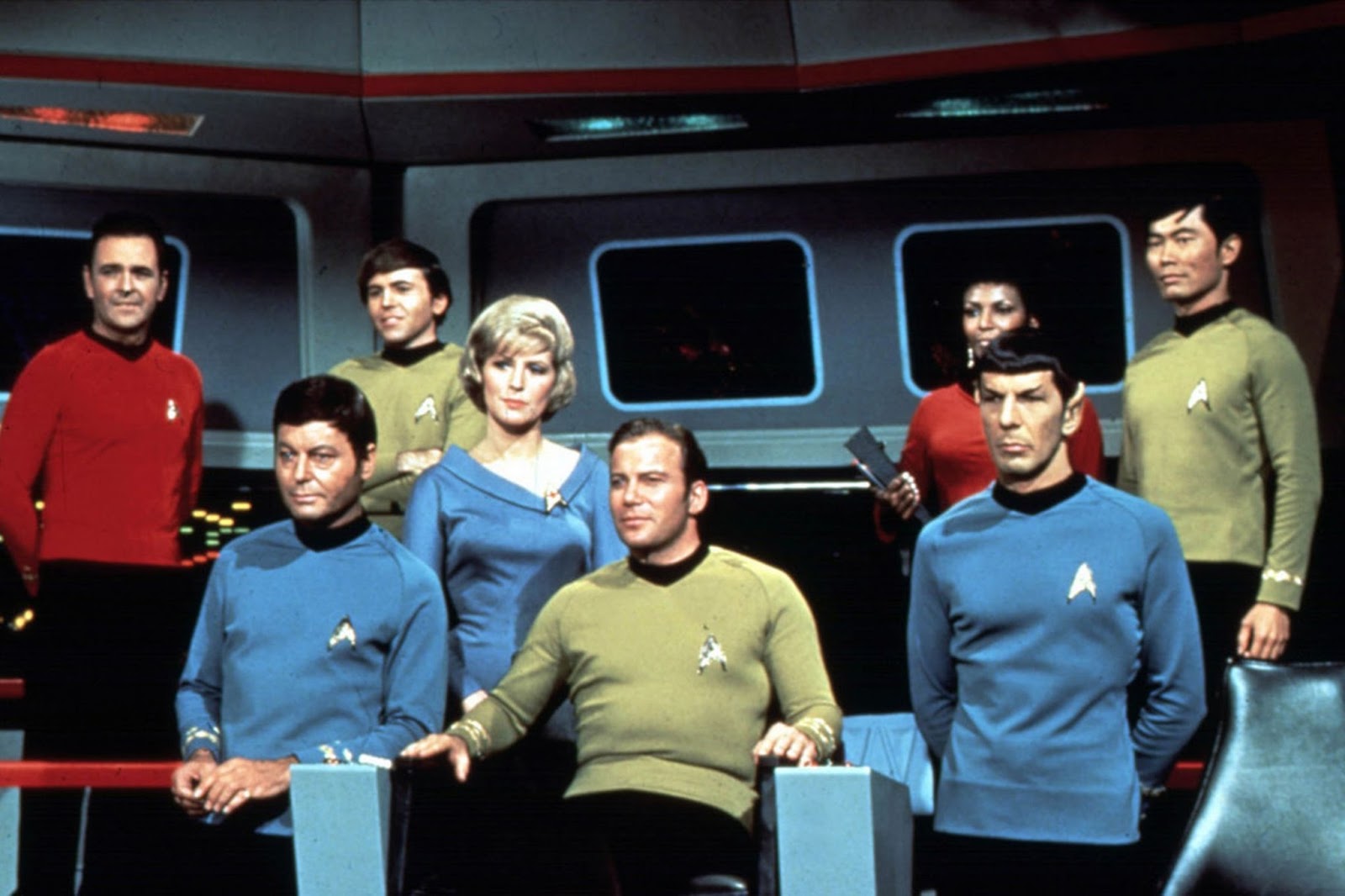
So Star Trek will celebrate its fiftieth anniversary this coming September 8.  I know people now refer to it as Star Trek: The Original Series, to differentiate it from the myriad shows that followed in the franchise…but I’ve never been one to follow the crowd.  (I’m a loner, Dottie.  A rebel.)  I suppose if I gave it a good deal of thought it’s probably because outside of TOS, I was never a huge fan of the other entries in the Star Trek universe.  Sure, I’ve watched episodes of The Next Generation and Deep Space Nine…but they really weren’t my cup of Luzianne, as it were.  They’re good television…but my personal preference is for the first series.  And I say this as someone who’s sat down with all of the Star Trek films…the only exception being the latest one, Star Trek Beyond (2016).

To cash in on commemorate Trek’s semi centennial, the Heroes & Icons channel has acquired all five series in the franchise: TOS, The Next Generation, Deep Space Nine, Voyager, and Enterprise.  They’re running them six days a week, and though H&I’s promos said they would be “back-to-back,” this really only applies to Sunday nights; Monday through Friday the block is interrupted by Xena: Warrior Princess, Hercules: The Legendary Journeys, and NYPD Blue.  H&I’s ads for the Star Trek schedule addition also boasted that TOS would be shown “uncut.”

Here’s why I’m a mite skeptical.  I pulled out my first season Star Trek set and watched the premiere episode, “The Man Trap”—and clocked that sucka at fifty minutes.  There is no way on this once-green Earth that Heroes & Icons can squeeze all those mesothelioma, catheter, and reverse mortgage commercials in the span of ten minutes.  I suspect the only way the channel can accomplish this is by subtly altering the running time of each episode by speeding it up…and I say “subtly” with a large dose of sarcasm because while they think they’re getting away with it they’re not.  FETV does this frequently with their Lone Ranger reruns, and the reason I know they’re speeding them up is that when I hear Gerald Mohr say “He was a fabulous individual…” it’s in a much higher register than the actor’s usual speaking voice.

Interestingly, my father has taken to Heroes & Icons’ Star Trek acquisitions like a duck to water.  (Well, not the last three Trek series—they air past his bedtime.)  To be honest, I thought the DISH austerity program here at Rancho Yesteryear would cause me to go cuckoo-for-Cocoa-Puffs…but it seems to be affecting the ‘rents far more.  I have to confess getting a kick out of seeing my mother yell at the television set: “There is not one goddamn thing on!”

As for me…well, I have been revisiting the show through the magic of DVD.  I’m not one of those people who read too much into the show (“It’s an allegory on the human condition”); I just enjoyed watching it as a kid (I thought Spock was one of the coolest characters on TV…and the fact that all the female members of the Enterprise wore shorty-short skirts as part of their uniform stoked my adolescent fantasies).  It still holds up…even the sub-par episodes.

Thursday, July 28, 2016

The doctor will see you now…


With enough butterflies in my stomach to attract a lepidopterist, I arrived at my appointment Thursday morning to see my newly-acquired family physician…and was not entirely optimistic.  (It’s just a personal philosophy I’ve adopted over the years—if pressed, I was probably influenced by Hope for the Best, Expect the Worst from Mel Brooks’ The Twelve Chairs.)  As I had feared, the retake on the bloodwork didn’t add anything new to the equation; the doc explained to me that in the five stages of kidney functions, I was in the middle at Stage 3—my kidneys are sluggish and not expelling wastes the way they should.  (Stage 5 is dialysis.  We don’t want that.)

The reason for the lethargic kidneys is that I am diabetic.  But here’s the rub: because my kidneys aren’t doing well on their performance evaluations, I can’t take something like the Metformin pill because that’ll do an even worse number on your kidneys.  So I will have to take insulin, and for someone who isn’t exactly leaping into large piles of money like Scrooge McDuck this will take somewhat of a financial toll.  Ask me how I know this.  Well, my father takes insulin (he, too, is diabetic) and even though he’s on Medicare a substantial amount of wherewithal is required to keep him supplied with that medication.  (There was a time when my sister Kat was in charge of a camp that catered to diabetic kids and whatever insulin was left over—since they were required to chuck it out anyway—she’d bring home for Dad.  But those days have come and gone.)

I’ll also have to make major changes to my diet, which won’t be too much of a struggle, but just as I was adjusting to this news I take a stroll down to our mailbox and I find an invoice for all that lab work.  Modesty prevents me from revealing the amount owed in the bill…but I have often joked in the past, it was big enough to be a William.  I was able to get in touch with the lab’s customer service department and negotiate a payment plan…but that doesn’t even take in what I’ll owe for the “retakes.”  Then there’s the appointment with the endocrinologist to figure out how I’m going to tackle this medical setback.  (When it rains…it pours.)

So activity on the blog will be sparse for the rest of the week—I’ve got a pair of assignments to finish up, and I can’t take on any TDOY activity until I empty out that inbox.  I do want to profusely thank everyone in both Yesteryearland and Classic Movie Bloggerland for the swell well wishes you sent my way when I first broke the news on my medical complaints.  We’ll get together here back on the blog real soon.

Monday, July 25, 2016

Keeping my hand in

In the comments section of the most recent Thrilling Days of Yesteryear blog post, I gave Jacqueline of Another Old Movie Blog fame a heads-up that there would be more prize swag to be given away this week.  I fully intended to make good on this promise…and then I got THE PHONE CALL this past Friday from the doctor’s office.  They got the results back from my blood work, and…well, long story short—I’ll be going back in tomorrow to have more of my blood suctioned because my kidney levels didn’t look too promising.  It may be that I wasn’t properly hydrated when they took my precious bodily fluids…so they want to do retakes to make sure.  Then I have another appointment for Thursday, because they want a chinwag about why some of the other tests were hinky.  To say I’m a little stressed out by all of this would be an understatement because as a rule…doctors scare the piss out of me sometimes.  I’m pretty sure this stretches back to my childhood, when going to the pediatrician usually meant I’d be taking a shot in the arm of some sort.  (Oddly enough, drawing blood or getting an injection doesn’t bother me much anymore…but I still get a sinking pit feeling every time I’m seated in a waiting room.)

I’m sure everything will come out in the wash…so in the meantime, let’s keep our fingers crossed for longtime TDOY compadre Bill “Kids! Off! Lawn! Now!” Crider.  He’s been diagnosed with, in his words, “a very aggressive form of carcinoma” and the prognosis is not particularly rosy—next stop: the M.D. Anderson Center.  He’s been one of the most fervent champions of my behavior in this scrap of the blogosphere, and it’s just not right that something this evil should happen to the definition of a very swell guy.  If you’re friends with him on Facebook, let him know you’re in his corner…if not, stop by and leave him a comment at Bill Crider’s Pop Culture Magazine.

Wednesday, July 20, 2016

A day late…but winning all the same!


My initial plan in concluding Thrilling Days of Yesteryear’s Suspense at Work giveaway yesterday was to inform the lucky winners early in the a.m…and then write up that information later in the day.  The first part of this went swimmingly; the winners of our contest were OTR historian Craig W. (a big fan of “radio’s outstanding theatre of thrills”) and longtime TDOY reader/supporter Roger S.  A copy of the Radio Spirits Suspense at Work collection (valued at $39.98) will be sent to both of these good people, and I only wish I had been able to do the same for everyone who entered (it’s an excellent set; one which I had a lot of fun writing).

The delay in making the announcement centered around the fact that I had a doctor’s appointment scheduled for that same day.  Back in May, I started to develop some blurriness with my vision…and because it had been some time since I had my eyes checked, I made arrangements with a local America’s Best for an appointment.  I thought perhaps I just needed a new prescription, but instead I was informed by the optometrist that my hinky vision problems might be a sign of diabetes…and he suggested I make an appointment with my “family physician” tor a physical checkup and some bloodwork.  I do not have a “family physician”; so my Mom made an appointment with her and my Dad’s doctor…and yesterday was the earliest I could see him.

I’m still waiting on the results from the bloodwork, but the vision problem was kind of concerning for my doc…so he was able to pull some strings and get me in to see in a retina specialist that same day.  (This, by the way, is the reason why our healthcare system will never have to go door-to-door begging for change—physicians make money sending patients to other physicians.)  The specialist was most reassuring in that I did not have any detached retinas (if you have that, you’re pretty much boned as far as vision is concerned) but he suspects my problem may be Fuchs’ dystrophy—“the disease usually affects both eyes and causes a gradual decline in vision due to corneal edema (swelling) and clouding.”  (Yes, I’ve been reading Stacia’s Big Scary Medical Book again.)  I have an appointment to see another optometrist in two weeks (this guy will also do a cataract evaluation, since I am apparently developing some of those as well).

By the time I got home yesterday, it was close to 4pm…and because I had to have my pupils dilated so the doc could get a better look at the problem I was pretty much a member of the “can’t see for sh*t” fraternity for the rest of the day.  My eyes are a lot better this morning (I’m able to type on the tablet provided I take my glasses off first), and I was able to whip this up for the blog.  So profuse apologies to all of you who were waiting on tenterhooks to find out who won in the giveaway.