Friday, February 22, 2013

In the interim

Thanks to a momentary lull here at Rancho Yesteryear, I was able to get a little blogging done for tomorrow—I’ll have a brand new installment of Serial Saturdays ready in the form of Chapter 6 of the not-quite-as-thrilling-as-I-remembered-it Don Winslow of the Navy (1942), which I’m seriously starting to regret choosing to tackle for TDOY’s semi-regular cliffhanger feature.  (This also does not bode well for doing the sequel, 1943’s Don Winslow of the Coast Guard, any time soon.)  I believe the reason for this might be that the characters in this one do silly things for the sole purpose of stretching this nothingburger out to twelve chapters, and it’s really starting to get on my wick.  (If you’re also wondering why there aren’t as many screen captures in the Winslow write-ups, it’s because the quality of this print isn’t as grand as I previously thought.  But this is the Filmcraft re-release: I shouldn’t blame on the people I bought it from—the late, lamented Heritage Hill Media. RIP.)

I also don’t want to make a promise I can’t keep…but if I can get the time this weekend there might also be a Mayberry Mondays up for Monday.  My nephew Davis is supposed to be around here this weekend to amuse the ‘rents and I with his child antics, but if I can steal away to my bedroom office MM might happen (and it’s a good one, too—“Howard, the Swinger”).  I regretfully have already broken a promise I made to the good people at Outspoken & Freckled, Once Upon a Screen and Paula’s Cinema Club to participate in their 31 Days of Oscar Blogathon—but in my defense the date I was supposed to submit something completely slipped my mind.  If things aren’t too hectic next week, I’ll try to whip something up in the lab…but the entries in that ‘thon have been so first-rate I’m not sure if there’s anything left to write about.

I thought that I’d take advantage of the time that I do have and run a few TV-on-DVD announcements by you, courtesy of TVShowsOnDVD.com.  The good news this week is that CBS DVD-Paramount is finally going to complete the library of Have Gun – Will Travel collectors by releasing the show’s sixth and final season to disc this May 7th.  My good friend Martin Grams, Jr.—author of The Have Gun – Will Travel Companion—didn’t think future HGWT collections would progress beyond the third season, so I’m glad CBS DVD is going to make this available, one of TV’s all-time best westerns.  The bad news is that like seasons four and five, Season 6 is one of those repellent split-season releases because apparently putting all thirty-two episodes in one collection is completely undoable for the people at CBS-Paramount.  Both volumes will retail for $29.98 SRP each, but you might be able to find them cheaper online if you do a little sleuthing.

Also hitting the streets on that same May 7 date will be the eighth season of venerable TV oater Gunsmoke—and even though Season 8 will follow the split-season practice (which has marked the Gunsmoke releases since Season 2), CBS-Paramount will make Volumes 1 and 2 available on the same day, as they have done with other shows like Bonanza and The Untouchables, for instance.  Both volumes are priced at $49.98 SRP (boo…hiss)—I haven’t been as quick to dip into this pond only because I recorded most of the black-and-white hour-long Gunsmokes when I still had Encore Westerns; I still plan to purchase the sets but they’re kind of a low priority right now and I’ve had to be a little conservative when it comes to putting things in my shopping cart.  I was fortunate to find both volumes of Gunsmoke’s sixth season (the last year the show was a half-hour) at Amazon Marketplace for a very good price, not to mention the two volumes that make up The Untouchables’ fourth and final season…so I’ll have to taper off the TV-on-DVD purchases for a bit.

In other boob tube western news, Timeless Media Video/Shout! Factory will wrap up their releases of The Gene Autry Show with the fifth and final season release this May 21st.  The set, which will contain all thirteen color episodes from Gene’s final TV year, will be a 2-disc package priced at $14.97 SRP.

Let’s move on to the world of crime with the announcement that the second season of Harry O became available this past February 5 courtesy of the Warner Archive.  This underrated series, which starred The Fugitive’s David Janssen for a two season run, was long lobbied for by many crime and mystery buffs…and even though it is MOD it’s great to have it available.  The Archive is selling this set—a 6-disc package containing the second season’s 22 episodes—for $49.95 SRP.

Warner Archive also has news that the fourth season of TV chestnut The F.B.I. will be available next Tuesday (February 26) in a single set…which will come as a bit of a surprise since the first three seasons were done as split-season releases.  (Update: the initial report that this would be a single set was erroneous...more here.)  All twenty-six episodes of the show that made J. Edgar Hoover a happy cross-dresser at a SRP price of $49.95—it’s a Christmas miracle, boys and girls.

But the big news in the world of television cops and robbers is that TGG Direct—the company that brought you the entire run of Sea Hunt and two out of the three seasons of western fave Bat Masterson—will be releasing seasons 2-4 of Highway Patrol to DVD this April 2nd.  Yes, the show that made Oscar-winning actor Broderick Crawford (“10-4, 10-4…”) a household name will finally find a home on disc in three 5-DVD sets priced at $24.96 SRP each.  Completists seeking out the first season will have to make arrangements to purchase the Amazon CreateSpace MOD set, which you can find here.  Highway Patrol was one of several classic TV shows (including Hunt and Masterson) that made the rounds of ThisTV—but I was never able to see it when WUGA-TV was an affiliate (it’s now a PBS station).  Maybe when we get on a more solid financial footing around here (or I marry the rich widow down the street) I can invest in the program.

Our entry in this week’s “I-can’t-believe-this-is-coming-to-DVD” sweepstakes is the news that Timeless Factory Video will be bringing the short-lived 1971 series Bearcats! to disc in a 3-DVD package (priced at $19.93) this May 14th.  The TSOD blurb doesn’t mention whether or not the show’s pilot will be included (the series originally ran for thirteen episodes—the pilot makes fourteen) but it will feature stars Rod Taylor and Dennis Cole (aka Mr. Jaclyn Smith) in a offbeat series that played a lot like a Western except that its protagonists drove around in a Stutz Bearcat.  (Kind of like Route 66, only set in 1914.)  The show had a few fans, but the competition was fierce—it was up against The Flip Wilson Show on NBC and Alias Smith and Jones on ABC…and to add insult to injury, when CBS cancelled the show in December they replaced it with one of the boob tube’s legendary stinkeroos, Me and the Chimp.  (Let me just state for the record that if Chimp ever comes to DVD, I may have to get out of the blogging business—only because by that time I will have seen enough to know that I’ve seen enough.)

Two entries in the cold-cereal-and-footy-pajamas department this week: first, Warner Brothers has a June 11 release in store for Tom & Jerry: Golden Collection, Volume 2—a two-disc collection of 42 theatrical shorts (priced at $26.99 SRP for the DVD—it will be available also on Blu-ray, too) featuring the famous cat-and-mouse team.  There is, however, a bit of controversy that has cropped up in that two of Thomas and Gerald’s animated adventures will not be included on the set—Mouse Cleaning (1948) and Casanova Cat (1951)—because of some admittedly non-PC content.  You can read all about it here at TSOD; I will reserve comment only to say I don’t agree with Warner Home Video’s decision but since I didn’t plan on buying the set (I like Tom & Jerry, but it’s not something I have to have) I really don’t have a dog in the fight (sorry about the pun, by the way).

The other collection I am kind of stoked about—the news that Warner Archive released Yogi’s Gang (1973-75) to MOD DVD this week (February 19).  The Saturday morning TDOY fave first surfaced as “Yogi’s Ark Lark” (09/16/72) on ABC’s Saturday Superstar Movie in 1972; an admittedly preachy ecological tale that features Yogi, Boo-Boo and the rest of the cartoon heroes of my youth tooling around in a flying ark looking for a place free of pollution.  Hanna-Barbera turned this pilot into a full-blown series in the fall of ’73, with much of the same sledgehammer learning-lessons content (even as a kid, I thought the hypocrisy of a bear who used to filch picnic baskets lecturing kids was a bit much)—be that as it may, I watched the show religiously because…well, look at the cast of characters: it’s like my childhood passing before my very eyes.  (Why do you think I always rooted for the Yogi Yahooeys on Laff-a-Lympics?)  All fifteen episodes and the “Ark Lark” pilot are available in a two-disc set that sells for $29.95 SRP.

A few other TV-on-DVD releases that might be of interest to the TDOY faithful:

TSOD now has a definite date on MPI’s upcoming Petticoat Junction cash-in, Return to Hooterville: 50th Anniversary Collectionit will be released on March 12 (price is $14.98 SRP).  That’s the same day the company is going to bring the 1981 TV-movie reunion The Return of the Beverly Hillbillies to DVD (priced at $14.99 SRP)—which I never bothered to watch because…well, without Irene Ryan there really wasn’t much point, was there?  (I must confess that I did see the 1993 Beverly Hillbillies movie—though I watched it in a moment of “there’s-nothing-on” cable weakness—and ask only that you not judge me.)

Finally, TSOD has the poop on the Time-Life release of China Beach: The Complete Series—a 21-disc collection (priced at $199.95) containing all 62 episodes of the cult 1988-92 series.  A little out of our jurisdiction here at TDOY, but I admire the work that went into putting it together since negotiating the music rights were a real bear.

Monday, February 18, 2013

Fabulous Films of the 1940s Blogathon: Foreign Correspondent (1940)


This essay is Thrilling Days of Yesteryear’s contribution to the Fabulous Films of the 1940s Blogathon, hosted this week (February 17-22) by members of The Classic Movie Blog AssociationFor participating blogs and the films discussed, click here for more information.  Oh, and for those of you who’ve not seen the movie I’ll discuss…be forewarned there are spoilers.


Frequent visitors to Thrilling Days of Yesteryear are no doubt aware that my viewing of offerings on The Greatest Cable Channel Known to Mankind™ has been somewhat curtailed since my parents and I decided to rent a house together: the ‘rents, as they are affectionately known, don’t quite share my classic movie mania—preferring to while away their hours in front of the TV watching sporting events or “reality” programming featuring very unpleasant individuals conversing with one another in language that is frequently bleeped for cable.  But on occasion, particularly when it’s their bedtime, I am able to steal out into the living room and turn on TCM…since the living room TV is the only set that gets Turner Classic Movies.

It’s been rough this past month, campers.  The channel is hosting its annual 31 Days of Oscar event, and many of the films on the schedule I have no desire to ever watch.  Thursday night (February 14) is a case in point: I had just settled into Count Comfy von Chair around 10 pm and used the remote to access TCM…only to find Gone with the Wind (1939) already in progress.  I have seen GWTW only one time (I agreed in a moment of weakness to watch it with a lady friend of mine, who was cuckoo-for-Cocoa-Puffs about the film) and have no desire to sit through it again because at this point in my life I simply do not have 3 hours and 42 minutes at my disposal to hand out freely.

I was going to be up for a while, so I stuck around for the movie that came on afterward—Alfred Hitchcock’s Rebecca (1940).  (Apparently it was David O. Selznick night.)  I’d already seen Rebecca as well…though in its defense, the movie doesn’t fill me with nearly the amount of revulsion as GWTW (it’s shorter, for one thing).  But as I watched Rebecca, I couldn’t help but feel that I would much rather be watching (something I rectified for this blogathon) the other Hitchcock film that was nominated for Best Picture that same year (and five additional categories as well): Foreign Correspondent (1940).

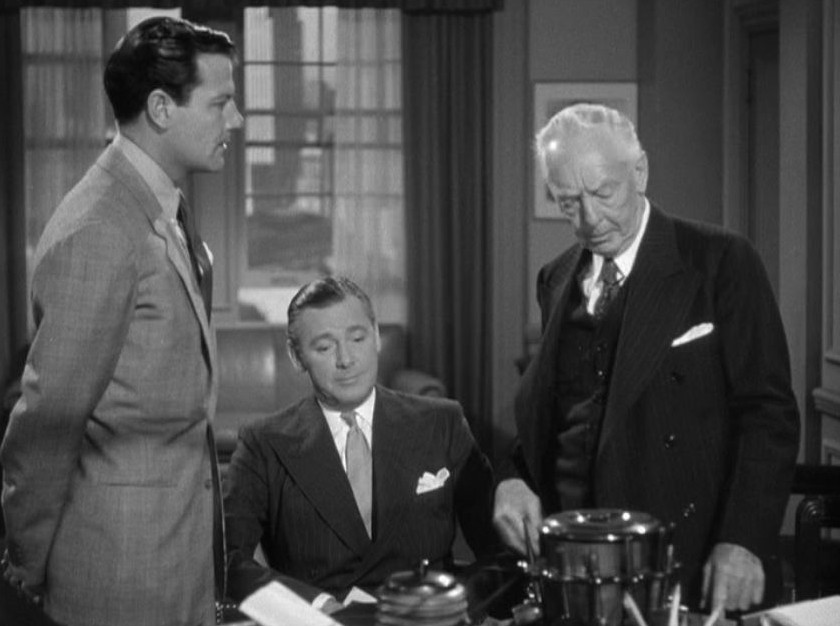
The year is 1939, with the world on the brink of the Second World War.  Powers (Harry Davenport), the dyspeptic editor of The New York Globe, is frustrated by the lack of information coming out of the European theater, and is disgusted that the paper’s foreign correspondent, the alcoholic Stebbins (Robert Benchley), cables nothing but news of crop failures.  Powers’ idea is to assign a crime journalist to cover Europe, and offers a beat reporter named Johnny Jones (Joel McCrea) the assignment.  “Give me an expense account and I’ll cover anything,” responds Jones—though he admits he’ll have to bone up on the crisis first.  Powers tells him to never mind—he wants a fresh perspective on the reporting, and after introducing Jones to Stephen Fisher (Herbert Marshall), the head of an organization known as the Universal Peace Party, sends Jones on his way…but not before giving Jones a new identity in “Huntley Haverstock.”  “’Jones’ will only handicap you,” explains Powers, apparently unaware that “Huntley Haverstock” doesn’t exactly come trippingly off the tongue.

Arriving in London, Jones meets correspondent Stebbins…and also makes the acquaintance of Dutch diplomat Van Meer (Albert Bassermann), with whom he shares a taxi as both men are on their way to an event sponsored by Fisher’s Universal Peace Party.  Jones is also introduced to Fisher’s daughter Carol (Laraine Day)—though he’s not aware of the father-daughter relationship at their first meet.  Instead, Jones angers Carol by playing the “ugly American,” criticizing their group as being run by “well-meaning amateurs.”  Johnny only learns that Carol is Fisher’s daughter when she must speak in place of Van Meer, who has sent his regrets at having been called away at the last moment.

Jones’ next assignment sends him to Amsterdam to be present at a political conference where Fisher and Van Meer will also be attending.  In fact, Johnny spots Van Meer coming up the stairs outside the building and greets him…but the diplomat doesn’t seem to recognize Johnny or remember that they shared a cab previously in London.  A photographer asks to take Van Meer’s picture, and when the diplomat acquiesces the shutterbug pulls out a concealed gun and shoots Van Meer in the face.  As the assassin makes his escape through a sea of umbrellas, Jones gives chase…and lucks into finding a car to go after the fleeing killer, with Carol as passenger and a fellow newspaperman, Scott ffoilliott (George Sanders) at the wheel.

The trail of the assassin leads to a windmill, and while Scott and Carol go off in search of the police, Johnny investigates inside…and finds Van Meer very much alive and held hostage in an upstairs room.  Van Meer reveals that his assassination was faked because the spies who are holding him captive want to spirit him away and extract a vital piece of information from him.  Jones manages to escape before the villains detect his presence, but by the time Carol and Scott return with the police, the miscreants have disappeared save for a hobo (Martin Kosleck) who says he’s been sleeping inside the windmill all day and saw no one that matches Johnny’s description.

Back in his hotel room, Jones receives a visit from two men who claim to be policemen…but Johnny quickly deduces that they’re working for the people who put the snatch on Van Meer.  He’s able to elude them with the help from a reluctant Carol; the two of them manage to board a ship back to England in the nick of time and during their trip reveal their love for one another.  Carol and Johnny then go to her father’s home to inform him about Van Meer…but Jones recognizes a guest of Fisher’s—introduced as Krug (Eduardo Ciannelli)—as one of the spies from the windmill.  Fisher tells Johnny he’ll handle the situation…and that’s when we learn that Fisher is working in tandem with the spies.  Krug suggests that Fisher employ a thug named Rowley (Edmund Gwenn) to be bodyguard for Johnny—though Rowley’s intent will really be to silence the reporter permanently.  Rowley’s assassination attempt fails when the “bodyguard” falls to his death from atop the tower of Westminster Cathedral.

Nothing ever happens in a Hitchcock film by accident.  As Johnny Jones (Joel McCrea) makes his escape from the spies at the windmill, a wooden beam and several markings form a crude caricature of Hitler, as you can see in the space to McCrea's right.
Johnny now knows that Fisher is not whom he claims to be—something that ffoilliott has also been aware of for some time, and Scott suggests they pool their resources to find Van Meer’s whereabouts and expose Fisher by pretending to “kidnap” Carol.  (In actuality, the two men talk her into taking Johnny on a trip to Cambridge.)  Scott’s blackmail attempt fails when Carol returns home unexpectedly, but he’s able to trail Fisher to where the spies are holding Van Meer and has left word with Stebbins to have Johnny follow him when he returns.

The spies are torturing Van Meer to reveal a secret clause from a treaty signed by Holland and Belgium—something Scott is forced to witness when he is captured at gunpoint by underlings working with the spies.  Scott is able to distract the spies before Van Meer can spill the beans, and as Johnny and Stebbins arrive on the scene Fisher and the rest of the spies manage to escape.  Van Meer is alive but in a coma, and he is taken to a hospital while Jones and ffoilliott book passage on a plane that both Fisher are taking to America.

On the plane, ffoilliott gets word that the authorities will be waiting to pick Fisher up once the aircraft lands because Van Meer has regained consciousness and explained the situation to the authorities.  Carol has since learned the truth about her father, but vows to stick by him despite his activities…and Johnny, desperately in love with Carol, is reluctant to see her father arrested because that might put a damper on the wedding and all.  Fortunately for Fisher, he’ll go out a hero despite being a rat—the plane is strafed by a German destroyer, and in order to save the survivors from sinking in the drink he sacrifices himself by jumping off the plane’s wing so that the others may live.  The surviving passengers are picked up by an American ship, the Mohican, and despite orders from the captain (Emory Parnell) Johnny is able to give the story to Powers at the Globe through a bit of chicanery (aided and abetted by ffoilliott).  The film ends with an epilogue in which Johnny and Carol broadcast a patriotic speech to U.S. audiences from a London studio as the city is being shelled by the Germans.

The old maxim of “too many cooks spoil the soup” does not apply to Foreign Correspondent—who employed a passel of scribes to work on the constantly evolving screenplay.  Charles Bennett and Joan Harrison were credited with the final result (and received an Academy Award nomination for their efforts) with additional dialogue by James Hilton and Robert Benchley—but Harold Clurman, John Howard Lawson, John Lee Mahin, Richard Maibaum and Budd Schulberg also contributed to the script, which was based on the memoir Personal History, written by Vincent Sheean.  The final radio studio sequence was written by Ben Hecht and grafted onto the production at the last minute, influenced by Hitchcock’s return from London in July of 1940—where he reported that Germany had plans to bomb the city at any time.  At a time when the major studios were reluctant to tackle the subject of the war in Europe for fear of cheesing off foreign movie markets this last sequence was pretty daring stuff (though it was an independent production financed by Walter Wanger and released through United Artists).

Hitchcock didn’t particularly get along with Wanger, but working on Foreign Correspondent was a breeze compared to his legendary battles with Selznick.  He was fortunate in that the notoriously finicky producer pretty much stayed out of his hair during Hitch’s work on Rebecca (since Selznick was distracted by GWTW) but by the time Correspondent went into production the Master of Suspense was already receiving Selznick’s infamous memos.  Selznick may have been willing to loan out Hitchcock to Wanger but he said no to Sir Alfred when the director wanted Joan Fontaine for the female lead, so Hitch had to make do with Laraine Day, who was best known to movie audiences at the time for her appearances in the Dr. Kildare films as Lew Ayres’ love interest (nurse Molly Lamont).  Hitchcock also ended up casting Joel McCrea as his hero when Gary Cooper turned him down (Coop wasn’t interested in making a spy thriller) but the actor later told the director “I’ve made a huge mistake” in a manner that would have made Gob Bluth proud.

Because of the casting of McCrea and Day as the leads in this film, Foreign Correspondent never really got the respect that most of Hitchcock’s major films received—though the critical reaction was mostly positive, more than a few called the movie a glorified B-film.  I think this does a disservice to the film—I’ve long championed McCrea as one of the most underrated film actors of his generation, with a range that extended everywhere from comedy to westerns…and I think Day is splendid in the film as well, acquitting herself very nicely in her role and demonstrating a rather sweet chemistry with her co-star.  Their celebrated scene on the boat back to London—in which both of them declare their love and intention to marry, prompting McCrea’s character to crack: “Hmm…that cuts down our love scene quite a bit, doesn't it?”—was supposedly inspired by Hitchcock’s real-life proposal to his future bride, Alma Reville.

In addition to McCrea and Day, I think the casting in Correspondent is one of the reasons why I have such an affection for the film…beginning with Herbert Marshall, whose suave and debonair manner makes him one of Hitchcock’s great deceptive villains—the revelation that he is part of the spy ring who’s kidnapped Van Meer comes as quite a shock, even though viewers are kind of tipped off to the fact that there’s something not quite kosher about him by the presence of a rather sinister-looking dog.  In Correspondent, actors frequently play against type: Edmund Gwenn, whom we remember fondly as “Santa Claus” from the beloved Miracle on 34th Street (1947), effectively plays a ruthless assassin.  Both Marshall and Gwenn had worked with Hitch before (Marshall in Murder!; Gwenn in The Skin Game, Waltzes from Vienna and the future The Trouble with Harry) and their performances here stand as two of the best of their careers.

Another great visual moment (in three separate scenes): an establishing shot of Jones' hotel in Holland...

...then a close-up of Johnny's typewriter, announcing to his editor he's "hot on [the] trail"...

...and punctuates this during his escape from the spies in his hotel room by accidentally putting the "E" and "L" out of commission (which also comments that the situation on the continent is indeed "hot").

My favorite character in Foreign Correspondent is the one essayed by George Sanders…and while I’m not saying that Sanders always played villainous sorts throughout his film career (he was the hero in both the Saint and Falcon film series cranked out at RKO) he had a screen persona that can be summed up in just one word: cad.  So even when he gets to be the good guy, he’s still unable to shake that taint of the roué off of him—it’s his Scott ffoilliott who suggests that the way to getting Fisher is by kidnapping his daughter (fighting fire with fire, so to speak).  (When ffoilliott thinks his bluff with Fisher has succeeded…only to learn that the information as to Van Meer’s whereabouts is simply a note that informs him Fisher heard his daughter’s car pulling up—you kind of can’t help but admire Fisher’s cleverness.)  The sequence where ffoilliott infiltrates the spies’ nest is one of the highlights of Sanders’ screen career: “I would gladly relieve the young lady of this embarrassment, but you know how women are with firearms—they have no sense of timing.”

Of course, a few of the actors in the film were cast to do what they do best: Eduardo Ciannelli, already known for playing bad guys (he made a terrific villain in the serial Mysterious Dr. Satan released that same year), is memorably menacing as the thuggish Krug…and Martin Kosleck was already on his way to becoming the silver screen’s go-to Nazi officer.  Robert Benchley, the humorist who was originally hired to write additional dialogue for Correspondent, was drafted into playing comic relief as the alcoholic Stebbins (though he explains to Jones he’s on the wagon, even comically drinking a glass of milk).  Albert Bassermann only has a few scenes as Van Meer but his performance impressed enough of his peers that he was nominated for a Best Supporting Actor Oscar (maybe it was because Bassermann spoke no English, and had to learn his lines phonetically).  Other familiar character faces in the film include Harry Davenport, Charles Halton, Ian Wolfe, Barbara Pepper, Gertrude Hoffman, Holmes Herbert and Emory Parnell (and Joan Leslie plays McCrea’s sister in the scene where his family is giving him the send-off on the boat!).

Foreign Correspondent, like most great Hitchcock films, contains so many unforgettable set pieces: the assassination of the fake Van Meer (and the wonderful effect in which the assassin escapes in a sea of umbrellas), the discovery of the spies in the windmill (the interior of which was designed by William Cameron Menzies, and it looks like something out of a Universal horror film) and the exciting plane crash of the film’s climax, which utilizes deceptively simple special effects but required a special tub for the studio’s water tank to be built to accommodate actor Marshall—he lost a leg in World War I and had difficulty swimming.  (I always make it a habit to watch Marshall in films and am amazed that the actor rarely walks with a limp.)  The cinematography by Rudolph Maté is breathtaking (Maté later became a director himself, helming the likes of D.O.A. and When Worlds Collide), the editing by Dorothy Spencer perfection and Alfred Newman’s film score—which belies the serious nature of the movie with a cheerful bounciness—is first-rate.

During my two years inside the hallowed halls of Marshall University back in the 1980s, I was fortunate to meet Hitchcock biographer Donald Spoto—who paid the college a visit in 1983 while he was promoting The Dark Side of Genius: The Life of Alfred Hitchcock.  Spoto gave a talk at a showing of Hitchcock’s Psycho (1960), but he also met with a few of us Speech Broadcasting geeks to discuss the Master’s work…and I remember telling him how excited I was that I was going to get to see North by Northwest (1959) that weekend, which Marshall’s film committee had also scheduled, along with Rebecca.  Spoto told me he wished he could be there—though he didn’t have much praise for Rebecca, jibing that “it’s a Selznick film.”  This might be why I’ve always preferred Foreign Correspondent—there’s no question that it is steeped in Hitchcock-ness, a slight tweaking of the director’s patented “wrong man” formula (the main character hasn’t been accused of a crime but is doggedly determined to solve a mystery while constantly in motion) that zips along in its two-hour running time with all the ferocity of a cliffhanger serial.  (And yes, because of its six Academy Award nominations, Correspondent will be on TCM’s 31 Days of Oscar schedule—this Thursday, February 21, at 5:45pm.) 

Thursday, February 14, 2013

Happy 39th birthday, Jack!


While in the process of writing over at the Radio Spirits blog a special valentine to the funniest man who ever walked this planet, I came across this great picture on the Internets…and while I wouldn’t be completely comfortable placing my hand on a stack of bibles, I’m pretty sure this classic Lucy Show outing from September 28, 1964 (“Lucy and the Plumber”) was my introduction to Jack Benny.  I didn’t see the episode first-run, of course (I would’ve only been a year old and I didn’t become a prodigy until I was three); I caught it in reruns because growing up, The Lucy Show was in perpetual reruns on WCHS-TV, Channel 8 in Charleston, WV and practically everywhere else.  (I’m serious about this.  If you turned the toaster to a higher setting you’d probably pick it up on that.)

I remember asking my mother who the gentleman was and she told me (I’m surprised she knew), and I guess the name just lodged itself in my childhood cranium, only to be brought up later in the 1970s when the nostalgia boom was in high gear and you could hear Benny’s classic radio broadcasts on clear channel stations if you had the manual dexterity of a safecracker (I could catch him early Sunday evenings on St. Louis’ KMOX-AM).  The episode—in case there’s someone out there who hasn’t seen it—also features Willard Waterman and another big-name comedian as Benny’s assistant.  (I wasn’t planning on giving it away...but the picture above does, so...)

Valentine’s Day means many things to many people—candy…flowers…a thoughtful card—but here at Rancho Yesteryear, we honor the holiday knowing that on this date in 1894, Jack Benny was born and gave us the gift of laughter, a present we cherish like no other.  In the meantime, I’m working on some things for the blog, so don’t wander too far out of the yard.  (And look both ways when you’re in the crosswalk.)

Sunday, February 10, 2013

Guest Review: What’s Up, Doc? (1972)

By Philip Schweier

“This is the story of a plaid overnight bag…”

So begins the opening shot of What’s Up, Doc?, a 1972 screwball comedy starring Barbra Streisand and Ryan O’Neal. I chose this movie for a number of reasons, which include Randy Quaid, who is featured in a bit part, and Madeline Kahn who made her film debut in this movie.

Actually, it’s the story of four identical plaid overnight bags, and how they somehow miraculously end up in separate rooms on the same hallway of the same hotel in San Francisco. The first bag, in the possession of a reporter, Mr. Smith (Michael Murphy), contains top-secret government. Smith is being followed by a government agent Mr. Jones (Philip Roth).

Bag #2 is owned by Mrs. Van Hoskins (Mabel Albertson), stuffed with jewels (the bag, not Mrs. Van Hoskins). It is being cased (no pun intended) by desk clerk Fritz (Stefan Gierasch and Harry, the house detective (Sorrel Brooke).

Bag #3 is in the possession of Howard Bannister (O’Neal), a mild-mannered musicologist from Ames, Iowa, visiting San Francisco for the Congress of American Musicologists convention. He is competing for the Larrabee Grant with his research on primitive music of igneous rocks. With him is his domineering fiancé Eunice Burns.

Eunice is played by Madeline Khan in her screen debut, as she introduces the shrewish demanding wife/fiancé/girlfriend she would portray in so many other movies.

In the hotel lobby, Howard runs into Bag #4, Judy Maxwell (no pun intended) played by Streisand, a brilliant but directionless young woman. Smitten with the nerdy scholar at first sight, she makes it a point to insinuate herself into Howard’s big weekend, first crashing his hotel room and later the awards dinner posing as his fiancé.

She deflates Howard’s pompous rival, High Simon (Kenneth Mars) and charms Frederick Larrabee (Austin Pendleton), who tells Howard that thanks to his fiancé, the $20,000 award is practically in the bag (no pun intended). However, love goes out the door when money comes innuendo, and in fear of blowing the $20k award, Howard denies Eunice upon her arrival at the convention dinner.

Of course, this is the first fragment of many as the mortar of Howard and Eunice’s relationship begins to crumble. Judy certainly doesn’t help when she is discovered taking a bubble bath in Howard’s room. In an effort to hide her from Eunice, Howard sends her out onto the ledge wearing only a towel, but as Howard’s efforts to keep Judy under wraps (no pun intended) only results in more chaos.

As the night progresses, it becomes a game of four-bag monty, as bag #1 is stashed in Mrs. Van Hoskin’s room, whose bag (bag #2) is stolen by the house detective and hidden under Howard’s bed, amazingly right next to Judy’s bag (bag #4). With all the bags being shuffled around from one room to another, inevitably everyone ends up with the wrong bag.

The next morning, Howard wakes up in what’s left of his hotel room, and the manager (John Hillerman) asks that he leave. On his way out, he runs into Judy, who informs him that he’s been invited to Larrabee’s home for brunch. Meanwhile, Judy overhears Harry and Fritz discussing their plans for their jewel heist, and the address as to where the exchange is to take place. She takes the opportunity to send Eunice to that location so she can accompany Howard to brunch.

Of course, the would-be thieves’ partners are none to happy to discover they’ve been handed a bag full of seemingly ordinary stones, and even less so when Eunice arrives demanding the return of Howard’s igneous rocks. Under duress, she reveals the location of Larrabee’s brunch and the other bags.

Following a free-for-all, Judy and Howard take it on the lam with all four bags. Chased through the city streets, all the major players end up in San Francisco Bay. Fished from the sea, they appear before Judge Maxwell (Liam Dunn), where Howard tries to explain what happened in his usual clumsy fashion.

It is here that the revelation that Judy is the judge’s daughter saves the day. A quick screen wipe and we’re back at the airport where everything started. Howard has his igneous rocks back, Mrs. Van Hoksins has her jewels back and is willing to split the reward for their return evenly between Howard and Judy. However, with all the property damage that has been incurred, it leaves a total of only $25 each.

The damage is done to Howard’s betrothal, and Eunice has taken up with Larrabee, who arrives with Simon, the designee of the $20,000 grant. But because Judy is brilliant, she recognizes he’s cribbed the research from a 60-year-old paper never translated into English. Howard wins.

It is on the plane back to Iowa that Howard discovers Judy in the row behind him, and as the classic 1950 Looney Tunes cartoon What’s Up, Doc? plays in the background, the two of them share a sweet reunion, complete with a not so subtle reference to another of Ryan O’Neal’s better known movies.

The film was directed by Peter Bogdanovich from a script by Buck Henry, David Newman and Robert Benton. It is a pleasantly enjoyable update of the classic screwball comedies of the 1930s and ‘40s, even going so far as to sub-reference Bringing Up Baby (1938).

I’m no fan of Streisand, but I found her con artistry ways charming in so many ways, sort of a blend between Bugs Bunny and Rufus T. Firefly. I might’ve enjoyed more roles like this from her.

O’Neal is only passably believable as the nerdy professor; too good looking to be that socially awkward. A less handsome actor might’ve worked better, but O’Neal was a hot property at the time.  (Ivan’s note: O’Neal was also chosen because of his strong resemblance to director Bogdanovich.)  And to no great surprise, Madeline Kahn was in high demand soon after, appearing in high Madeline mode in such films as Paper Moon (1973), Blazing Saddles (1974) and Young Frankenstein (1974).

I hadn’t seen the movie since a handful of TV airings in the 1970s, and now that I can appreciate the film for more than it’s not-so-subtle nod to a certain wascally wabbit, I can appreciate the film on a much higher level. It’s not a great film, but for those that haven’t seen it (or haven’t seen it in years), it worth a peek.

Monday, February 4, 2013

Classic TV Variety Show Blogathon: The Jerry Lewis Show


The following is Thrilling Days of Yesteryear’s contribution to the Classic TV Variety Show Blogathon, which is being hosted from February 3-5 by the Classic TV Blog AssociationFor a full list of participants and the shows covered, click here.


Though the title of Martin Scorsese’s 1983 serio-comedy The King of Comedy can be open to two interpretations—either the character by Robert De Niro (aspiring standup comic Rupert Pupkin) or Jerry Lewis (as talk show host Jerry Langford)—in the 1960s, it definitely applied to the latter of these two performers.  Naysayers were certain that Lewis would not be able to continue his accomplishments in show bidness after his acrimonious split with longtime crooner-straight man Dean Martin in 1957, but the comic became even more successful (as did Dean, after bouncing back from the travesty known as Ten Thousand Bedrooms [1957]) with a string of popular box office vehicles that culminated with the film Lewis devotees consider his masterpiece, The Nutty Professor (1963).  Before Professor, Paramount inked the comedian to a fourteen picture deal in 1958 that netted him $10 million, possibly making him the highest-paid movie actor in the industry at that time.  The lucrative take for his stage appearances also added to his coffers, and in late 1962 Jerry signed on the dotted line for an ambitious ninety-minute live variety-talk show that would premiere in the fall of 1963 on ABC-TV.  Eight million dollars for forty shows—nice work if you could get it at the time.

When Jerry was still with Dean, the comedy duo wowed the nation with their frequent appearances on TV’s The Colgate Comedy Hour in the 1950s; many of the team’s fans believe that those showcases came closest to duplicating the zany wildness that was their nightclub act.  So Lewis was anxious to succeed as a solo performer in TV…but alas, it wasn’t in the cards.  The comedian, famous (or infamous, depending on your point of view) for maintaining strict control over his films and other performance outlets (Jerry was “King of All Media” years before Howard Stern swiped that title), also held a tight rein on a show that ended up—in the politest phrasing possible—a complete and total clusterfudge.  The associate producer of that series must have been named Murphy’s Law, because on the technical side, anything that could did go wrong on opening night…and subsequent installments could do little to save the sinking ship.

Jerry Lewis was also experiencing problems at the box office as well.  Much as the 1950s films of Bud Abbott & Lou Costello had gradually started targeting kid audiences, so did Jer’s feature output in the mid 60s—Lewis tried to jumpstart the interest of adult fans with more mature movies (Boeing Boeing, Three on a Couch, Way…Way Out), but to no avail.  What’s more, the competitive Lewis had to be rankled by the fact that his onetime partner was conquering primetime TV with the mega-successful The Dean Martin Show…so in the fall of 1967, to television sets that were not only featuring Martin but the variety shows of Ed Sullivan, the Smothers Brothers, Jackie Gleason, Lawrence Welk and Red Skelton—as well as Rowan & Martin’s Laugh-In, The Kraft Music Hall and The Hollywood Palace—Jerry Lewis made his move.  (The fall of 1967 would also see Danny Thomas strike out with a variety hour, but usher in the success of Carol Burnett’s program that would run on small screens for over a decade.)

In an interview at the Archive of American Television, director-producer Bob Finkel takes credit for coming up with the idea that ultimately became the second primetime Jerry Lewis Show.  Finkel’s account seems plausible—he mentions having worked with Martin & Lewis during their Colgate Comedy Hour days—but it starts to go off the rails with an anecdote in which he reveals that Jerry relinquished creative control of the show to him.  (Another interview with costume designer Ret Turner disputes the “control,” saying Lewis was hands-on at all times and in every aspect of the show…which knowing what I know about the comedian is far more believable.)  Regardless of whose story you swallow, The Jerry Lewis Show premiered on September 12, 1967 in a Tuesday time slot at 8pm EST.  Though the program had a tough row to hoe in that most of its audience deserted it at the half-hour mark to watch the seventh-ranked show in the Nielsens, CBS’ The Red Skelton Hour, NBC brought it back for a second season the following year, moving it up a half-hour to 7:30.  But Lewis’ show lost its I Dream of Jeannie lead-in with that move, and found its butt kicked by the ABC series that put ten pounds of hip in a five pound bag, The Mod Squad.  Even plugs by Lewis’ old compadre Dean Martin (whose own variety hour was snuggled in the Top Ten) couldn’t save it (though in all fairness, Dino’s “Be sure to watch The Jerry Lewis Show this week…’cause I know I will!” might not have been totally sincere), and The Jerry Lewis Show vanished from the schedule.

Because it had been mostly unseen by the general public since its sayonara at the end of the 1968-69 season, Lewis fans and other curiosity seekers were excited at the news that Infinity Entertainment had plans to release a collection of thirteen programs from the show in December of 2009.  The warning signs should have been apparent: the release date for the set was pushed up a few times, and after seeing what the company did with such shows as The Real McCoys and Route 66 it shouldn’t have bode at all well…so when consumers got their hands on the set when it hit the streets they got the bad news—the shows in the collection were edited (and badly at that) twenty-three and a half minute versions of the original hour telecasts (well, including commercials) much in the truncated way that The Carol Burnett Show (as Carol Burnett and Friends) and The Tonight Show with Johnny Carson (Carson’s Comedy Classics) were cut to ribbons for syndication.  The shows open with bad graphics, bad synthesizer music…and that grating laugh of Jerry’s that makes you wonder why they would ever have to resort to torture—listening to that on a loop for an hour or so would break anyone’s free will.

Let me give you an example of the night-and-day difference between what’s on The Jerry Lewis Show: Collection and what you might find, say, on the Internets.  The December 5, 1967 telecast is available for viewing on YouTube, a show originally guest-starring Frank Gorshin and the McGuire Sisters.  The McGuire stuff is fairly forgettable, but Gorshin does do some hilarious impressions of celebrities like Marlon Brando, Anthony Quinn, Burt Lancaster, etc.  There’s also a comedy sketch in which Jerry—in his “Sidney Portnoy” persona, a character he played often on the show—arrives as a spooky old castle as a delivery boy for a fried chicken fast-food joint and runs into both a mad scientist (Gorshin doing Karloff) and a vampire (Gorshin doing Lugosi).  It’s as lame as it sounds, but anytime you have Gorshin doing two of my favorite film personalities it can’t be all that bad.

Now, this show is included on the DVD set…but contains mostly the Lewis-Gorshin skit, which also contains some horrendous edits.  There have been multiple theories as to why these shows have not been presented in their original format.  The most plausible is that the show was cut up for a possible syndicated series, given the cheesy opening and godawful graphics.  There’s also credible speculation that the shows may not survive in their complete hour-long form; a photo gallery included with the set has two pictures with Jerry and Jack Webb…who, along with Harry Morgan, was guest star on a program that apparently no longer exists (and the caption underneath the photo says they will have to cobble together the program from existing foreign kinescopes).  A third theory posits that the ever sticky wicket of copyrights might have reared its ugly head and prevented musical numbers (including many with Jerry singing—though one could argue this is not necessarily a terrible result) from being included.  If you purchased a copy of this 2-disc set, you have my sympathy at feeling like you were rooked (my copy was a Christmas present, so there was no personal financial rooking on my part); if you look at the listing on Amazon the collection is still listed at 640 minutes, which is a complete crock.

So apparently the only way to experience what was once The Jerry Lewis Show is either through this collection or random YouTube sharings (Kliph Nesteroff at Classic Television Showbiz has a second season show up here, February 5, 1969, that features John Byner and the Osmond Brothers as guests; Byner and Jerry do a funny "Governor of California" sketch and John does his Ed Sullivan impression)—and it’s apparent that the DVD release doesn’t really give you the full sense of the show.  Much of your enjoyment of The Jerry Lewis Show will depend on your personal opinion of Lewis himself; it’s my personal belief that Lewis wasn’t quite the same after the breakup with Dean Martin but I have had several people tell me I’m insane.  The only real flaw in Lewis’ variety program is that it was so very ordinary considering the person in charge—the best way to describe it is it’s like watching one of the comedian’s MDA telethons only it’s over and done with in fifty minutes.  (Again…to many this will be a blessing and not a curse.)

Lewis put together a veteran staff of writers to pen mediocre sketches for his series—two of the more interesting names on his staff were Bill Richmond, a longtime Lewis crony who co-wrote, among other Lewis movie classics, The Nutty Professor (he also turns up in some of the sketches) from time to time, and Ed Simmons, who wrote for Martin & Lewis’ radio show back in the 1950s…with then-partner Norman Lear.   (Simmons later went to work for Carol Burnett, winning a few Emmys in the process.)  The second season saw the addition of scribes like Honeymooners veteran Syd Zelinka and the team of Gerald Gardner & Dee Caruso…and though it might be because I’m biased (Gardner & Caruso wrote many scripts for The Monkees and Get Smart) I think the writing improved a little in the second season.  (Then again, Gardner & Caruso wrote the screenplay for Jerry’s Which Way to the Front? so it could be those mushrooms kicking in.)

Whatever one’s personal opinion of the program—you can’t deny that it wasn’t big-time variety at its most prevalent.  The surviving sketches on the DVD range from abominable to amusing—some of the people Jerry worked with, particularly Nanette Fabray, seemed to be enjoying themselves (Nanette appears in sketches from two separate shows—one in which she’s a policewoman who has to deal with her kleptomaniac husband, the other in which she’s a newlywed who discovers her presumed-dead husband is anything but; both feature Lewis in his “Professor Julius Kelp” character…renamed “Professor Frobischer” for the TV version); others are trapped in sketches so bad the only real laughs come from Jerry’s ad-libs.  (Audrey Meadows appears with Jerry in a Bonnie and Clyde spoof that is so unfunny Jerry remarks “Terrible!” at one point.)  The highlights in the collection are a sequence with character great Mike Mazurki as a bone-crunching lumberjack who’s being given his marching orders by marshmallow Jerry, and a sketch in which Jerry reworks the hilarious boxing sequences from Sailor Beware, assisted by Harold J. Stone (his nemesis in The Big Mouth) and Del Moore (The Nutty Professor).

You’ll also get the opportunity to see Jerry and Don Rickles square off in a sketch (which also features Dorothy Provine) in which Rickles can’t stop his perspiration (his reaction of his attempts to make out with Dorothy—“The cobra strikes!”—is a real gut-buster, too) and both he and Lewis can’t stop the ad-libs.  Shirley Jones guests in one edited show as the wife of Oriental detective Sam Leechee (played by Lewis in his not-at-all-hilarious buck teeth) which will make you wince at the insensitivity prevalent on TV at the time.  Other guests include Lynn Redgrave (who, in light of her famous feud with Lewis during the stage production of Broadway flop Hellzapoppin’, is most interesting), Janet Leigh, Barbara Feldon, Laurence Harvey and Joey Heatherton.  (It even sounds like the lineup for a Lewis telethon.)

With the cancellation of The Jerry Lewis Show in 1969, the comedian abandoned any future attempts to become a weekly variety fixture in TV families’ homes, preferring to do a season’s worth of television with his yearly MDA telethon that began in 1966 and ended in 2010 (the show didn’t end, just his participation because they ran him off).  (Though you could make a strong argument that the telethon wasn’t quite the same when they started pre-recording parts of it; some years Jerry really went on hilarious rant rampages in the last hour due to sleep deprivation.)  Die-hard Jerry Lewis fans will love The Jerry Lewis Show (and if you’re interested in a copy of the DVD, I’ll sell you mine—I even have the collectors’ cards to go with it); others will use it as just another reason to hate the French.