Wednesday, November 16, 2016

B-Western Wednesdays: Gun Law Justice (1949)


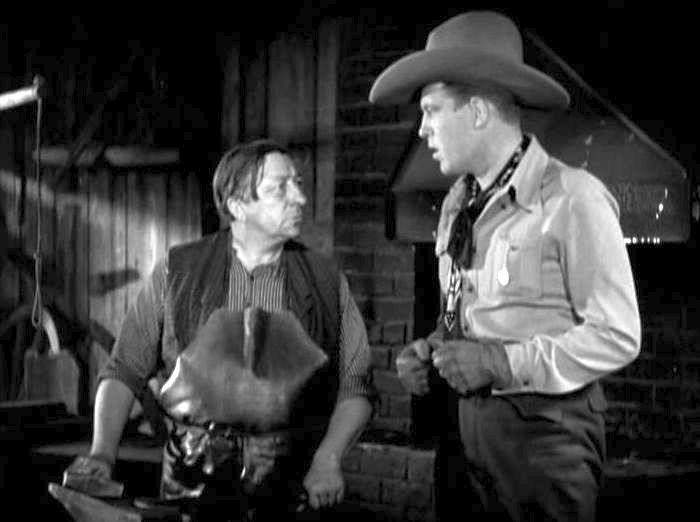
Legendary “road agent” Hank Cardigan (Lee Phelps) receives a parole after doing his boardin’ with the warden for the past ten years…and he returns to his old stomping grounds of West Bend, determined to find a job and walk the straight-and-narrow.  But if we have learned anything from dozens of Merle Haggard songs, an ex-con is not always welcomed back into society easily—Cardigan is not having much luck on the employment front, with several West Bendians noticeably hostile to his return.  Hank gets into a barroom scuffle with a pair of rowdies, and gets an assist from Jimmy Wakely (as himself)—who works for a stage line owned and operated by Jane Darnton (Jane Adams).  

Cardigan’s former protégé Duke Corlis (I. Stanford Jolley) can take responsibility for most of the criminal activity in West Bend, and one of the men in his gang is Tom Cardigan (John James), Hank’s son.  So anxious is Duke to have Hank back in the organization (he would prove a most valuable asset) that he arranges for one of his goons, Slim Craig (Bob Curtis), to stage a hold-up at the office of Bill Thorpe (Tom Chatterton), who ends up killed in the commission of the robbery.  Once again, it’s Jimmy to the rescue—he apprehends Slim, and extracts a confession from the outlaw that Hank wasn’t involved (the sheriff [Edmund Cobb] has thrown Cardigan in the sneezer, thinking he was in on Slim’s caper).   Jimmy persuades Jane to hire Hank as a stage guard despite her reservations of having an ex-con on the payroll—as for Cardigan, his loyalty to his employer and his son will be challenged before Gun Law Justice (1949) rolls out the closing credits.

I mentioned in the write-up I did last week for Strictly in the Groove (1942) that Jimmy Wakely—the poor man’s Gene Autry—would be returning to B-Western Wednesdays soon, and here I am to make good on that threat promise.  I discussed Wakely and his career at great length in Brand of Fear (1949), a previous Wednesdays write-up in 2012, so I’ll refrain from rehashing that biography.  Fear is thought to be one of Wakely’s best oaters (maybe his very best), but in reading over what I wrote it looks as if I wasn’t too impressed with it.  I did, however, find Gun Law Justice quite engaging (Boyd Magers gives it three stars at Western Clippings).

Boyd describes Lee Phelps’ turn as reformed outlaw Hank Cardigan as “the part of a lifetime,” and I’m in solid agreement with him on that score; Phelps does an amazing job portraying a man who’s wrestled with his bad man past and is quite sincere about starting a new life.  But society has a prejudice against those who’ve done time, and particularly those individuals who despite having done their penance deserve an opportunity to demonstrate that they’ve learned from their mistakes.  Cardigan’s situation when he’s immediately accused of shooting and killing Bill Thorpe (who was prepared to give his old friend a job) is particularly poignant, and were it not for our hero (go Jimmy!) would probably be at the mercy of the justice system simply due to that previous black mark by his name.  Later in Justice, several townsfolk throw a party in Hank’s honor in an effort to change his mind about leaving West Bend (Hank thinks it’s hopeless to reform son Tom), and when he’s presented with a gun as a token of their esteem his jubilance reminds Tom of “a kid at Christmas.”

Jimmy Wakely has always reminded me of a young Bing Crosby, and while he may not have been the most gifted actor in Western films, he also had an earnestness about him that suggests a little Tim Holt thrown in for good measure.  He was one of the last of the “singing cowboys” in motion pictures, and he gets ample opportunity to do what he does best with a couple of musical numbers including the Foy Willing-penned Rose of Old Santa Fe (performed with Shelby Atchinson and Ray Whitley—Jimmy’s manager at the time).  What I liked best about the musical interludes in Gun Law Justice is that they’re unobtrusive for the most part; my gripe with the Dick Foran westerns is that the songs seem to be forced in with a shoehorn.

The supporting cast in Justice is first-class:  I. Stanford Jolley—who you may remember as “Dr. Jaffa,” one of the villains in our Serial Saturdays feature of The Black Widow (1947—I really need to finish this one of these days)—is very effective as the villainous Duke (towards the end of the film, Duke is ready to double-cross his gang like the sebaceous slug he is), and other B-Western vets like Edmund Cobb and Myron Healey are also a welcome presence.  Before Dub Taylor was Dub Taylor, he was “Cannonball” Taylor—Dub used his sidekick experience along such Western film stars as Charles Starrett, Don “Red” Barry, and “Wild” Bill Elliott to make excellent comic relief for Wakely in sixteen of Jimmy’s features, and he’s in fine form here (the running gag about whether Cannonball should be entrusted to carry a gun is most amusing).  Jane Adams is also sturdy as Jimmy’s love interest (I’ve seen Jane in any number of movies [Batman and Robin, Master Minds], but for some odd reason I remember her best as the hunchbacked nurse in 1945’s House of Dracula).

Basil Dickey wrote Gun Law Justice’s screenplay; the prolific scribe contributed to scores of Western programmers/movie serials including the previously mentioned Black Widow and three other cliffhangers that have received the blog’s Serial Saturdays treatment: The Green Hornet (1940), Riders of Death Valley (1941), and G-Men Never Forget (1948).  The man in the director’s chair was also no stranger to the world of B-oaters and chapter plays; Lamont Hillyer helmed 1943’s Batman, though he’s perhaps better known for the sequel to Dracula, Dracula’s Daughter (1936).  Both Dickey and Lambert knew how to crank ‘em out fast while making sure they entertained audiences, and Justice is an exemplary example of their work—it’s available on the Warner Archive MOD release Monogram Cowboy Collection: Volume 1 (I rented it from ClassicFlix).

Monday, November 14, 2016

Book Review: Twenty Five Mystery Science Theater 3000 Films That Changed My Life In No Way Whatsoever


In retrospect, I probably shouldn’t have plunked down $4.99 to purchase the Kindle version of Frank Conniff’s Twenty Five Mystery Science Theater 3000 Films That Changed My Life In No Way Whatsoever.  It’s not that it’s a terrible book, you understand; some of it is quite funny in parts.  But once you’ve finished, you come to the realization that you’ve just digested a tome with all the nutritional value of cotton candy.  (There is, however, a reason why I bought this book…but it won’t be revealed until next week’s review, so stay tuned to this space.)

Frank Conniff is a writer-comedian-erelybout next week.e might make you want to wait until BookBub offers it up at a sale price, like the book penned by anothe who was hired as a member of the writing staff on Mystery Science Theater 3000—the cult TV classic in which people made snarky comments during cheesy science-fiction and horror movies—in 1990, a year after the series had made the leap to national prominence on cable’s The Comedy Channel (later Comedy Central).  (MST3K had begun in 1988 as an offering on Minneapolis’ KTMA-TV.)  Conniff then demonstrated a flair for the buskin playing “TV’s Frank,” the bumbling assistant to mad scientist Dr. Clayton Forrester (Trace Beaulieu), and was eventually assigned the task of selecting the movies that would be riffed on the show.  (Conniff once stated that he would often have to sit through twenty godawful films in their entirety to find the perfect piece of odious cinematic fromage for the MST3K treatment.)

“I could try to remember all the celluloid water closets I viewed, but I don’t think my psyche could survive such a tortuous thought experiment,” Frank writes in the book’s foreword.  “So I have narrowed it down to twenty-five films.  I will talk about the effect they had on me and how those films changed my life in no way whatsoever.  I will mention a few other movies that we didn’t riff on MST3K and also talk about any other useless crap that happens to pop into my head.”  I think Conniff should have bolded and italicized that last part of the sentence; I was looking forward to reading a book where the author gives us a history on the nuts and bolts of an entertaining TV show…and instead, he seems to be addressing the audience at an open mike night.

Occasionally, Conniff offers up some entertaining anecdotes on some of MST3K’s most notorious efforts—take this section on one of the show’s legendary bad movie takedowns, Manos: The Hands of Fate (1966):

I am partly responsible for Manos: The Hands of Fate’s status as one of the most famous bad movies ever made.  Knowing this, would you feel bad if you saw a temperamental Italian guy beating me to within an inch of my life in the middle of an open fire hydrant on a New York City street during a hot summer day?  If you saw me kick my feet through a car window as I was being strangled to death, wouldn’t you feel worse for the window than you would for me, knowing that I was one of the main reasons you are aware of Manos: The Hands of Fate?

It happened one day at the Minnesota offices of MST3K in beautiful downtown Eden Prairie.  I pulled a VHS copy of Manos out of a box of screeners.  I watched it and I knew it was a film that Mystery Science Theater 3000 had to do.  My colleagues agreed with me, and the world as we know it was never the same.  In the world of cheesy movies, Manos: The Hands of Fate is my original sin, and there’s not a rosary bead long enough to atone for what I did.

Other chapters in Frank’s book included such delightful slices of Camembert as It Conquered the World (1956), The Amazing Colossal Man (1957), Santa Claus Conquers the Martians (1964), and yes, the ever-popular Mitchell! (1975).  In his section on Bride of the Monster (1955), Conniff observes of the notorious Edward D. Wood, Jr.: “Yes, his movies are what noted film theorist Sergei Eisenstein would call batshit.  They are poorly written, directed and acted.  Anything that might be taught in a school for the arts was never taught to Ed Wood.  All of his movies would get a failing grade in a film class.  Hell, they’d get a failing grade in shop class.”

The problem I had with the book is…I’m only a casual MST3K fan.  I watched the show, but at the risk of courting blasphemy, I wasn’t what you would call a dedicated disciple.  It would have been nice if Conniff had included a plot description in each of the entries (on some of them he does…but most of the time he’s depending on whether or not you remember the movie).  In one such chapter on The Girl in Lover’s Lane (1960), he decides to do an extended riff on teen sexuality—as in an observation on the squeaky-clean June Allyson: “A good actress and a delightfully wholesome screen presence, she sent a message to America that said, in essence, ‘Hey, kids, I’ll keep it sexless up here on the movie screen, so you guys can make things as sexual as possible in the theater seats’…It’s quite appropriate that The Stratton Story helped many kids get to first base.”

At the end of each chapter, there’s an amusing device known as the “F.B.I. Obscure Reference Task Force Report”—which explains to the reader what some of the pop culture references that went sailing over their heads mean.  “Did you know that The Stratton Story is a baseball film that starred Jimmy Stewart and June Allyson?  No?  Then you probably didn’t get the first base joke.”  Some of this is genuinely hysterical (like explaining who Grady Sutton was), but to be honest—if you didn’t have a working knowledge of pop culture, I question your commitment to watching MST3K in the first place.

This book will probably be best-received by the MST3K faithful—and even though I wasn’t as committed to the show like some folks I know, it did provide some hearty guffaws while I perused its chapters.  But its skimping on substance might make you want to wait until BookBub offers it up at a sale price, like the book penned by another MST3K alum which I’ll talk about next week.

Friday, November 11, 2016

Forgotten Noir Fridays: Danger Zone (1951)


I’ll get the disappointing news out of the way first.  Despite the title of this week’s Forgotten Noir Fridays entry, there is no music from Kenny Loggins in this film.  (Some of you may not be disappointed.  I’m not here to judge you.)  Instead, we’ll traverse the renowned piers of San Francisco, where Dennis “Denny” O’Brien (Hugh Beaumont) rents boats…and on the side, plies his trade as a part-time shamus.  A casual drop-in at an auction parlor will set in motion O’Brien’s hooking-up with Claire Underwood (Virginia Dale)—an enigmatic woman who asks O’Brien to bid on an equally mysterious suitcase (the final bid is a thou).  What’s in the suitcase? Pulp Fiction fans might be asking.  Just a saxophone—but there must be something valuable in it, because a man named Larry Dunlap (Ralph Sanford) is very interesting in obtaining the musical instrument…at all costs.

O’Brien has no sooner solved The Singular Affair of the Special Sax when he’s hired by con man Edgar Spadely (Tom Neal) to escort socialite Vicki Jason (Pamela Blake) to a party aboard a yacht.  Once aboard, Denny discovers it’s a set-up: Spadely snaps a candid of Vicki giving O’Brien an oxygen-deprived kiss for the benefit of her husband Arnold—Mr. Jason is planning to sue his wife for divorce, and O’Brien is a ready-made co-respondent.  While Dennis may be many things, he refuses to play the sap for anyone…but when he pays Arnold Jason a visit, he’s greeted by his murdered corpse.

Anytime you watch a movie that focuses on two plots in less than an hour’s running time—Danger Zone (1951) clocks in at 54—it’s a tip-off that it’s essentially a couple of half-hour television shows stitched together to make a feature.  (Imagine how ripped off you would feel if you plunked down your hard-earned cash at the theatre box office, only to discover you’ve seen it previously for free on the small screen.)  And that’s pretty much what Danger Zone is: two episodes of a never-aired syndicated series that someone at the Robert L. Lippert movie factory thought: “Well, hell—let’s see if we can make some money off this!”

What I found so fascinating about this—because I’m not going to mince words; Danger Zone is not a particularly good movie—is that while I watched this presentation it all seemed so familiar.  A guy who rents boats moonlighting as a private eye?  Who exchanges sarcastic, hard-boiled banter with his nemesis on the police force (Lt. Bruger, played by Richard Travis)?  And has a sidekick in the besotted ex-professor Frederick Simpson Schicker (Edward Brophy)?  It all sounds eerily similar to Pat Novak…for Hire.

Pat Novak…for Hire was one of several programs that future Dragnet creator Jack Webb worked on during his stint at ABC affiliate KGO in San Francisco, where Webb had relocated in 1945 after doing his bit in WW2.  Despite its brief time on the air (the show ran on KGO from 1946 to 1948—with Webb jumping ship in the spring of 1947 to be replaced by Ben Morris), it has acquired a cult reputation among old-time radio fans.  (Webb resurrected Novak for the ABC Network in February of 1949, staying with the program until it was cancelled in July.)  The dialogue on the show, written by Webb crony Richard L. Breen, was the epitome of hard-boiled parody, and the program featured first-rate support from radio veterans such as Raymond Burr (who played Hellman, Novak’s verbal sparring partner) and Tudor Owen (as the soused Jocko Madigan, who ironically referred to his shamus pal as “Patsy”).

When Jack Webb left KGO, it was for bigger and better things: he found regular work on ABC’s Murder and Mr. Malone (based on the detective created by Craig Rice, a.k.a. Georgiana Ann Randolph Craig), and made the rounds on such programs as The Whistler and Escape.  For the Mutual Radio Network, he put together a virtual Pat Novak clone that premiered on April 23, 1947 as Johnny Madero, Pier 23.  The cop who made life miserable for Madero (Webb) was renamed Inspector Warchek (played by The Man of a Thousand Voice, William Conrad), and the Jocko character became “Dipso”—before it was changed in the second broadcast to the sober waterfront priest Father Leahy (Gale Gordon).  (ABC had planned to file suit against Mutual for plagiarism, so Mutual retooled their show to make it less like Pat Novak, to which ABC still owned the rights.)  Johnny Madero ran on Mutual until September 3, 1947…and though the show was popular enough to generate publicity that the show would return to Mutual on several occasions, that was the last boat Madero rented as far as he was concerned.  (The popularity of Madero convinced ABC to resurrect Novak on the full network in 1949, once Webb left CBS’ Jeff Regan, Investigator.)

I mentioned the similarity of Danger Zone’s plot to the Novak series to film historian Richard M. Roberts in an e-mail, and he did confirm for me that any similarities between the two are not coincidental.  “Lippert had shot episodes for syndication then pulled the plug and cut them into three feature films,” he informed me—the other two being Pier 23 (1951) and Roaring City (1951—both coming to a nostalgia blog near you soon).  RMR is the go-to guy for all things Lippert/Kit Parker; the Forgotten Noir DVD on which Zone makes its “co-hit” appearance showcases him in a featurette on Phillips H. Lord (the same VCI release features David Harding, Counterspy [1950]—previously covered on the blog) and in that “recreated” interview with Robert L. Lippert, Jr. that I mentioned in last week’s review of The Big Chase (1954), it is Richard who essays the role of Robert, Jr.  (ACT-ing!)  It would appear that Johnny Madero, Pier 23 was the main inspiration for the aborted Lippert series (Madero scribes Herbert Margolis and Lou Morheim are credited with Zone’s screenplay); the first story in Zone was even broadcast in radio form on Johnny Madero June 26, 1947 (though it’s entirely possible the script could have been recycled from Novak).

Now that I’ve learned why I experienced profound déjà vu while watching Danger Zone—how is the movie?  Well, look…on Leave it to Beaver, Hugh Beaumont had no peer among TV dads (though my buddy Jeff Stewart has always made convincing arguments that Ward Cleaver was a terrible role model where fathers were concerned)—but his sideline as an ordained Methodist minister often kept him from being truly convincing as a hard-boiled gumshoe (Beaumont played “Michael Shayne” in a series of B-flicks for PRC in 1946 and 1947).  I will, however, give props to character great Ed Brophy for tackling a role waaay out of his wheelhouse; as the erudite but smashed Schicker, Ed makes you forget temporarily that he cornered the market on none-too-bright sidekicks (Larceny, Inc., The Last Hurrah) in the flickers.  The rest of the performers in Zone—Tom Neal, Pamela Blake, etc.—manage not to bump into the furniture and get the work done…but there’s nothing really memorable about their acting turns.

I might have enjoyed Zone more if I wasn’t familiar with its old-time radio connection—in its favor, it’s a heck of a lot better than Fingerprints Don’t Lie (1951) or Mask of the Dragon (1951), two Lippert films that did the reverse: entertain (or put to sleep, depending on your opinion) audiences before resurfacing on TV.  But in what is rapidly becoming a mantra here at Thrilling Days of Yesteryear: the movie is short-and-sweet, and once you’re done your schedule is freed up to pursue a life of religious fulfillment.

Wednesday, November 9, 2016

B-Western Wednesdays: Moonlight on the Prairie (1935)


Cowpoke Ace Andrews (Dick Foran) and his sidekick “Small Change” Turner (George E. Stone) are in search of work after the carnival employing them hangs up its “out of business” sign (Andrews is a trick rider, Turner an “escape artist”).  Their unemployed status finds them drifting back to Ace’s old stomping grounds of Wagon Wheel Gulch…but for some of the townsfolk, Andrews is persona au gratin—he’s still a “person of interest” in the murder of Butch Roberts, a local rancher.  There was bad blood a-plenty between the two hombres—Ace threaten to kill Butch if he ever caught him mistreating a horse again—and legal shyster Buck Cantwell (Robert Barrat) seems to have a vested interest in making certain Ace checks into The Grey Bar Hotel.

Butch’s widow Barbara (Sheila Mannors) arrives in town not long afterward, with her young son Dickie (Dick Jones) in tow.  Under the terms of Butch’s will (Barbara left her husband not long after they tied the knot when she found out what a wanker he was), Dickie must live on the ranch until he’s 21 for he and his ma to inherit the place…and if the Roberts aren’t on the property by midnight (thirty days after Butch is buried) that evening, they lose everything.  Barbara can’t get anyone in town to escort her out to the ranch, but once Ace learns all the details, he volunteers his and Small Change’s services.  The two men are momentarily detained by the town sheriff (Joseph King), who throws them into the hoosegow on the orders of Cantwell.  But the lawman isn’t convinced of either man’s guilt, and doesn’t make too concerted an effort to secure the door to their cell (allowing them to escape and high-tail it out the back).

Ace and Small Change meet up with Barbara and Dickie on the way to their ranch…and though Luke Thomas (Joe Sawyer)—who’s been running the spread since Butch’s death…and bleeding it dry—does everything in his power to make sure they don’t meet the deadline (including sending a wild horse stampede their way), Ace gets Dickie on the property with two minutes to spare.  Andrews is convinced that both Luke and Buck found out about the terms of Butch’s will and dispatched Butch to the Happy Hunting Ground…and he’s able to prove it before the movie’s sixty-three-minute running time ends.

Moonlight on the Prairie (1935) was the first of fourteen westerns Richard “Dick” Foran (that’s how Foran was billed on the posters, btw) made for Warner Brothers between 1935 and 1938…and while I’ll admit I’m not much of a fan of these oaters (Foran’s warbling as “The Singing Cowboy” gets wearisome after a while) I was very entertained by Prairie.  (Boyd Magers at Western Clippings isn’t as generous as I will be—he gives Prairie two stars.)  I particularly liked how the film kicks off with the slam-bang B-Western action from the get-go, with Ace at the reins of a speeding stagecoach being attacked by outlaws.  (It’s then revealed that this is all part of his carnival act.)

George E. Stone, the character actor fondly remembered as “The Runt” in all save two of the movies in the Boston Blackie film franchise, is a wonderful asset as “Small Change” (the Roberts kid calls him “Chicken Feed,” much to my amusement).  There’s a running gag in Prairie where Small Change is always hungry (might be a tapeworm) and when Ace tells him they either don’t have time to eat or no money, he tightens his belt another notch.  Once they hit Wagon Wheel Gulch, the two men decide to raise “eating money” in a saloon by passing the hat after Ace sings Covered Wagon Days (with Small Change on guitar).  It turns out the money won’t be necessary; a friend of Ace’s offers to stake them to a twenty-pound butt steak…and Small Change eagerly awaits the first meal he’s had in days.  The problem is: he’s trying to escape from being hogtied by a few of the saloon’s barflies (he’s demonstrating his escape prowess) …and by the time he works himself free the cook has gone home for the evening!  (Small Change finally gets his chow on in a funny sequence just before the end of the picture.)

Sheila Mannors makes for a lovely leading lady, and she’s feisty as well, slapping villain Joe Sawyer (whose character of Luke Thomas is pretty much in his cups for the entirety of film) when he needs it while fending off the amorous advances of Robert Barrat’s Cantwell.  I’m not normally a champion of kid thespians as you are well familiar…but I liked Dickie Jones in this (hey—he played Henry Aldrich on radio at one time) and was chortling that his character’s name is “Dickie Roberts,” because it seems appropriate for a child star.  (Get it?  Dickie Roberts?  (Former) Child Star?  Okay, the staffer who assured me the David Spade reference would kill—off the payroll.)  Of course, I shouldn’t leave out the contributions of Foran’s noble steed “Smoke” (who even gets second billing in this!), a horse who comes to the rescue when the chips are down.  (Though Smoke is no Trigger, who probably looked up from his Advanced Math homework at his rival’s antics and just whinnied.  His homework is in Trigger-nometry, you know.  Oh, yeah…that writer is dead to me now.)

Moonlight on the Prairie is competently directed by journeyman D. Ross Lederman and scripted by William Jacobs (he adapted his story, “Boss of the Bar B Ranch”) Fortunately for me, I have only one more Dick Foran western to get through and then he’ll no doubt disappear from B-Western Wednesdays for a while (unless The Greatest Cable Channel Known to Mankind™ schedules more of them soon).  Moonlight on the Prairie is an exception to Foran’s sagebrush oeuvre, however, and it’s available on the Warner Archive MOD collection Dick Foran Western Collection.

Monday, November 7, 2016

Book Review: W.C. Fields for President


Godfrey Daniel!  If it seems rather coincidental that this week’s Thrilling Days of Yesteryear book review earned a berth on the blog post schedule due to last week’s essay on Sally of the Sawdust (1925) …well, you’re half-right.  I mostly timed this to coincide with Election Day tomorrow, when our long national nightmare will be over…and the serious drinking can begin.  (So it’s understandable that I would think of Fields.)

I’ve tried to be good and not rant about politics on the blog this year (if you follow me on Facebook or Twitter, however, those outlets honor no such rule—which has not endeared me to some of my social media colleagues) but whatever side of the fence you’re on, I think we can agree that our rotted-with-corruption political system has saddled us with two of the most unpalatable president candidates in the history of the republic.  As such, any respite from this horrible contest—be it baseball or the 50% off Criterion sale at Barnes & Noble—should be welcomed with more than just open arms…it should be invited into the house and bade sit a spell.  (There are a couple of Blu-rays calling my name at Kino-Lorber, where they’ve considerably marked down some noir titles.  Better luck next time, B&N.)

A month or so back, I got a heads-up from BookBub that the Kindle edition of W.C. Fields for President was on sale for $1.99.  So, I plopped down two wrinkly dollar bills for the privilege of reading musings from one of my comedy idols.  (Had I not already voted via absentee ballot, I might have written in The Great Man as my candidate of choice.)

William Claude wrote his presidential manifesto in 1940—the same year that his former movie nemesis Gracie Allen (from International House and Six of a Kind) also threw her chapeau into the ring as a candidate for the Surprise Party (insert gratuitous Radio Spirits plug here).  It’s been reprinted many times in the interim (in several editions as, if I may quote friend of the blog “Mr. Television,” an actual book), because its parody remains timeless.  “I am truly a candidate with both feet on the ground,” Fields writes in President.  “I take no fol-de-rol from any man, much less any fiddle-faddle.  And when, on next November fifth, I am elected chief executive of this fair land, amidst thunderous cheering and shouting and throwing babies out the window, I shall, my fellow citizens, offer no such empty panaceas as a New Deal, or an Old Deal, or even a Re-Deal.  No, my friends, the reliable old False Shuffle was good enough for my father and it’s good enough for me.”

What I have always revered about The Great Man is his love of the English language (I’m constantly using Fieldsian exclamations in real-life, like “Mother of pearl!” and “Suffering sciatica!”) and it’s this affection for words that makes W.C. Fields for President an entertaining read.  The book is divided up into several sections:

1. Marriage: Since approximately half the population of the United States is made up of the fairer sex, any President worthy of the name should be familiar with the intricacies of the matrimonial problem—unless he wants to change his residence from the White House to the château de la chien (doghouse).

2. Income Tax: The major responsibility of a President is to squeeze the last possible cent out of the taxpayer; thus he should be at least familiar with the intricacies of the ransom notes that the Internal Revenue Department sends out each spring.

3. Resolutions: If the chief executive is not an expert in the art of making resolutions, how can he hope to break his (Ivan’s note: Or her) campaign promises gracefully?

4. Etiquette: At a state dinner, should the Nazi ambassador be served Chateaubriand a la Marseillaise?  Failure to understand this delicate question might well plunge our nation into war.

5. Physical Fitness: There is no room in the White House for a man who is afflicted with barber’s itch, spots before the eyes, hang-nails or housemaid’s knee.  A President must now how to keep himself fit—else who would throw out the first ball at the Washington Senators’ opening game?

6. The Care of Babies: Shall didies be folded square or triangular?  This is the burning question of the day, and the better the candidate understands the little darlings, the more competently he can decide the issue.

7. Business Success: If he knows nothing else, a President should at least understand the secret of success in the business world.  For, after all, what is the Presidency but a glorified business—or, at least, a fine racket?

Topicality in comedy is always endangered by an expiration date…so some of the humor in the Fields book doesn’t wear well (the Nazi ambassador gag is a good example) and there are inarguably jokes that will sail over the heads of readers who took a lot of naps in their high school history classes.  But as Shakespeare wrote in King Lear: “Jesters do oft prove prophets.”  There is much truth in W.C.’s political humor, including one of my favorites: “At any rate, here is my best advice on the matter of deductions: just count off on all your fingers all the items you suspect might be deductible…and then forget them, because they aren’t.”

This latest edition of W.C. Fields for President was re-released in February of this year from Taylor Trade Publishing (Rowman & Littlefield) and features a foreword by the “Raconteur to the Stars,” Dick Cavett.  I have a lot of respect for Dick, but I’ll admit he doesn’t endear himself to me whenever a major celebrity passes on…because they usually collar Cavett for a TV program to remember the deceased and he has difficulty shutting the hell up when needed.  But this bit in Cavett’s introduction did produce a rather audible snicker: “The late Dorothy Kilgallen, best known for being the ‘What’s My Line?’ panelist who reportedly punched a tiny hole in her blindfold to more easily identify the ‘Mystery Guest’ before anyone else could…”  (I laughed at this—and I realize this is going to make me sound like Cavett—because it reminded me of an observation Fred Allen once made to a friend about Kilgallen and Arlene Francis on Line: “They really want to win this thing!”)  Dottie wasn’t a fan of Fields, remarking “Friends keep telling me how funny W.C. Fields is.  I looked at two of his movies.  He is not funny.”

I suspect Kilgallen would get on famously with my mother—as for me, I agree with Mr. Cavett that Dot’s observation vies for “Dumbest Remark Ever Made About A Comedian.”  (Though Dick’s memory is jogged by a letter received at The Jack Paar Show—where he toiled as a joke writer—from a viewer asking why Paar kept inviting Jonathan Winters on.)  My point—and I do have one—is that if you’re a fan of W.C. Fields, you will love this book.  If not…well, I can’t help you.  In the immortal words of our candidate: “Remember, folks, cast a vote for Fields and watch for the silver lining.  Cast several votes for Fields and watch for the police.”  I thank you.

Sunday, November 6, 2016

“I tell the kids, somebody’s gotta win, somebody’s gotta lose. Just don’t fight about it. Just try to get better.” – Yogi Berra


Congratulations are in order (as well as a laurel and hearty handclasp) to Ray R., who was the winner of the blog’s Fibber-Gildy giveaway (oh, there’ll be champagne corks a-poppin’ in the streets of Minnetonka tonight!).  Copies of the Radio Spirits collections Fibber McGee & Molly: Cleaning the Closet and The Great Gildersleeve: For Corn’s Sake will soon be winging their way to Ray, and the only down note about this is I wish I could have handed out sets to everyone who entered (particularly since the response was outstanding!).

But be of good cheer, Charlie Brown: Thrilling Days of Yesteryear will be offering another opportunity to win some free old-time radio swag in two weeks, so keep your eyes peeled for the announcement.  Congrats to Ray, and remember: Thrilling Days of Yesteryear is the phrase that pays!

Friday, November 4, 2016

“Thirteen…thirteen children, and I love…I love them all. And I think I’ve been a good father to all of them.” – Anthony Quinn


In the future, when someone has perfected time travel, I hope no one takes that WABAC machine to November 4, 2003 and informs me that the little “blog” I have decided to start will still be going strong thirteen years later.  Only because I’ll probably have a hearty chortle at that traveler’s expense.  Honest to my grandma, I never thought Thrilling Days of Yesteryear would last as long as it has…but it has.

To be honest—I gave serious thought earlier this year to folding up TDOY’s tent and riding on to other small towns that needed a sheriff; not because I didn’t enjoy writing posts (I love that new blog smell after I’ve finished one) but because I had kind of slipped into the nasty habit of neglecting the site, primarily to this crippling laziness that I have had to cope with nearly my entire life.  The temporary DISH Austerity Program here at Rancho Yesteryear yielded positive results in that it was a catalyst in getting my fat, sloppy carcass into gear and start once again being productive; when the Program went into receivership, I was worried that I would resort to my previous slothful ways.  But 2016 has already administered a beatdown to the previous year in terms of postings (50 in 2015…99 and counting in 2016), and though I am concerned about the backlog of movies building up on the DVR, I’m gambling I can address that issue in February of the next year—when The Greatest Cable Channel Known to Mankind™ is running 31 Days of Oscar.

I’ve even—against my better judgment, I know—rejoined the ranks of Twitter, and it’s every bit as awful as I remembered when I said “no mas” back in May.  But the classic movie folks there are damn good people, so they make the tweeting experience a positive one.  If you’re interested, my Twitter handle is @tdoyleft.  Looking forward to saying “hidy” to you.

I’m going to cut the blogiversary commemoration short (if you hear weeping, that’s me—because I can’t enjoy cake and ice cream with you) but I do want to remind you that TDOY’s latest giveaway (a chance to win the Radio Spirits Fibber McGee & Molly collection Cleaning the Closet and The Great Gildersleeve set For Corn’s Sake) ends Saturday night (November 5) at 11:59pm EDT.  You need to follow the directions here if you want to enter (the responses have been very encouraging!).  I want to thank each and every member of the TDOY faithful for sticking with the blog all these years (even during its fallow periods) and wish all you cartooners a great weekend.

Forgotten Noir Fridays: The Big Chase (1954)


At the dawn of the brief 1950s 3-D movie fad, independent producer Robert L. Lippert wrote out a check for $30,000 and commissioned his son, Robert, Jr., to direct Bandit Island (1953), a 26-minute color short starring Glenn Langan, Lon Chaney, Jr., and Jim Davis.  It would be the junior Lippert’s directorial debut (also his last excursion behind the camera), filmed in four days with no script—just action, action, and more action (the three-reeler takes a kitchen sink approach to 3-D with people throwing things into the camera, actors shooting at the camera, and actors leaping at the camera).  To keep costs low (a typical Lippert oater, for example, was budgeted at $75,000), Robert, Jr. called in a lot of favors—even Lon, Jr. agreed to work for scale.  (Robert II would later be fined because he was not a member of the Director’s Guild at the time he sat in the chair with his name on the back.)

Robert, Sr. clearly was a man devoted to the concept of recycling…because nine months later, the entirety of Bandit Island was incorporated into a feature film entitled The Big Chase (1954).  To pad Chase out to an hour’s running time, a script was conjured up by Fred Freiberger (later of The Wild Wild West and Star Trek fame) with a framing story (directed by Arthur D. Hilton): reporter Milton Graves (Joe Flynn!) is interviewing LAPD’s Lt. Ned Daggert (Douglas Kennedy) for a story on criminal procedures when Graves notices both a baby’s rattle and a revolver on Daggert’s desk.  Pushed into revealing the reason why (though it’s not much of a push), Daggert tells the reporter about a friend of his, Pete Grayson (Langan), a Korean War vet who decided to enroll in the police academy and pursue law enforcement as a career.

On Graduation Day, Grayson must settle for patrol duty until there’s an opening in the Juvenile Division (Pete was once a delinquent yute, and yearns to straighten out other young hoodlums) …even though Lt. Ned has the juice to get him a slot with the Detectives Bureau.  Grayson’s wife Doris (Adele Jergens), who is great with child, is worked up enough about Pete’s police work—she’s relieved when he promises her he won’t become a detective.  Her pregnancy is going to be a walk in the park, however; the doctor prescribes bed rest due to some signs of anemia, prompting Pete to don the comical apron as he prepares his and her meals.

Meanwhile, in the Big House, convicts Brad Bellows (Davis) and Jim Miggs (Jay Lawrence) have been released from the joint and are planning a robbery in L.A. with the help of a stolen Chrysler convertible.  Alerted to this, Daggert pays a visit to motel court manager Monty Nicholas (Jack Daly), who lets spill that his ex-wife Ginny and a confederate named Kip (Chaney) are also in on the caper.  After dropping Doris off at the hospital when she starts experiencing labor (it turns out to be a “false alarm”—but the doctor has now determined it’s going to be a breach birth), Pete and a rookie get word that Bellows, Miggs, and Kip have killed the driver of an armored truck while robbing it.  The two cops give a merry chase to those miscreants; and that where’s the action footage of Bandit Island takes over.

I think it was a good idea that Robert L. Lippert, Jr. abandoned the idea of motion picture directing as a career.  His strength was purportedly in film producing and editing, but as a director he falls short of the mark.  I say this because if you can’t make an action sequence exciting (well, there’s a nifty fall from a police helicopter…but that’s about it) you’ve chosen the wrong path in the business.  The Big Chase is not a good motion picture (Lippert, Jr. even admitted this to noted Olsen & Johnson fan Tom Weaver as one of the interviewees in the 2005 McFarland book Earth vs. the Sci-Fi Filmmakers; the conversation between the two men is “recreated” in audio form as an extra on the Forgotten Film Noir Vol. 7 DVD), but if a pro like William Witney or John English had been at the helm of Bandit Island, it follows that The Big Chase might have been salvageable.  (As of this writing, Bandit Island is not known to have survived, and is considered a lost film; the only extant record of it is in The Big Chase, where it was converted to monochrome to match Chase’s black-and-white footage.)
The extra story added to The Big Chase doesn’t progress beyond your average outing of Racket Squad, and character veterans like Chaney (I don’t remember Lon even uttering a line of dialogue—his character must be mute) and Davis don’t have much to do.  I liked seeing Adele Jergens in an atypical role as Langan’s concerned wife (most of the time Adele plays it slinky as the bad girl you’d be an idiot to trust)—even though it’s not too hard to discern that she’s having trouble with her pregnancy due to a little boozing and smoking.  In addition, I got a big snicker out of seeing Flynn (billed as “Joseph Flynn”) as the reporter whose curiosity bookends the plot.  Douglas Kennedy looks as if he ended up in this one only because his name wasn’t on the casting call for the latest Lone Ranger episode.  Phil Arnold has a small role as Lawrence’s cellmate (“Bunky”), and in the TDOY tradition of remembering actors for performances in the oddest things, I always think of Phil for a bit he does in a Harry Von Zell two-reeler, Meet Mr. Mischief (1947), as the sound effects guy (he imitates a barking dog!).

"What is it, McHale...wha-wha-wha-what?"
“RAW! ROUGH! VIOLENT!” blared the production material for The Big Chase—a movie that I sadly won’t recommend even though it’s over and done with in sixty minutes.  Even Lon Chaney, Jr. devotees will be disappointed with his three-minute appearance.

Wednesday, November 2, 2016

B-Western Wednesdays: Western Heritage (1948)


Ex-convict Joe Powell (Walter “Hunh?” Reed) drops in at the Tucson saloon where his old flame Cleo Raymond (Lois Andrews) works as a singer, and he attempts to rekindle that dormant romantic spark with promises of “diamonds and pearls.”  Powell produces a wallet from his inside pocket, and while he’s a little vague on the details he brags that they contain documents that will make that jewelry a reality and set Cleo and himself on Easy Street.  (Suffice it to say...his scheme isn’t entirely legit.)  When Cleo mentions that she’s seen three of his former confederates seated in the saloon during her performance, Joe high-tails it out the back…and comes face-to-face with the very trio he had hoped to avoid: Arnold (Harry Woods), Pike (Robert Bray), and Trigg (Tony Barrett).  As the men administer a proper pummeling to Powell for the purposes of securing the wallet, cowpoke Ross Daggert (Tim Holt) happens by to give Joe a hand.  Interestingly, that’s what Joe suggests Ross talk to when our hero suggests he report the incident to the sheriff.

Back in his stomping grounds in San Carlos, Arizona, Ross and partner Chito Rafferty (Richard Martin) stop by the recorder’s office (where Ross’ best girl, Beth Winston [Nan Leslie], works) to make a payment on their ranch…and on the return trip home, witness Powell racing his horse at breakneck speed to escape the same bad hombres he had a run in with in Tucson.  Joe isn’t so lucky this time; he’s plugged by one of the outlaws…and with his dying breath, hands the wallet to Ross with instructions to deliver its contents to Cleo.  Ross doesn’t get too far before he’s drygulched by The Unholy Trio…and when he comes to, the wallet and Joe’s corpse have vanished.

The three outlaws soon make their presence known in San Carlos: posing as the dead Powell, Arnold presents Judge Winston (Jason Robards, Sr.)—Beth’s uncle—with a Spanish land grant that, per its written terms, places in his possession every square acre of land in the area.  As you can guess, this bit of breaking news doesn’t sit well with the good townsfolk—who set out to prove that the land grant is bogus, with Ross and Chito leading the way.

When I started watching Tim Holt westerns for B-Western Wednesdays I made a point to start with the post-War Holts so I could get them out of the way due to my stated dislike of Chico Jose Gonzales Bustamonte Rafferty (Martin).  Imagine my surprise when I sat down with Western Heritage (1948); Chito didn’t get on my nerves nearly as much as he usually does (maybe I’ve built up an immunity to his shtick) and I thought he was an asset in this one.  There’s an amusing scene at the saloon in Tucson where the Don Juan sidekick is romancing a dance hall girl (Rita Hall)—as Tim Holt’s Ross kibitzes from an open window—and when Daggert asks the gal if his partner has proposed yet she gets that look in her eye…prompting Chito to dive out that same window faster than you can hum Golden Slippers.  As Heritage is calling it a wrap, the subject of matrimony is again brought up as Chito and his lady love are riding with Beth and Ross in a wagon…and surprisingly, Chito does not run for the exits at the idea of getting hitched—he even pulls out four rings for the occasion!

Nan Leslie (later a cast member on TV’s The Californians) has a great rapport with star Holt—this might be because the two of them were an “item” off-screen in addition to their work together in six of Tim’s oaters.  (Nan was also a “lady friend” of Gene Autry’s, from what I’ve read.)  I really liked Leslie (her Beth is sweet), but she’s just one member of a very impressive supporting ensemble that includes the senior Jason Robards (when he makes his appearance in Heritage you’ll spot the resemblance to his Academy Award-winning son right off the bat), former cowboy star Tom Keene (billed here as “Richard Powers”; there’ll be a Keene western or two featured in this space in future), Robert Bray, and Harry Woods (a cold-blooded cuss who orders one of his henchies to gun down San Carlos’ sheriff with the efficiency of licking a postage stamp).  Amusingly, Emmett Lynn—“the poor man’s Gabby Hayes”—is uncredited as the town doctor (he’s also the vet and dentist); I’m not so sure I would select him as my family physician.  Tony Barrett, an OTR veteran (Tales of the Texas Rangers) who later penned many episodes of Peter Gunn and produced The Mod Squad, has a nice turn as Trigg McCord and Walter Reed—you may remember him as the hero of (Big) Government Agents vs. Phantom Legion (1951), a Serial Saturdays presentation—is very good as the doomed Joe Powell.

Boyd Magers at Western Clippings gives Western Heritage a four-star rating; I heartily concur with this assessment, since I thought the screenplay by Norman Houston (who penned a previous Holt favorite of mine, 1949’s Stagecoach Kid) and direction by veteran serials/westerns journeyman Wallace Grissell solid and exciting.  Western Heritage hasn’t made it to MOD DVD as of this writing…so keep an eye out for it the next time you spot it on The Greatest Cable Channel Known to Mankind™’s schedule.