Showing posts with label Olive Signature. Show all posts

Friday, November 25, 2016

Adventures in Blu-Ray: Macbeth (1948)


There’s something about “The Scottish Play” that lends itself to first-rate film adaptations.  It’s William Shakespeare’s shortest tragedy, which makes it perfect for those moviegoers with attention span deficits; the various cinematic versions include a 1908 effort from J. Stuart Blackston (the earliest known film version—it’s unknown as of this writing if a print exists); Roman Polanski’s 1971 incarnation (produced in the aftermath of his wife Sharon Tate’s murder at the hand of the Manson family); and a feature directed by Justin Kurzel that was released just last year.

I’ve seen the Polanski film but I’ve yet to view Kurzel’s movie.  But I don’t think it would matter much, because my favorite silver screen treatment of Macbeth is the one from 1948, with our obedient servant Orson Welles in the director’s chair.  There are any number of reasons why:  I’m a huge Welles fan, and the wunderkind had a special affinity for Shakespeare—he performed in a few of The Immortal Bard’s plays while in prep school, and after making the acquaintance of stage legend Katharine Cornell, he was assigned the part of Mercutio in Romeo and Juliet in a repertory company headed up by Cornell’s husband, Guthrie McClintic.  Orson later received much critical acclaim for his Voodoo Macbeth, an all-black version of the play that he staged for the Federal Theatre Project in 1936.

A year later, Welles would produce the audacious Caesar—a version of Julius Caesar in modern dress that was quite anti-fascist in manner and tone; Orson’s good chum Joseph Cotten described it as “so vigorous, so contemporary that it set Broadway on its ear.”  Orson would then breathe life into Five Kings (Part One)—a five-hour presentation incorporating parts of Richard II, Henry IV, Henry V, Henry VI, and Richard III—for a 1939 stage production, tackle Othello in 1951 (Welles would later bring the tragic tale of the Moor to the big screen in 1952), and pay tribute to King Lear in 1956.  Chimes at Midnight, a production featuring portions of Henry IV, Henry V, Richard III, and The Merry Wives of Windsor trod the stage boards in 1960, and Orson later adapted it in motion picture form in 1965 (a movie some have called his very best).

Herbert J. Yates
Versions of Hamlet and Twelfth Night got the Welles treatment on radio’s The Columbia Workshop while the director’s signature program, The Mercury Theatre on the Air, made time on its schedule for yet another take on Julius Caesar.  There’s no doubt about it: Orson Welles loved his Shakespeare—so much so that it took him three years to fund and film Othello (he was truly an independent producer on this one—he used the money from other acting jobs to finance the stop-and-start production).  In 1948, his stock in the industry was still solid enough that he could convince Republic Studios head Herbert J. Yates to let him tackle a low-budget version of Macbeth.

This is the main reason why I love Orson’s Macbeth so.  It was filmed at Republic Pictures.  Republic, the MGM of the Poverty Row studios; they had no peer when it came to cranking out serials and B-Westerns, but on the A-picture side Republic was lucky if they put out one or two of those a year…and it was even money that it would be a film featuring the studio’s big draw, John Wayne.  Yates’ Republic had gotten a little adventurous before Macbeth; both Jealousy (1945; an experimental noir directed by Gustav Machaty) and Specter of the Rose (1946; written and directed by the legendary Ben Hecht) were lensed at the studio, and the success of Laurence Olivier’s Henry V (1944) persuaded Herbert J. to budget $700,000 for Orson’s film.

Republic’s board of directors were understandably a little nervous about Orson’s participation in the Macbeth project, notably because of the director’s reputation for cinematic profligacy.  (Something, by the way, that has acquired mythic proportions; director Peter Bogdanovich dismissed it all as bovine excrement, firmly stating that Welles paid great attention to economy when filmmaking.)  Welles allayed their fears by having a clause inserted into his contract that he would make up the difference should the movie go overbudget.  Orson filmed Macbeth in 23 days (with one day for retakes) on the same soundstages that once saw “Gabby” Hayes proclaim “dadgummit” to Roy Rogers; the director was able to cut corners by filming many scenes in long, fluid takes; pre-recording much of the dialogue in advance (the cast ended up doing a lot of lip-synching); and taking advantage of an invite from the Utah Centennial Festival in 1947 to stage six performances of the play at the University of Utah (this gave Welles the rehearsal time he couldn’t afford with Republic’s stringent budget).

"Bubble, bubble/Toil and trouble..."
Welles’ Macbeth has been released in any number of home video incarnations but the recent Olive Signature Blu-ray/DVD—which hit stores November 15th—stands head-and-shoulders above all the rest.  It’s a two-disc collection; the first disc contains a new High Def digital transfer of Welles’ 1948 film (with audio commentary by Joseph McBride, author of three books on O.W.), and the second features the 1950 re-release of the movie along with some truly eels shorter from its original 107-minute length) and the burrs were eliminated with re-dubbingeare'e of an invite kes) on tsmashing bonus features.  Not many people saw the 1948 version on its initial release; it was in competition at the Venice Film Festival that year but was overshadowed by the critical enthusiasm for Olivier’s Hamlet.  The audiences that did see Welles’ Macbeth (in a select number of U.S. cities) bitched about the cast’s accents (they fashioned authentic Scottish burrs) and the fact that Orson took a few liberties with Shakespeare’s play (among the modifications were more emphasis on “The Weird Sisters” and the addition of a character in “The Holy Father,” played by future Batman butler Alan Napier).  Macbeth went back into the editing room (it was now two reels shorter from its original 107-minute length) and the burrs were eliminated thanks to re-dubbing.

A while back on the blog, I did a write-up on a documentary on the legendary B-picture director Edgar G. Ulmer—which features author Gregory W. Mank’s right-on-the-money observation that as a filmmaker, Ulmer “had to take a rat…and make Thanksgiving dinner out of it…”  That’s kind of what Welles did here; true, Republic Pictures productions had a bit more professional sheen than, say, something cranked out at Monogram or PRC…but the handcuffs of the tight budget necessitated that Welles do a lot of improvisation.   The opening scenes of Macbeth made me smile because Orson relied on the B-movie director’s best friend (fog), and a lot of the staging that he used for his Shakespearean theatrical presentations (risers, staircases and the like) figure into the film as well.  Most importantly, he puts great emphasis on the audacious audio techniques that he honed in his earlier radio days.

Evil never looked so good.
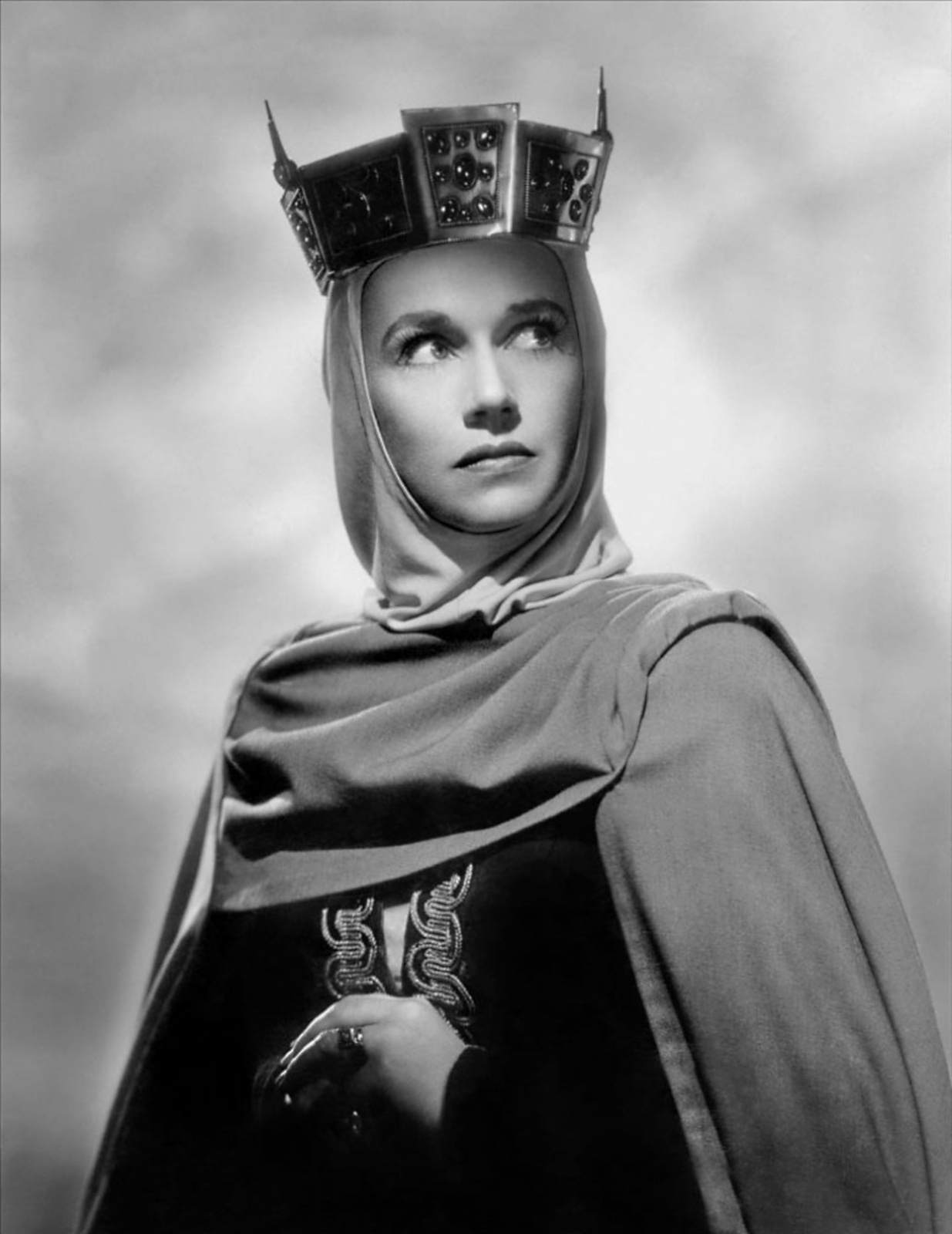
Welles wanted Vivien Leigh to play Lady Macbeth…but he never screwed his courage to the sticking post and asked her, because he thought her husband Larry (Olivier) would disapprove.  Tallulah Bankhead turned him down, and entreaties to old friends like Anne Baxter, Mercedes McCambridge, and Agnes Moorehead (oh, how I would have loved to seen Mercedes or Aggie in this part) didn’t pan out because those actresses had previous commitments.  So, Orson settled for TDOY crush Jeanette Nolan (making her film debut), with whom he had worked on radio’s The March of Time…and I’m going to be as blunt as I can possibly be: Jeanette is positively incredible in the role.  (Anytime someone references Lady Macbeth, Jeanette’s visage is the first image on my retinas.)  Other radio veterans in Macbeth include Edgar Barrier (as Banquo), Peggy Webber (as Lady MacDuff and one of the witches), and my other crush Lurene Tuttle (also one of the sisters, in addition to playing “A Gentlewoman”).

Roddy McDowall and John Dierkes
Dan O’Herlihy made his American feature film debut as MacDuff, with Roddy McDowall as Malcolm and Orson chums like Erskine Sanford (King Duncan), William Alland, and Gus Schilling rounding out the cast.  (Gus Schilling doing Shakespeare.  The mind boggles.)  Familiar TV face Keene Curtis (from Cheers) made his film debut in this movie, and you’ll also spot John Dierkes, Morgan Farley, and Welles’ daughter Christopher in her only film appearance as the child of MacDuff.  The striking photography comes courtesy of John L. Russell, who later was nominated for an Oscar for his cinematography on Psycho. Among the extras on the Olive Signature release: a fascinating accounting from Robert Gitt (from the UCLA Film & Television Archive) on the restoration of Macbeth; much reminiscing from Peter Bogdanovich on his friendship with Welles (his anecdotes on Orson’s The Trial made me laugh out loud); and an excerpt from We Work Again, a 1937 WPA short showing Welles working with the cast of Voodoo Macbeth.

“Unfortunately, not one critic in any part of the world chose to compliment me on the speed,” lamented Orson Welles about Macbeth at the Edinburgh Fringe Festival in 1953.  “They thought it was a scandal that it should only take 23 days.  Of course, they were right, but I could not write to every one of them and explain that no one would give me any money for a further day's shooting.”  The fact that Welles pulled off this amazing cinematic feat with the movie equivalent of “spit and baling wire” just makes me love Macbeth that much more…and I don’t think my love affair with this Olive Signature Blu-ray will end anytime soon.  (Many thanks to Bradley Powell at Olive Films for providing TDOY with the screener—this is unquestionably their finest presentation yet.)
m for his Voodoo Macbeth (1936) Housemen) for the Federal aim for his Voodoo Macbeth (1936), an all-black version of the play t

Friday, October 28, 2016

Adventures in Blu-ray: The Quiet Man (1952)


I’ve joked on the blog in the past that the time I spent living in Morgantown, West Virginia—from January 1992 to June 2000—is referred to both by myself and the family as “my years in exile.”  My stay there was marked by my longest period of gainful employment: I worked nearly the entire time I lived in Mo-town for University Health Associates, the insurance billing arm of the West Virginia University Medical system.  Among the many friends I made at UHA was an individual who oversaw ordering office supplies for the company…I’ll keep his identity on the Q.T. and give him the nom de blog of Durwood.

Durwood was a big fan of John Wayne movies, and since I had a reputation for being somewhat of a classic film buff myself, it often gave us a subject to talk about since one of my duties was sorting the company mail in the mornings, which I did in an area adjacent to his.  (Conversation tended to break the monotony inherent in the task.)  He even lent me a VHS copy of McLintock! (1963) on one occasion—the movie had just been released to home video at that time, and I had never seen it.  Durwood was a kind of macho guy—the women in my section considered him a bit of a chauvinist, though the ones who had known him longer (as in “I-went-to-high-school-with-him”) clued me in that it was mostly an act.  Anyway, we were holding forth on The Duke one day as I was sorting, and he said to me: “You’d probably be surprised at which John Wayne movie is my favorite.”

I tossed out a few titles—Red River, Rio Bravo—and was completely gobsmacked when he replied “My favorite is The Quiet Man.”  Amazed because it’s also my favorite (though it’s in tough competition with Stagecoach and The Searchers), and I was pretty much my friend’s opposite in terms of temperament, politics, worldview, etc.  And yet…in a way it’s not too surprising.

Ex-boxer Sean Thornton (Wayne) returns to the land of his birth: the peaceful village of Innisfree in Ireland, where he’s welcomed by the populace (normally a little bewildered and suspicious of newcomers) due to his strong family roots.  He arranges to purchase his former homestead, “White O’Mornin’,” from the wealthy Widow Tillane (Mildred Natwick) …and in doing so makes an immediate enemy in “Red” Will Danaher (Victor McLaglen), who had wanted the property for his own.

The enmity Sean earns from Danaher will come back to bite him in the tuchus…because Thornton has fallen, and fallen hard, for Will’s sister Mary Kate (Maureen O’Hara).  With the help of seachrán (matchmaker) Michaeleen Oge Flynn (Barry Fitzgerald) and parish priest Father Peter Lonergan (Ward Bond), “Squire” Will is duped into believing that Sean has set his cap for the Widow Tillane, and since Will rather fancies the Widder himself, he reluctantly agrees to allow Thornton to court Mary Kate (Flynn convinces him that he hasn’t a chance with Tillane because there’s no way she would consent to sharing the Danaher home with Mary Kate).  After following custom and tradition in the “expected” fashion, Sean and Mary Kate are wed…but at their reception, Will learns of Flynn and Lonergan’s deception and he refuses to relinquish Mary Kate’s “fortune” (her dowry).

Sean argues to his bride that the dowry doesn’t matter—but he doesn’t understand that it’s of vital importance to Mary Kate; without the “fortune,” she’s little more than a servant in the House of Thornton.  What Mary Kate doesn’t comprehend (in fact, the viewer doesn’t learn this until about an hour into the film) is that her husband could confront her brother with physical violence…except that as “Trooper Thorn,” he sent a man to the canvas and that opponent never got back up again.  He’s taken a vow to hang up his boxing gloves…but as we have learned from so many Randolph Scott-Budd Boetticher Westerns, there are some things a man can’t ride around.  We’ll experience that eventual donnybrook between Sean and Will in one of the most memorable brawls ever captured on celluloid.

Whether you’re a John Wayne fan or not, it’s impossible to ignore that in many of the actor’s movies John Wayne played…John Wayne.  The Quiet Man (1952) is a notable exception (as is 1940’s The Long Voyage Home, another film of The Duke’s of which I am quite fond), giving Wayne to play a role quite different from his established silver screen persona.  Wayne fans won’t be disappointed in that The Duke delivers the he-man, two-fisted heroics they’ve come to expect (with Quiet Man’s rip-roaring fight finale) …yet all the same, I think they’ll be captivated by the thespic range he demonstrates as a stranger in a strange land, swept off his feet by a lovely lass he first spots walking barefoot through the lush green pastures of “the old country.”

Though he was born in Cape Elizabeth, Maine in 1894, director John Ford (who often insisted on calling himself by his Irish name, “Sean Aloysius Kilmartin O’Feeney”) had a deep and abiding love for Ireland (where both of his parents were born before emigrating to the U.S.A.).  It’s present in many of his movies—The Shamrock Handicap, Hangman’s House (which has a steeplechase sequence similar to The Quiet Man), The Informer—but his Irish influences also dictated many of the themes in his non-Irish works: the rituals of courtship, the loss of a loved one, the presence of a close-knit community and its traditions, etc.  Ford’s return to County Galway (his father’s home was in Spiddal) to make a movie based on Maurice Walsh’s 1933 Saturday Evening Post tale (screenplay by Frank S. Nugent) would win the director his fourth and final Oscar (Winston C. Hoch and Archie Stout would also take home a trophy for their breathtakingly lush color cinematography).

Color films were a positive boon to actress Maureen O’Hara, because the effect of the actress’ striking red hair is completely lost in a monochromatic movie; when we first see Mary Kate Danaher we view her just as Sean Thornton does: a virtual Eve in his ideal of Paradise.  I don’t want to get the impression that it’s all about Mo’s beauty, however; her Mary Kate is one of the movies’ most positive and strong female characters, refusing to consummate her marriage to Sean because she sincerely believes she’s not entering the union on equal terms without her “fortune.”  Yet she gives herself to her husband even though he’s not come through for her (a marked difference from, say, the unsavory association between Rhett Butler and Scarlett O’Hara in Gone With the Wind) because theirs is a mature relationship—she accepts that Sean has a reason for not fighting her brother for what is rightfully hers even if she doesn’t realize why.

Because it’s a fine broth of a film, The Quiet Man has become a viewing tradition on St. Patrick’s Day…but the movie is so darn good it seems a shame to limit it to just that day; I got the opportunity to revisit it this week when Olive Films released the classic as another DVD/Blu-ray in their “Olive Signature” series (many thanks to Bradley Powell for the gratis screener) on Tuesday (October 25) of this week.  Sure, and it’s been released on previous editions before but Quiet Man gets the deluxe Signature treatment with some bodacious supplemental features: audio commentary by author-historian Joseph McBride (author of Searching for John Ford: A Life); a visual essay (“Don’t You Remember It, Seánin?: John Ford’s The Quiet Man”) from historian Tag Gallagher; and a tribute to the late Maureen O’Hara from actresses Ally Sheedy and sisters Hayley and Juliet Mills.  “The Making of The Quiet Man,” a featurette hosted by Leonard Maltin that has been making the rounds of the movie’s home video releases since 1992, has an encore appearance on this release as well as “Free Republic: The Story of Herbert J. Yates and Republic Pictures” (available on the Olive Signature release of Johnny Guitar).

The Olive Signature release of The Quiet Man also features a 4K master scanned from the original negative, allowing for an incredibly enjoyable viewing experience of a film that received a total of seven Academy Award nominations including Best Supporting Actor (McLaglen) and Best Writing, Screenplay (Nugent).  The Quiet Man even got a Best Picture nom…and if it weren’t for the fact that the unnominated Singin’ in the Rain (the greatest movie musical of all time) should have won the top prize that year in a saner world, I wouldn’t have any regrets declaring Quiet Man the best of all the nominees (and far superior to the film that did win, The Greatest Show on Earth).  Buy a copy of the Blu-ray (or DVD) and either squirrel it away for the next St. Pat’s or defy tradition and watch it again at your convenience.

Friday, September 23, 2016

Adventures in Blu-ray: Johnny Guitar (1954)


This past Tuesday (September 20), Olive Films rolled out their “Olive Signature” series with a re-release of the 1952 classic High Noon…but what distinguishes this Blu-ray (and DVD) from past incarnations is its amazing new video/audio transfer, not to mention some bodacious bonuses and extras to enhance the home video experience.  In addition to High Noon, the company has afforded the same blue ribbon treatment to another oater that’s held in high esteem here in the House of Yesteryear: Johnny Guitar (1954), which director Bernardo Bertolucci once described as “the first of the baroque westerns.”

Danny Peary’s essay on Guitar in Cult Movies inarguably whetted my appetite to initially see this film, and my first opportunity arrived when it turned up on Cinemax in the 1990s (along with Pursued and Force of Evil), where it was introduced by director/movie buff Martin Scorsese.  (Scorsese’s introduction to Guitar is one of several extras on the Olive Signature Blu-ray.)  It’s a Western unlike any other, loaded with subversive, radical content (it’s even more of an indictment of the political climate in Hollywood than High Noon) and sexual imagery that gives it a most contemporary feel.  Guitar is also an example of what critic Andrew Sarris labeled “Freudian feminism”; it’s unavoidable noticing that the two female characters in the movie are far more “tougher” than their male counterparts.

The plot involves a saloonkeeper named Vienna (Joan Crawford), who is not held in particularly high regard by her fellow townsfolk, a mob headed up by Emma Small (Mercedes McCambridge) and wealthy rancher John McIvers (Ward Bond).  Emma condemns Vienna for consorting with a group of outlaws led by “The Dancin’ Kid” (Scott Brady), a man for whom she secretly has strong feelings herself.  This alleged collusion with the Kid and his gang is really just a smokescreen for the fact that Vienna’s establishment lies in close proximity to a transcontinental railroad being constructed in the area; if Vienna goes through with her plans to build a rail station she will be a very wealthy woman indeed.

Conflict arises when Vienna hires an old flame (Sterling Hayden) who calls himself “Johnny Guitar” to protect her interests; unbeknownst to anyone else, Johnny is actually an ex-gunslinger named Johnny Logan.  During the course of the movie, Vienna finds herself accused of helping the Kid stage a bank robbery (one of the Kid’s minions lies about her participation in a futile attempt to escape a lynch mob) and is forced to take it “on the lam” with Johnny.  Johnny Guitar concludes with the anticipated showdown between Vienna and Emma, and presumably Vienna and her Guitar man will be free to pursue a life of marital fulfillment.

My enthusiasm for Johnny Guitar is such that I selected it as the topic of my sermon during the Classic Movie Blog Association’s Fabulous Films of the 50s blogathon in May of 2014…so if you want a more thorough examination of this fascinating film, I implore you to click here.  It’s a movie that without question demands multiple viewings in order to take in all of its sly subtext (for example, the way the various characters’ wardrobe colors comment on their motivations).  It also helps to know the fascinating production history of the film; sure, Joan Crawford’s Vienna and Mercedes McCambridge’s Emma square off against one another in Guitar…but the two actresses tangled off-screen as well (Joanie was jealous of her younger co-star—a sentiment expressed to any ingénue who appeared in a movie with Joan).  There was no love lost between the male (Hayden) and female (La Joan) stars, either: “There’s is not enough money in Hollywood to lure me into making another picture with Joan Crawford,” Hayden purportedly remarked after his experience.  “And I like money.”

Because Johnny Guitar was filmed in what Republic Pictures labeled “Trucolor”—a more economical alternative to Technicolor—the movie was the victim of severe fading over the years until it underwent significant repair in the 1990s.  The new 4k restoration featured on the Olive Signature Blu-ray only highlights the film’s dazzling color scheme, making it sparkly as all get out.  Accompanying the disc is a first-rate essay (“Johnny Guitar: The First Existential Western”) contributed by film critic/author Jonathan Rosenbaum (who included Guitar on his list of the 100 best American films in a 1998 Chicago Reader column in response to the American Film Institute’s Top 100), and an audio commentary track from Geoff Andrew (author of The Films of Nicholas Ray).

Of the Blu-ray’s supplementary material, my fascination with movies that either deal directly or indirectly with the Hollywood blacklist made me gravitate toward “Tell Us She Was One of You: The Blacklist History of Johnny Guitar.”  Historian Larry Ceplair and blacklisted screenwriter Walter Bernstein (The Front) encore on this (they do a similar mini-feature for High Noon).  Film critics Miriam Bale, Kent Jones, Joe McElhaney, and B. Ruby Rich are featured on “Johnny Guitar: A Western Like No Other” (an overview of the movie) and “Is Johnny Guitar a Feminist Western?”—which offers some lively give-and-take on “questioning the canon.”  Rounding out the bonuses are reminiscences from Tom Farrell and Chris Sievernich on working with director Ray (“My Friend, the American Friend”—which references the 1977 Wim Wenders movie) and another one I enjoyed (I only wish it had been longer), “Free Republic: The Story of Herbert J. Yates and Republic Pictures,” from archivist Marc Wanamaker (author of Early Poverty Row Studios).

“Coveted editions of the films you know and love, Olive Signature is our gift to the many fans, aficionados, and cinephiles who hold these films near and dear,” a press release from Olive Films boldly states.  In the case of both Johnny Guitar and High Noon, they are among my favorite films and most worthy of rediscovery time and time again.  (Many thanks to Bradley Powell at Olive Films for providing Thrilling Days of Yesteryear with the Johnny Guitar screener.)

Thursday, September 22, 2016

Adventures in Blu-ray: High Noon (1952)


This past Tuesday (September 20), Olive Films officially introduced its “Olive Signature” series on Blu-ray and DVD.  “Highlighting cult favorites, time-honored classics, and under-appreciated gems,” the company states in a press release, “each Olive Signature edition boasts a pristine audio and video transfer, newly designed cover art, and an abundance of exciting bonus material.”  (Think of it as a second Criterion for the classic movie fan.)

The inaugural Olive Signature release is High Noon (1952), the Oscar-winning Western (including a second Best Actor trophy for star Gary Cooper and Best Original Song for High Noon [Do Not Forsake Me, Oh My Darlin’]) that has been a longtime favorite here at Thrilling Days of Yesteryear (Noon was my contribution to The Chaney Blogathon back in 2013, celebrating the cinematic achievements of Lon, Sr. and Lon, Jr.).  Why, I hear you ask?  (At least…I hope that’s you, and not the little voices returning to cavort inside my head…)  Well, I’ve long had an affinity for those oaters that turn what is an admittedly conservative film genre (rugged individualism, strict adherence to a strong moral code, etc.) on its head with a bit of subversive tongue-in-cheek.  Carl Foreman, who penned Noon’s screenplay, never made any bones about the fact that the movie served as an allegory about Hollywood and the motion picture industry (Foreman would later fall victim to the blacklist) and the result so infuriated director Howard Hawks that he purportedly made Rio Bravo (1959) in response to Fred Zinnemann’s film.  (Bravo’s star, John Wayne, stated in his infamous 1971 interview with Playboy that Noon was “the most un-American thing I’ve ever seen in my whole life.”)

You know the story by heart: on the day of his wedding to Quaker Amy Fowler (Grace Kelly), ex-Hadleyville marshal Will Kane (Cooper) receives word that convict Frank Miller (Ian MacDonald) has been paroled and is headed his way…and he’s not bringing a fondue set.  No, Will sent Miller up on a murder charge five years earlier, but apparently Frank has slipped through the cracks of the justice system and is returning to Hadleyville to settle the score.

As his gang (Sheb Wooley, Lee Van Cleef, Robert J. Wilke) wait at the depot for the train to arrive at noon, Will attempts to round up a posse to help him take care of Miller upon his return.  Kane doesn’t have to do this—and he’s told that by several townspeople, including judge Percy Mettrick (Otto Kruger), who’s already high-tailing it out of town, and mayor Jonas Henderson (Thomas Mitchell).  But Will Kane is a man bound by his sense of duty…and besides, what’s the point of running away?  Miller has all the time in the world to track him down in whatever town he and Mrs. Kane decide to settle.  Deputy Harvey Pell (Lloyd Bridges) is of no use—he’s upset that Kane didn’t recommend him for Will’s job—and one by one, the townspeople reveal their true colors: they’re either deathly afraid of Miller (and more than a few are worried that the confrontation will give the town a bad name) or welcoming him back (many Hadleyville businesses enjoyed having Frank and Company around—it was good for the economy).

The underlying plot of High Noon—there’s a psychotic killer headed for town and its inhabitants can’t or won’t do anything to stop him—has been one that has fascinated me since the first time I sat down and watched the movie with my father.  (I’ve logged any number of visits with the movie since.)  No one expresses this inaction in the film better than the character of Martin Howe (Lon Chaney, Jr.), the man who was marshal of Hadleyville before Will, and who recommended him for the job.  Howe wants nothing more to help Will in his time of crisis, but reasons that Will would be so worried about protecting him in the fight (Howe’s lawman career has left him with “busted knuckles” and arthritis) that Will would wind up getting killed.  As for the rest of the town?  “It’s all happenin’ too sudden,” observes Martin.  “People gotta talk themselves into law and order before they do anything about it.   Maybe because down deep…they don’t care…they just don’t care.”  It’s a powerful political message that is still frighteningly relevant today.

The Olive Signature transfer of High Noon (mastered from a new 4K restoration) looks razor-sharp and positively pristine—it’s the best I’ve seen this film looking in years.  The bonus materials are abundant and most entertaining; I never noticed that cinematographer Floyd Crosby paid homage to a shot of a swinging clock pendulum from Noon in his later work on Roger Corman’s Pit and the Pendulum (1961)—a feature with a considerably larger pendulum—until film editor Mark Goldblatt (The Terminator) pointed it out in “The Ticking Clock.”  “Oscars and Ulcers: The Production History of High Noon” is a nice overall look at the making of the film narrated by Anton Yelchin, and I particularly enjoyed “Imitation of Life: The Blacklist History of High Noon,” which features historian Larry Ceplair and Walter Bernstein, the blacklisted scribe who wrote one of my favorite films on the subject, The Front (1976).

I’ll admit a little bias and confess that my favorite feature on the Noon Signature Blu-ray is “A Stanley Kramer Production,” because my good friend (and Facebook amigo) Michael Schlesinger holds forth on the career of the producer-director.  Because I was watching this with my mother, I said to her: “Mike is going to proclaim It’s a Mad Mad Mad Mad World the greatest movie of all time at some point during this.”  (He did not disappoint.)  There's also an accompanying original essay, "Uncitizened Kane," contributed by Sight and Sound editor Nick James.

Something else that will not disappoint: a purchase of this Blu-ray for your classic film library.  I know it’s been released several times before, but the transfer in this edition is worth the price of admission; it’s that breathtakingly beautiful.  Tomorrow in this space: I’ll look at the other Olive Signature release from this week—and not coincidentally, another one of my very favorite Westerns.

Many thanks to Bradley Powell at Olive Films for providing Thrilling Days of Yesteryear with the High Noon screener.