Showing posts with label CMBA. Show all posts

Thursday, July 6, 2017

Adventures in Blu-ray: When Knighthood Was in Flower (1922)


The Kickstarter project from March of 2016 to raise funds to restore the 1922 Marion Davies feature film When Knighthood Was in Flower came to a most gratifying conclusion on the first of this month, when I received the Blu-ray/DVD combo that was my reward for tossing a few coins into the guitar case.  (There were 317 backers, and a total of $11, 928 was raised; the project’s goal was attained eight hours within its initial Kickstarter posting.  Yowsah!)  We have silent film accompanist Ben Model (and Undercrank Productions—in association with Greenbriar Picture Shows) to thank for this beautiful restoration; Ben availed himself of a 12-reel 35mm nitrate print of Knighthood’s “road show” release in the collection of the Library of Congress…so if you’re saying to yourself right now “Oh, I saw this already on YouTube” you really haven’t seen it the way silent movies are meant to be seen and enjoyed.

Ben Model
For starters, the refurbished Knighthood sports digitally reinstated tints and tones; the LOC print (which includes a reel from a nitrate print courtesy of the Michael Yakaitis Collection at the Academy Film Archive) was in black & white, but the indications for the tinting and toning were printed into the first and last frames of most of the reels, which proved quite a help in the restoration project.  The final reel, which features the film’s protagonists being pursued by soldiers wielding weapons and torches, digitally replicated the hand coloring (thanks to Jack Theakston, the torches give off an orange glow that is amazing to look at) of the original release.  Knighthood also boasts a brand-new theatre organ score composed by Mr. Model, and a most informative liner note booklet written by the woman who trims the hedges at Backlots—Marion Davies biographer and fellow CMBA member Lara Gabrielle Fowler.

Lyn Harding, Marion Davies & Forrest Stanley
Based on the 1898 novel by Charles Major (under the pseudonym Edwin Caskoden—one of the film’s characters amusingly borrows this name) and the 1901 play by Paul Kester, When Knighthood Was in Flower is a romantic melodrama set against the background of England’s Tudor period.  King Henry VIII (Lyn Harding) wishes for his sister Mary to wed French king Louis XII (William Norris) …though it’s more of a merger than marriage.  Alas and alack, Mary has become quite taken with Charles Brandon (Forrest Stanley)—a commoner who makes her poor heart go lub-dub from the moment she meets him at a jousting tournament.  Chuck’s lower societal caste dictates that any coupling between him and the princess is RIGHT! OUT! —so when Henry exiles Charles to “New Spain,” Mary insists on running off with him disguised as his brother.

The male masquerade of Marion Davies’ Mary isn’t any more convincing that the drag she donned in Little Old New York (1923); she and Charles are quickly rounded up by all the King’s horses and all the King’s men.  Charles is to have a date with the executioner…but Mary agrees to marry Louis XII if her brother will spare his life.  The scrofulous old fart (Louis) has his card punched when he attempts to behave like the young lover he’s convinced Mary wants and needs…and with the King’s death, his skeevy nephew Francis (William Powell—billed as “William H.”) decides to put the moves on the Widder Tudor.  Fortunately for Mary, Charles comes to her rescue…and King Henry VIII provides the obligatory happy ending.

A title card that produced a hearty guffaw.  (Why would she be dressed like a wonton?)

Davies & William Norris
With the help of her producer-patron—newspaper mogul William Randolph Hearst—Marion Davies had already headlined fourteen feature films by the time When Knighthood Was in Flower hit theatre screens in 1922.  Flower would be the movie that cemented Davies’ stardom; it was a big budget costume epic, produced at a cost of $1.5 million (about $21 million in today’s dollahs) and believe you me—every penny of it shows in its lavish attention to detail (costumes, sets, etc.).  The 1922 version of the Major novel-Kester play made quite a few “best” lists (in addition to being the sixth biggest box office hit that year); it had been previously filmed in 1908 (though it is believed to be lost) and would see another adaptation in 1953 with Walt Disney’s The Sword and the Rose (the U.S. title).

William (H.) Powell
The more of Marion Davies’ cinematic oeuvre that I am exposed to the more I enjoy, though I’m firmly in the camp that believes that she was showcased best in comedies like The Patsy (1928—still my personal favorite) and Show People (1928).  Her talents as a comedienne are on display in Knighthood though, in very brief glimpses; I laughed loudly at the face she makes at one of the foreign ambassadors giving her the once-over on behalf of their marriage-minded monarchs, and when she and Stanley are hiding out at an inn while on the run from King Henry she does a funny backwards stagger into a fireplace as she cavorts in her male masquerade.  Knighthood started out kind of slow for me (I’m not much of a costume epic guy) but became more engaging as it built up a head of steam toward the finish.  It was also a treat seeing William Powell (in his second film…and in tights, even) as the lecherous Frances; a note at the (always reliable) IMDb states that despite both Davies and Powell being stars at MGM in the 1930s this was the only film they appeared in together.

The restoration of When Knighthood Was in Flower is beautifully done and a round of kudos go out rewarding the hard work that went into this Blu-ray/DVD.  It will be made available for general release July 25, 2017 (according to the listing at Amazon), and if you’re a silent movie buff you’ll want this one for the shelf…if you’re a Marion Davies fan, you’ll definitely have to have this.  Knighthood is also scheduled for a showing on The Greatest Cable Channel Known to Mankind™ when Marion Davies is one of the thirty-one stars feted during Tee Cee Em’s Summer Under the Stars in August.  (It airs at 8pm EDT on August 29th; two other recently restored Davies vehicles—Enchantment [1921; 9am EDT] and The Bride’s Play [1922; 10:30am EDT]—are also in the lineup.)

Wednesday, May 17, 2017

Underseen and Underrated: Afraid to Talk (1932)


The following essay is Thrilling Days of Yesteryear’s contribution to Underseen and Underrated: The Classic Movie Blog Association’s Spring 2017 Blogathon, underway this week from May 15-19.  For a complete list of the participants and the films discussed, click here.

From May 13 to June 15 in 2016, The Museum of Modern Art hosted Universal Pictures: Restorations and Rediscoveries, 1928–1937—a collection of films from the period when that studio was run by Carl Laemmle, Jr., son of Universal founder Carl, Sr.  (Certainly, not the first nor last case of nepotism in Tinsel Town, but the younger Laemmle rarely got any respect—wags derisively referred to him as “Junior” Laemmle—and he often found himself the butt of jokey observations like “the son also rises.”)  The MoMa schedule included some movies that make the occasional rounds of The Greatest Cable Channel Known to Mankind™ (The Good Fairy, Show Boat [the 1936 version]) and some that I personally have not seen since the days when AMC literally stood for “American Movie Classics” (Air Mail).  The event was a classic movie lover’s dream come true, and one of the offerings was Afraid to Talk (1932)—which, as of this point in 2017, is the best “new” classic film I’ve seen all year.  (Afraid was also unspooled at MoMa’s To Save and Project festival in 2011.)

Tully Marshall, Eric Linden, Frank Sheridan
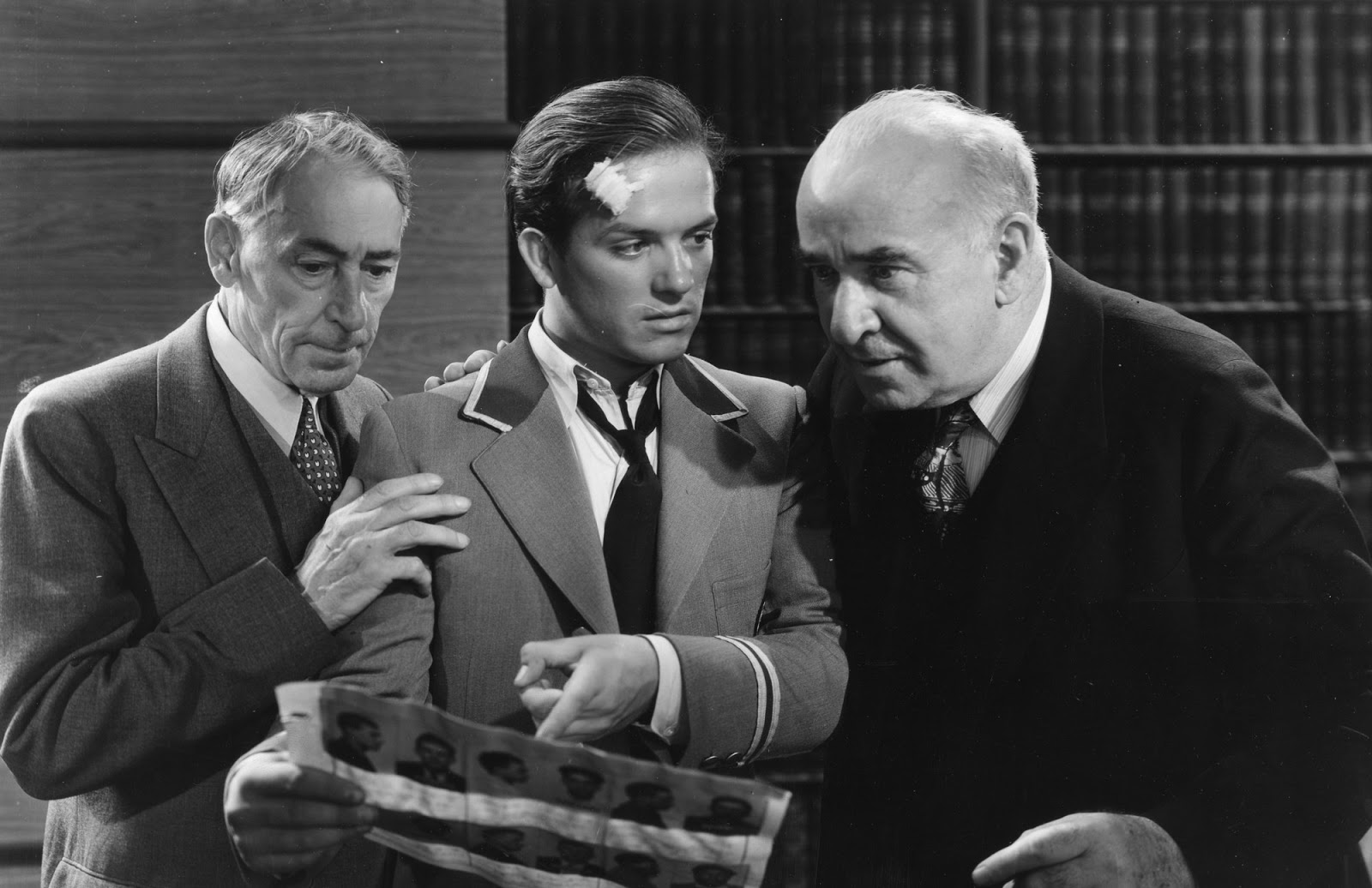
Racketeer Jake Stranskey (Robert Warwick) is gunned down in a Chicago hotel room…but fortunately for the Windy City police, there was a witness to the killing: bellhop Eddie Martin (Eric Linden), who is initially reluctant to finger the trigger man (snitches get stitches, you know).  Police Commissioner Garvey (Frank Sheridan) gives him the usual line of “civic duty” crap, and Eddie finally picks out Jig Skelli’s (Edward Arnold) ugly face from a mug sheet.  However, if Martin had known that a confederate of Jig’s threatened his wife Peggy (Sidney Fox) while she made her way to police headquarters to check on her spouse, he might have continued to maintain his code of omerta.

Albert Maltz
The corrupt powers-that-be—headed up by police chief Frank Hyers (Ian Maclaren), who also moonlights as one of the party bosses—reluctantly accept the fact that they’re going to have to prosecute Skelli…but they didn’t count on Jig’s ace in the hole: he found a sheath of documents on Stranskey’s corpse that detail the many payoffs collected by Mayor William “Billy” Manning (Berton Churchill), District Attorney Anderson (Tully Marshall), and other party ward heelers.  If they send him up for the murder, Skelli will make it snow with the blackmail.  Forced to let Jig skate, the PTB need a fall guy for the Stranskey hit—and choose as their patsy the bellhop who witnessed the killing in the first place.

Afraid to Talk was based on Merry-Go-Round, a controversial play written by George Sklar and future Hollywood Ten blacklistee Albert Maltz (the movie’s screenplay was adapted by Tom Reed).  When you think of hard-hitting social dramas in the films of the '30s, you usually associate that material with Warner Brothers—yet Afraid can hold its own against any film featuring the likes of Jimmy Cagney or Edward G. Robinson, and in many respects, surpasses a lot of the Warner’s product.  The amoral universe of Afraid—where everyone appears to be on the grift and honest individuals are few and far between—is most reminiscent of the brief cinematic oeuvre of writer-director Rowland Brown, responsible for such pre-Code flicks as Quick Millions (1931), Hell’s Highway (1932), and my favorite of them all, Blood Money (1933).

Edward L. Cahn
The Brown-like director of Afraid to Talk is Edward L. Cahn, a name usually associated with motion pictures like Creature with the Atom Brain (1955) and It! The Terror from Outer Space (1958—acknowledged as the inspiration for Alien [1979]).  Cahn began his career at Universal as an editor (his brother Philip also worked in the cutting room) and his exemplary work doing last-minute cuts on All Quiet on the Western Front (1930) got him a promotion to the director’s chair, working on crime pictures and comedies.  Before his fertile career as a director of second features in the 1950s, Ed worked as a journeyman in the MGM shorts department, notably entries in the studio’s “Crime Does Not Pay” franchise (last Friday’s CDNP on the blog, A Thrill for Thelma [1935], was directed by Cahn).  I noticed a preview of Cahn’s CDNP style in Afraid in one scene when the party bosses decide to make Chief Hyers’ soused nephew Lenny (George Meeker) the new magistrate after the only honest adjudicator (Reginald Barlow) refuses to have anything to do with the release of Skelli.  As Lenny slurs an acceptance speech, there’s a whip-pan to a bust of Abraham Lincoln, comically commenting on the absurdity of how relatives rise through the ranks of government.

Edward Arnold, Mayo Methot
Edward Arnold had a fairly prolific acting career in the silent era but his Joe Skelli is a blueprint for the later “big boss/fat cat businessman” roles he’d play throughout the talkies (The Glass Key [the 1935 version], Mr. Smith Goes to Washington, Meet John Doe), and with Louis Calhern as the contemptible assistant D.A. (who never lets his suave menace and complete lack of conscience falter for a second), the acting talent in Afraid to Talk may very well be the finest that director Cahn ever worked with.  Also on hand are Mayo Methot (the third Mrs. Humphrey Bogart) as Arnold’s moll and Matt McHugh (Frank’s bro) as his giggling brother, with silent movie villain Gustav von Seyffertitz in a heroic turn as the lawyer hired to help bellboy Martin out of his predicament.  I also got a chuckle spotting Joyce Compton and Dorothy Granger as the two “party girls” at Joe Skelli’s “get out of jail” celebration, and seeing favorites like George Chandler (as a fellow bellhop) and Arthur Housman (as a drunk—who’da thunk?).

There’s a pervasively bleak atmosphere that shrouds Afraid to Talk—those individuals chosen by the people to represent them do nothing of the sort, and instead live high off the hog from graft and kickbacks, never batting an eyelash at the horrific notion of framing Eddie for a crime he didn’t commit.  (Commissioner Garvey is the only official who won’t go against his conscience, though this is provoked more by Skelli’s mob gunning down children in the streets during a heated moment in a gang war.)  It’s a riveting pre-Code picture because you’re never quite certain where it’s headed and the cynicism that runs rampant throughout (I love the Greek chorus of “bystanders” who comment on the action as they watch developments on an overhead news ticker) appeals to the disillusioned person that I have become late in life (one of the film’s most unforgettable sequences is the interrogation of Linden’s Eddie, which gradually gets physical as Calhern’s goons work him over to extract a confession).  It’s not an easy movie to track down, and though I’m a little red-faced to resort to shilling in the blogathon I obtained a very nice copy (it’s from a VHS recording—there’s a little tracking trouble at one point, but overall I was most impressed with the print) from my friend Martin Grams, Jr. at Finders KeepersAfraid to Talk is a fourteen-carat gem.

Tuesday, May 16, 2017

Rain delay


My mad scheme was to have up on Monday and Tuesday reviews of two movies that I recently watched off my Hopper (Dish’s cute nick for their DVR…though the one in my room is technically a “Joey”) …and then that plan quickly went south.  I’m still trying to tame the dusty Thrilling Days of Yesteryear archives (I seem to have accumulated a lot of DVDs over the years) by cataloging my holdings (every time I do this, I find a movie or two I missed previously) and because I set Sunday aside to do that, my Monday post never materialized.  Monday, I spent three hours of my life that I’ll never get back journeying to the doc’s for an appointment (I wouldn’t mind the wait so much but the chairs in the endocrinologist’s waiting room appear to be leftover furniture from The Flintstones) and then after lunch, I agreed to go with Mom to Kroger Nation to get some things she needed.  For reasons that I can only attribute to my stupidity, I lifted a few cases of water from one section of the store to my cart (the water was in the area where you walk in, and I didn’t want to set off any alarms in the store since I had already placed items in the cart), then picked them up to put them in the trunk of the car…and then picked them up to set down on the carport.  That left me kind of stove-up, and I decided to just continue with Operation DVD Reorganization.

Artist's depiction of the waiting room at NAED.
Because I have committed to the current Classic Movie Blog Association blogathon, there will be an “Overlooked Films” entry tomorrow (that’s the blogathon theme), and (knock wood) normal posting will resume on Thursday and Friday (Crime Does Not Pay!).  (I splurged on a metric butt-ton of DVDs from Oldies.com since I had a little jingle in my pocket, and I’ll be reviewing some of my acquisitions in the coming month and June.)

Wednesday, December 14, 2016

B-Western Wednesdays: Hollywood Round-Up (1937)


In the world of the B-Western, there are only so many plots to go around.  You can only have a certain number of times when unscrupulous wealthy people want to rape the people’s land for precious minerals (or just take their ranches regardless of whether there’s gold, copper, silver, etc. present) or fighting Indians on the warpath or thwarting stagecoach hold-ups.  Occasionally, filmmakers who churned out oaters would get a little creative…and a popular diversion would be building the movie plot around the making of a B-Western.

The Greatest Cable Channel Known to Mankind™ recently aired Scarlet River (1933) as part of their month-long tribute to Myrna Loy; this Tom Keene programmer features our hero as a cowboy actor who comes to the aid of real-life ranchers, and there are very brief cameos from RKO stars like Myrna, Bruce Cabot, Rochelle Hudson, and Joel McCrea.  A better example is a fun little Roy Rogers vehicle, Under California Stars (1948), in which Roy not only plays himself (he returns to his ranch after wrapping up shooting on his latest feature) but is joined by the likes of fellow Republic co-workers Monte Hale, Allan “Rocky” Lane, and Don “Red” Barry.

One of the Gene Autry features I managed to snag during our Starz/Encore/Movieplex “freeview” was The Big Show (1936); this western casts “America’s favorite singing cowboy” as both himself and a silver screen star named Tom Ford.  Gene doubles for Ford’s stunts in his pictures, and is pressed upon to keep impersonating the actor at the 1936 Texas Centennial celebration when Tom takes a fishing vacation.  Show is an entertaining little romp—one of the best early Autrys—though it does suffer from that irritating quality present in Gene’s films when the narrative must come to a screeching halt so that our hero (or someone else in the cast) can warble a song.

Mack V. Wright is credited as the director of The Big Show, and interestingly enough served as the production manager of a movie that’s quite similar to Show: 1937’s Hollywood Round-Up.  Round-Up features Grant Withers as Grant Drexel, the box office champ of Crown Pictures, a studio that specializes in cranking out oaters.  Though Drexel is the idol of many a kid who enjoys a Saturday matinee, in real life he could use some coaching in the social skills department…because he’s a bit of a prick.  When Carol Stephens (Helen Twelvetrees), an on-the-wane star is loaned out to Crown because she’s “box office poison” at her home studio, Drexel starts taking a few liberties during one of their love scenes.

Grant is soon set straight on this matter by Buck Kennedy (Buck Jones), the genuine article when it comes to cowboys…and a man who’s forced to demean himself as Drexel’s double to keep groceries on the table and oats in his horse Silver’s feedbag.  Kennedy has a thing for Carol himself, particularly after befriending her younger brother Dickie (Dickie Jones), and the romantic rivalry between Buck and Grant for Carol’s attentions eventually comes to a boil, prompting “the star” to have his stunt man fired.  Buck is only temporarily in the unemployment line, however; he’s hired by a rival studio to appear in their production…which includes filming a hold-up on the town bank.  The only problem is: the hold-up is real—the company are really a gang of outlaws, and they’ve left Buck holding the bag!

I like Dickie Jones, so I was kind of sorry to see him in The Grey Bar Hotel. (Why don't these things ever happen to She Who Must Not Be Named?)

I really believe Hollywood Round-Up to be a superior picture to The Big Show…primarily because there’s no musical numbers to slow down the action, and primarily because star Buck Jones is one of the most likable individuals to ever sit tall in the saddle.  Buck was one of the major assets in our Serial Saturdays presentation of Riders of Death Valley (1941), a chapter play that paved the way (along with the 1941 Columbia serial White Eagle) for the former silent movie hero to appear in a series of Monogram oaters known as The Rough Riders franchise.  (Jones was one of the many victims—close to 500 in all—who perished in the infamous Cocoanut Grove fire in Boston on November 28, 1942.)  Jones has been described as the middle point between Tom Mix and William S. Hart, and I find myself becoming more and more of a fan with each movie I see him in.  He has a wonderful sense of self-deprecating humor, and makes for a first-rate sagebrush hero without resorting to the moralizing of many of his peers.

TCM ran Hollywood Round-Up as part of a day-long feting of Helen Twelvetrees, who is also one of the movie’s pluses.  The scene where Helen’s Carol Stephens is told by Federal studio boss Lew Wallace (Eddie Kane) that he’s loaning her out to Crown is very well-done (Carol is visibly upset, and Twelvetrees nails it without being mawkish), and though despondent at first, Carol demonstrates she’s a trouper by showing her professionalism and making lemonade out of her situation.  (I’ll take a moment here to remind folks that if you’re interested in learning more about Ms. Twelvetrees you should check out fellow CMBA member Cliff Aliperti’s biography Helen Twelvetrees: Perfect Ingénue—available as an actual book or e-book at an Amazon near you.  Yes, I could use a check this month.)  Twelvetrees also has a solid chemistry with her leading man.

Hollywood Round-Up was comedian Shemp Howard’s first film for Columbia.  (Shemp plays Oscar Bush, the assistant director, and generates much mirth despite Scott Clevenger’s dissenting opinion.)  Howard was so well-received in Round-Up that he appeared in an additional Buck Jones vehicle, Headin’ East (1937) …and that started him on his long association with the studio—appearing in Andy Clyde shorts (often as Andy’s obnoxious brother-in-law) and The Glove Slingers comedies before starring in his own series of two-reelers and then replacing brother Curly in The Three Stooges.  I am not going to lie to you: I DVR’d this film solely on Shemp’s participation, and I’ll freely admit that I’m fond of it because he’s always welcome ‘round Rancho Yesteryear.  But Round-Up turned out to be a pleasant surprise, and it features familiar Columbia players in Kane and Monte Collins (perfect as Withers’ fast-talking agent).

Monday, October 3, 2016

Book Review: Sin and Vice in Black & White


Two weeks ago in this space, I ate up a little Internets bandwidth telling you about my fellow Classic Movie Blog Association compadre John Greco’s e-book Film Noir at Twenty Four Frames Per Second.  I mentioned that John was prolific when it came to e-book publishing…and while I don’t wish to trivialize his notable efforts, John’s kind of a piker when it comes to the output of another CMBA member-in-good-standing—Rupert Alistair.

Rupe is the proprietor of Classic Movies Digest, a fine weblog about one of my favorite subjects (natch)…yet I think the wonderful thing about Rupert’s blog is that his posts are laced with passion for the cinematic subjects he writes about.  Alistair is the kind of writer who is just going to bust unless he can pass along his excitement about a favorite movie to the person perusing the essay.  This, as you may have already suspected, is a very good thing.

It’s Rupert’s prolificacy in the e-book arena that really sets him apart from his fellow movie mavens: as of this writing, he’s e-published five issues of essays in the Classic Movies Digest series; three editions of The Name Below the Title (an emphasis on those great character thesps that we worship here at TDOY); Hollywood and the Home Front: 25 Fabulous Films from the Forties; The Search for Scarlett O’Hara: Gone with the Wind and Hollywood’s Most Famous Casting Call; and three “why-haven’t-you-watched-this-already” books that are available separately or in a single Kindle bundle: Classic Movies, Classic Movie Gems, and Hidden Hollywood Gold.  I think it’s a safe bet that by the time I’ve finished a bowl of Cheerios tomorrow morning Rupe will have added at least three more e-books to that list.

I kid.  I kid because I love.  You know what else I love?  Pre-Code movies.  Which is why I took several trash bags filled with pop cans (a souvenir of my former sugary soda-drinking ways) down to the recycle center, raising enough scratch to purchase a Kindle copy of Sin and Vice in Black & White: 15 Classic Pre-Code Movies.  (Okay, I’m just joking about the soda cans.  It hasn’t come to that…yet.)

After a brief chapter (“What Are Pre-Code Movies?”) that educates the classic movie novice on what constitutes a Pre-Code film, Rupert describes vehicles featuring Joan Crawford (Paid, Dancing Lady), Jean Harlow (Red-Headed Woman, Red Dust), and his personal favorite, Barbara Stanwyck (Ladies of Leisure, Shopworn).  Alistair covers some very familiar titles (I’m No Angel, Footlight Parade) and some that are a bit lesser-known (Girls About Town, Mandalay) …and also some personal favorites here at TDOY (Safe in Hell, Blonde Venus).  If I were Rupe’s editor, I might have suggested maybe adding another Warren William title (his essay on 1933’s The Mind Reader is exceptionally good)—but that’s just a pin prick of a nitpick.

I’ve said this often on the ol’ blog…but to me, the mark of a good movie critic is making the reader unfamiliar with the film discussed say to him/herself: “Hokey smoke, Bullwinkle—I have got to slip this in my ClassicFlix queue!”  (Okay, so I did a little pimping there for my bosses.  This is assuming it’s on DVD, of course.  If not, your friendly neighborhood bootlegger will no doubt be getting an e-mail.)  A good reviewer can also persuade that reader who has seen the film that they need to put the ClassicFlix-bootlegger wheels in motion in order to experience it a second—or third, or however many occasions it’s been watched—time.  Rupert has an edge over a lot of his fellow classic movie scribes in that there’s no question he loves the movies he writes about, and is able to vividly express that adoration on each e-book page.  (It’s so awkward not being able to write “printed page.”)

“The films discussed here are by no means the only ones worth their salt as movie offerings during the period,” Alistair notes in his “What Are Pre-Code Movies?” prologue, “nor are they necessarily the best or the worst.”  But I feel Rupert’s batting average in Sin and Vice in Black & White is pretty solid, and not only would I not hesitate recommending it to classic movies fans, I’d emphasize the fact that the price of the Kindle book ($2.99) is sweeter than high fructose corn syrup.  (Which reminds me…I have some soda cans to crush in order to fundraise buying more of Rupe’s books.)

Monday, September 19, 2016

Book Review: Film Noir at Twenty Four Frames Per Second


My Classic Movie Blog Association colleague John Greco—in addition to being a writer and photographer—is not an individual content with letting grass grow under his feet.  He’s the author of two Kindle books on classic films including his latest, Lessons in the Dark, and a mystery entitled Murder with a Twist.  In addition to contributing to two e-books of past CMBA blogathon essays—Words, Words, Words! and Planes, Trains and Automobiles—he owns and operates three blogs including a personal one and one devoted to his photography, watching shadows on the walls.  (Me?  I’m lucky I was able to get back into the blogging game without taking time out for a nap.)

Twenty Four Frames is the title of John’s classic movie blog, and an e-book containing essays from that site, Film Noir at Twenty Four Frames Per Second, was published in 2014; the price was right ($2.99) and the topic of the articles within is my particular classic movie meat, as you probably well know.  There are twenty-one in all, covering a lot of familiar “Dark City” territory: Night and the City, Ace in the Hole, Kansas City Confidential, etc.  There’s even a nod to neo-noir with a piece on the 1990 film After Dark, My Sweet.

What I enjoyed most about John’s book is that much of its content covers those films that sometimes get skipped over as film fans are feverishly leafing through the Noir Encyclopedia.  One in particular is Night Editor (1946), which has its antecedents in old-time radio (it aired on various networks and various coasts from 1934 to 1948).  It’s a “bargain basement” effort from Columbia that does feature a laudatory performance from actress Janis Carter—who, according to John, is a “nasty, treacherous, cold hearted man-eater” bringing nothing but bad news for the movie’s hero, luckless William Gargan.  I also read about this movie in a book that will be reviewed on the blog in this space next week, and since it’s available for purchase on the Sony Home Video release Bad Girls of Film Noir, Volume 2 it’s going to be one I track down at the first available opportunity.

John brings new insights to lesser noirs like Roadblock (1951) and Crashout (1955), and like so many of us classic movie nuts, received his education growing up watching old movies on TV (he hails from Brooklyn, and received essential exposure to WNEW’s Channel 5 as a youngster).  He was most taken with The Maltese Falcon (1941), and kudos to him.  “The world of noir evoked a shadowy universe of danger and violence crammed with duplicitous women and dangerous men,” Greco writes in the introduction.  “It didn’t matter what side of the law they were on, and sometimes it was hard to tell.”

Greco’s background in photography is a major plus when appreciating the stylized cinematography that’s the hallmark of good noir movies, and John’s prose is lean, mean, and to the point—no need for lacey artifice here.  To me, the best thing a critic can bring to the table is to make you want to seek out films you haven’t crossed off your list yet…and on the off-chance you have seen it, instill in the reader a new appreciation for the movie—or better still, tempt them into sitting down with it again.

“So, grab a bottle of the hard stuff and settle down in a comfortable chair,” invites John seconds before the first review, the Poverty Row classic Detour (1945), commences.  (I’m already in Count von Comfy Chair, but the hard stuff will have to be Crystal Light Fruit Punch.)  “It’s going to be a perilous journey down those darkly lit mean streets.”  You can’t beat the price, and I think you’ll enjoy what is undeniably a brisk, efficient read.