Showing posts with label OTR references. Show all posts

Friday, July 21, 2017

Crime Does Not Pay #10: “It May Happen to You” (06/05/37)


This week’s Crime Does Not Pay outing has been discussed previously at Thrilling Days of Yesteryear…but since our Friday excursions into MGM’s popular series of shorts allow me to go into a bit more comprehensive detail I’ll apologize in advance for the rehash.  CDNP not only provided work for character veterans, it also served as a showcase for future stars like Robert Taylor (starring in Buried Loot), Barry Nelson, and Cameron Mitchell.  The big name in It May Happen to You (1937) straddles the cinematic worlds of stardom and smaller character actor fame—it’s “that celebrated actor,” J. Carrol Naish, a two-time Academy Award nominee for his supporting performances in Sahara (1943) and A Medal for Benny (1945).  I use the term “celebrated actor” in a tongue-in-cheek manner because that’s how announcer Bob Lemond always introduced him in his starring role on radio’s Life with Luigi (like how I reverently refer to Mister John Dehner in recognition of his billing on radio’s Have Gun – Will Travel).


Philip Trent—last seen as “the MGM Crime Reporter” in The Public Pays (1936)—is back for this entry, but he doesn’t do much outside of introducing this week’s faux law enforcement official, Captain John Mallory—“chief of the larceny squad of the Metropolitan Police Force.”  Mallory is portrayed by character veteran Guy Usher, who appeared in a couple of chapters of The Green Hornet (1940) as an odious criminal type named “Lynch” (nice to see Trent and Usher together in this short, by the way).  Usher’s credited work includes such films as Penguin Pool Murder (1932), This Day and Age (1933), It’s a Gift (1934), and The Spanish Cape Mystery (1935—an Ellery Queen film where he plays Inspector Queen).


MALLORY: Police and the city health department often have to work close together to smash the activities of vicious racketeers…human rats worse than the carriers of bubonic plague…

Hey…hey…there’s no need for name-calling here.

MALLORY: If you think that criminals live in another world that can’t affect you, consider this case…recently, the state highway patrol was fighting a wave of truck hijackings…


There’s a whip-pan to a truck tooling down the road, with “Lathrop Canning Co.” displayed on the back.  (“When…it…says…Lathrop’s, Lathrop’s, Lathrop’s/On the label, label, label/You will like it, like it, like it/On your table, table, table…”)  A car follows the truck, and inside the vehicle are a gang of no-goodniks comprised of Bunco (Emmett Vogan), Torpedo (Eddie Marr), Musclebound (Dick Rich) …and our “celebrated actor” as their fearless leader, J. Carrol Naish as “Moxie.”  (“Make Mine Moxie!”)  Moxie instructs Bunco (who’s at the wheel) to “kill the lights,” then to pull up beside the truck as Torpedo gets out on the running board, smashes the truck’s passenger window, and orders the driver to turn off onto a side road.  Fortunately for the Lathrop employee, a couple of uniformed motorcycle patrolmen are nearby to witness what will surely be some major criminal activity…and after coasting down to where Moxie and his stooges have positioned the truck, shine their headlights to scatter the mob like cockroaches reacting to turned-on lights in the kitchen.  There’s a bit of gunfire exchanged, and Bunco takes some shrapnel before the crooks beat a hasty retreat.

A scene shift, and Moxie is at a pay phone talking with this gent:


Yes, it’s character legend Clarence Hummel Wilson—the beloved hatchet-faced thespian who’s been in countless shorts and features…but around Rancho Yesteryear, we remember him for roles in several Hal Roach-produced comedies (Our Gang’s Shrimps for a Day [1933], Charley Chase’s Public Ghost #1 [1935], etc.).  This is Wilson’s last CDNP outing (he was previously seen in Alibi Racket), and while we are unquestionably saddened by this he gets a great showcase here as the “brains” of the operation, Van Buren “Pop” Sheafor.

MOXIE: Bad news, Sheafor…that job fell through tonight…
SHEAFOR: Fell through?  How come? (Pause) All right—meet me at the warehouse in one hour…
MOXIE: Right…

As he hangs up the phone and exits the phone booth, we see that Moxie phoned “Pop” from a gymnasium…and that his fellow goons are whiling away their copious crook time watching a pair of amateur pugilists have at it for a few rounds.  Torpedo tells his boss that Bunco’s “slug went through his hand—but he’ll be okay.”

MOXIE: From now on we lay off the highways—those state cops are gettin’ too smart…we gotta figure out a new way to work…
TORPEDO: Gettin’ so a man can’t earn his livin’ no more…

Nice little laugh line from Marr—who had a most prolific acting career on radio (The Lux Radio Theatre, Suspense) in addition to motion pictures.  Moxie’s gang takes delight at watching an amateur (Arthur Rankin) display his unique boxing style, which consists of him hitting the other fighter’s glove repeatedly with his face, then falling to the mat.  Musclebound jokingly refers to him as “Horizontal Eddie.”


MOXIE: Why…that guy don’t look like a fighter…
MUSCLEBOUND: He ain’t!  He works for a livin’…checks out trucks at the Cassidy Meat Packin’ Company…
MOXIE: Meat packin’ company?
MUSCLEBOUND: Yeah…


You can almost see the wheels a-turnin’ inside Moxie’s cranium as he begins to devise an eevillll scheme…he then visits young Edward in one of the locker rooms at the gym…

MOXIE: That’s a wicked left you got, kid…
EDDIE: Thanks…
MOXIE: I’m Moxie…
EDDIE: Yeah—I heard about you…

“Don’t get any ideas about my sister, though—she’s off-limits!”


MOXIE: Whaddya trainin’ for?
EDDIE: Oh…I just need to make a little extra money…
MOXIE: Well, you sure picked yourself a tough way to get ten bucks…

Moxie knows all about Eddie’s job at the meat packing company, of course—but he’s coy about it until Eddie brings it up.  The racketeer then goes to work on his mark’s financial insecurity: “Those joints never pay anything—even when you work up to somethin’.”  He’s got a little proposition for the money-minded young lad, and while there’s a fade-out as Moxie goes into the details, we get the gist of what he discussed with Edward in a conversation with “Pop” Sheafor.


MOXIE: …every morning he helps load those big refrigerator trucks and sees that they’re locked before they leave the plant…kid’s workin’ for peanuts—crazy about dough…it’s the perfect setup…
SHEAFOR: Hijack meat?
MOXIE: Why not?  Hah!  There’s big dough in fresh registered beef…
SHEAFOR: How are you gonna work it?
MOXIE: Never mind about that…if I get the stuff…can you sell it?
SHEAFOR: Sure!  I got several sellers on the east side who’d be glad to get some cheap…

Moxie asks Sheafor if he wants it brought to his hideout, and “Pop” is adamant about scotching that scheme.  “The health department inspectors are always nosing around the warehouse,” he explains.  Not a problem—Moxie will just need to take it to “the old garage” and “pile it up—throw some ice on it.”  I suppose I don’t need to tell those of you who don’t have extensive experience in food storage why this is not going to end well (there’s a reason why sides of beef are always stored in freezers, kids).  But I’m getting ahead of the short.

The next morning, Moxie is waiting for Eddie as the enterprising young soul leaves his modest apartment on his way to an early shift at the plant.  Eddie has given Moxie’s proposal a lot of thought, and he’s in—all he’ll need to do is slip Moxie the key to the lock on the truck headed for the nearby burg of Gardenia, and provide the proper info on what route that truck will be taking.  Eddie does have some misgivings, though:

EDDIE: Suppose they miss the key at the plant?
MOXIE: Well, they won’t for ten minutes…and that’s all I’ll need it for—I’ll get copies made by a guy I can trust… (Eddie hesitates) Now—what’s the matter?  You said you were interested in easy dough…
EDDIE: Well, I don’t know…I…
MOXIE: All right…forget about it…you’re the kind of a sucker who likes to work for a livin’…


Don’t you just hate those guys?  Moxie starts to walk off…but Eddie asks him to wait a minute, then gives him a big grin.  Looks like Eddie’s going to be kicking in on the tolls dotting the road to perdition.


The Great Beef Robbery goes according to plan.  As the driver (Jack Pennick) complies with a stop sign, Musclebound emerges from some bushes to puncture two of the truck’s tires, leaving the driver flat.  (I make leetle joke.)  Bunco then pulls up in a sedan, and when Driver explains the situation to him he offers to give him a lift to a phone so he can contact a tow truck.  As Bunco’s car drives off, Moxie, Torpedo, and Musclebound pull up in a truck of their own and help themselves to that sweet, sweet Cassidy beef once Musclebound unlocks the refrigerated section with that duplicate key.  There is then a scene shift to the plant, where the driver is being questioned by Cap’n Mallory as to the details of the theft.

DRIVER: …and when I got to Gardenia and opened the truck—it was empty…
MALLORY: Were the doors locked when you got there?
DRIVER: Yes, sir…
MALLORY (to the plant manager): You sure that truck didn’t go out empty?
MANAGER: These men loaded it…

He leads Mallory over to where a couple of plant employees are standing—Eddie is in the vicinity as well, seated at a desk.


MALLORY (to Eddie): What’s your job?
EDDIE: I check the load…and see that the doors are locked…and that the driver gets the invoice…
MALLORY: Were the doors locked?
EDDIE: Yes, sir…

Well, he was honest—he just left out the part about “…and then I gave the key to some greaseball hood who made himself a copy.”  Mallory is baffled by this case.  All the men at the plant have good records.  There are no discernible fingerprints on the truck (what prints do exist are all smeared) and “no jimmie marks on the locking devices.”  “Most hijacking is done at gunpoint or by violence,” muses Mallory.  He surmises that it must be an inside job, and he tells his man Reed (William Royle) to pore through the employees’ records with a fine-tooth comb.  A “Dr. Rexford” (Frank Dae) at the Health Department should also be contacted.

As the scene changes, a grocer (Rollo Lloyd) who answers to “Joe Mollock” is on the horn with Sheafor—salivating at the prospect of buying some cheap beef:


MOLLOCK: Three cents better than market?
SHEAFOR: Cash deal…and quick dough for both of us…
MOLLOCK: Quick dough, huh?  Okay—send me fifteen sides!

Getting off the phone with Mollock, Sheafor is one happy black marketer—crowing “Oh, what a racket!” and making me choke on my beverage.


MOXIE: It’s a pipe, isn’t it?
SHEAFOR: And easy to sell!  I’ve got orders for half that load already!
MOXIE: Where’d ya peddle it?
SHEAFOR: Outside of Joe Mollock, I’ve got three jobbers on the east
side I can trust—Ward, Wesley, and Britton…only they don’t want delivery before Thursday…so we’ll have to hold it for them before then…hope that stuff keeps in the garage for a couple of days…

“Torpedo!  Head out to the 7-11 for another bag of ice!”  Sheafor tells Moxie that he could use another load next week, and he asks his chief henchie if he can trust Eddie.  “I don’t trust him…I just keep an eye on him—he’ll do what I say” is his reply.  Sheafor suggests that Eddie pilfer some invoices from the Cassidy company—that way they can give them out to the “jobbers” and everything will be legit.

A scene dissolve, and Moxie and Torpedo are paying Eddie off at the gym…where Moxie asks the young criminal-in-training to score some “billheads.”

MOXIE (handing him $100): Bet that’s the easiest century that ever came your way, huh?
EDDIE: You said it!  It’s going right down on a yellow sport roadster…

You’re not even in the crime business a day, Eddie…and you’ve forgotten about sending some money home to your poor, gray-haired old mother.  Bad Eddie.  No hotrod.

MOXIE: Take it easy, kid—you don’t wanna start lookin’ too flush…we’re pullin’ another haul next week…
EDDIE: Sure…anytime… (He laughs) Simple…the cops don’t know where to start…
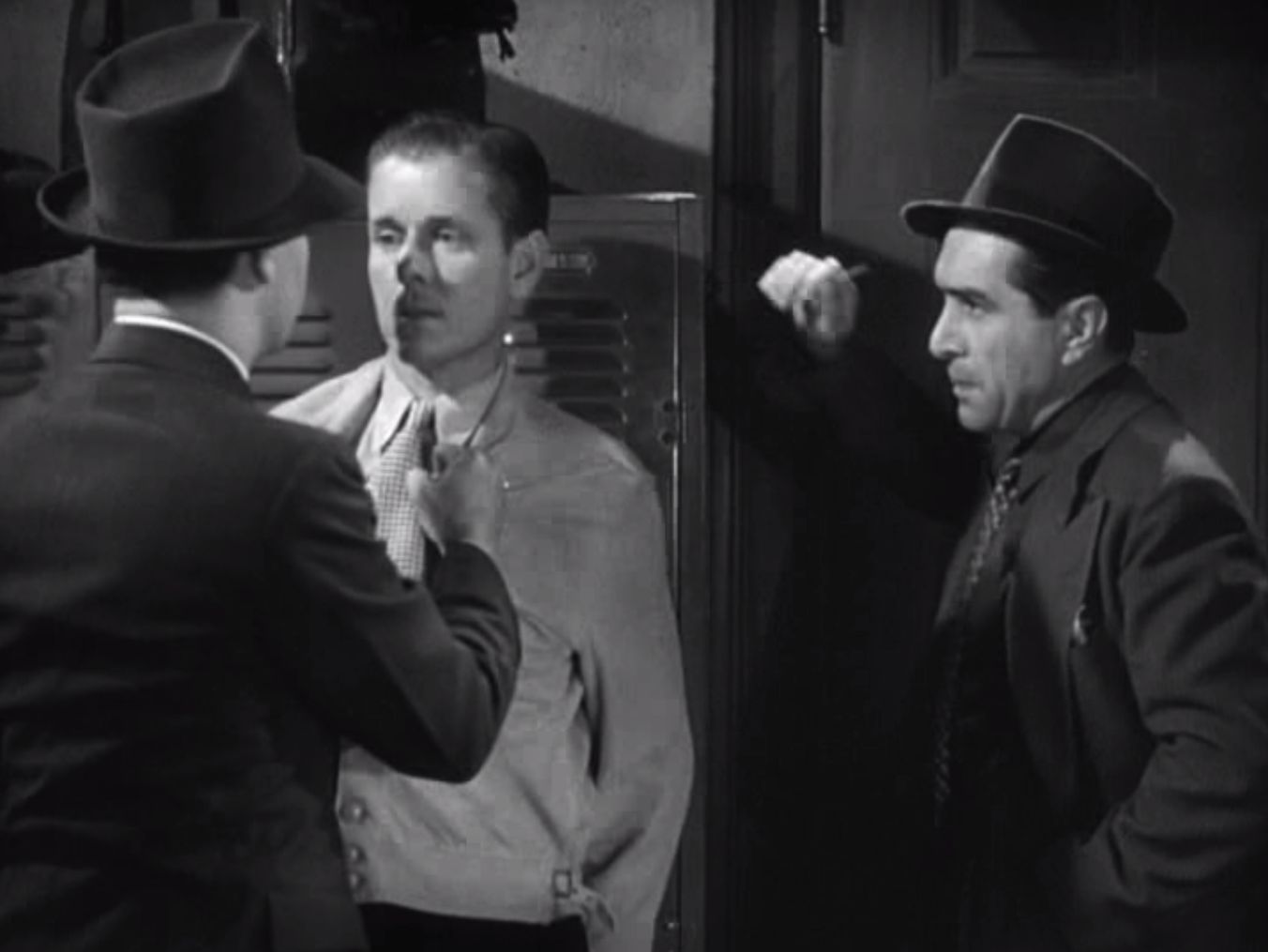

Rut roh, Raggy.  You see, Edward neglected to tell his hoodlum friends that the gendarmes paid the Cassidy people a visit after the meat robbery and started asking a lot of questions…this does not sit well with Moxie, though it’s Torpedo who grabs the little mook by the lapels, slamming him up against the lockers.

MOXIE: What did they say to you, Eddie…?
EDDIE: Oh, they just asked me a couple of routine questions…was the truck locked when it left?  I told them yes…and they asked me what I did…they questioned several other guys at the plant, too…don’t worry about it!
MOXIE: We’re not worried about it, kid…only watch your step…go on, beat it…


Well, we’re at the halfway point here and as you can tell by the newspaper headline—a couple of bags of ice is insufficient to keep meat from going bad.  Dr. Rexford informs Cap’n Mallory in one of the hospital wards that there’s been close to 200 cases of ptomaine—with four deaths—from “bad beef.”  “Forty-seven butcher shops and seven restaurants…had some of that spoiled beef,” he intones, adding that that’s why he’s called Mallory in on the case.  The three “jobbers” that handle Cassidy beef—Ward, Wesley, and Britton—have been vouched for (ha!) by Cassidy, and the plant has received a clean bill of health after being thoroughly inspected.


A distraught woman bursts out in tears as she is led out of the ward by an intern—sounds like she received some bad news.  “We’ve got to find the rest of that poisoned beef before it gets to any more people,” declares Rexford firmly.  “There’s no time to lose.”  What started out as a simple case of hijacking has turned into “a death threat.”  Mallory is still convinced that it’s an inside job…but since he’s had no luck with the leads, he turns to the Fourth Estate to flush the miscreants out.  Meanwhile—back at the hideout:

BUNCO: It’s no use…I can’t get rid of any more of that beef…the Health Department’s got the jobbers buffaloed…
MOXIE: How can the beef be bad—we got ice on it, haven’t we?

“Damn it, Jim—I’m a hoodlum, not a nutritionist!”


MUSCLEBOUND: Yeah…them headlines is just a copper’s gag…
BUNCO: We better drop it…maybe it is spoiled…
MOXIE: Now, listen—we got dough tied up in this!  Plenty!
SHEAFOR: That’s right…and we’re gonna sell it!  (To Moxie) We’ll make that beef look fresh with some chemicals…then we’ll re-stamp it with the Maxim Company stamp!
BUNCO (sarcastic): Oh—will that make it good?
MOXIE: Well, what’s the difference…as long as we get our dough!

Strategy session in a major corporation or powwow amongst the criminal element?  You make the call!  Moxie orders Musclebound to get his ass over to the garage and start preparing the beef… but he’s interrupted by the arrival of Torpedo, who produces this cherce headline:


“When that kid sees how bad it is…he’s gonna spill all over what he knows all over headquarters!” wails Sheafor.  “That’s what I’m thinkin’,” confirms Moxie.  Besides, Eddie has violated the “code” by buying that car after explicitly being told not to.  Ordinarily, an infraction like this would result in loss of supper and detention in one’s room the rest of the evening.  But the Moxie Gang plays for bigger marbles, and Moxie orders Bunco to grab a taxi and collect Eddie, who’s due off from work in twenty minutes.  “Tell ‘em we’re gonna let him in on a big job,” Moxie explains…then he adds “The heat’s on.”

Because Cap’n Mallory has also learned that Eddie’s become quite the plunger of late, he’s had the kid shadowed by Reed—he’s on the job observing that Bunco is waiting for Eddie in Eddie’s car when the whistle blows.


BUNCO: Moxie wants to see you…
EDDIE: Hey—what for?
BUNCO: He wants you to meet the Big Boss…they’re gonna bring you in on a real job…

“Gloriosky!  That sounds neat-o keen!”  Bunco has Eddie drive to Sheafor’s, where the kid can hardly contain his excitement that his friends will be taking him for a ride.  Moxie holds back to tell Bunco: “Take the kid’s car to the Dutchman…get what you can for it, and tell him to break it up…today.”  Reed can’t help but notice that Bunco drives off in Eddie’s car and so he follows the henchman…sadly, in taking his eye off Eddie he can do nothing when Torpedo later sends the kid to The Happy Hunting Ground while the hoods drive along a country road.

Eddie did not die in vain.  (It was more like in B.F.E.)  Since Reed told Mallory about the kid and Bunco arriving at Sheafor’s, it’s given the police a vital lead in that they leap into action to question those individuals who do business with “Pop” …and that leads them to the weaselly Joe Mollock, who “handled fifteen more sides of beef than his refrigeration allowed last week.”

REXFORD: You handled more meat than your refrigerators can take care of…
MOLLOCK: All right…I’ll pay the fine…
MALLORY (enraged): Say—you can’t settle this with a fine

“Who do you think you are—Goldman-Sachs?”


MALLORY: …two hundred people have been sick, four have died, and one was murdered because of the hijacking of some poisoned beef—and you handled fifteen sides of Cassidy’s beef that you can’t account for!
MOLLOCK: None of my meat poisoned anybody!  I never got a kickback!
MALLORY: No, but the health department did…you’re in a spot, Mollock…
MOLLOCK: I tell you that beef was okay!
MALLORY: Yeah?  Say, maybe we’ll slap a manslaughter charge on ya…we’re gonna close all your stores and hold you for investigation…

B-b-b-bad to the bone.

“Only if I don’t sing like a canary…and I’m going to do some warming up exercises right now!”  Mollock comes clean and confesses to the cops that he got the beef from Sheafor—still insisting the meat, however, was perfectly okay.  It’s all over but the shouting, cartooners—Moxie and the boys make separate deliveries to all three of Mollock’s stores (he won’t take the beef otherwise) and at each establishment, the cops are waiting to collar them (even Sheafor).  It’s all terribly anti-climactic, though I did chortle when they rounded up Bunco because he remarks “I had a hunch this was coming!” as he’s being slapped into handcuffs.  (Mama said there’d be days like this.)  When they arrest Musclebound at the same store, Rexford removes the tarpaulin from his truck and remarks of the beef: “Enough to kill a city…okay, pour the kerosene over it.”  (Yes, I was kind of surprised by this—I half-expected them to dole out the food out to the poor.)

Take us home, Mallory my man!


MALLORY: Moxie was right…the criminal can’t win…Bunco turned states’ evidence…Moxie and Musclebound went to the chair for Eddie’s murder…

I should point out that it was Torpedo who popped a cap in Eddie…but he was gunned down as the cops swarmed in on him at one of the stores.  (“He asked for it.”)

MALLORY: …Sheafor drew fifty years to life…and Eddie the working boy—who wanted to run with the so-called big shot gangsters—did not live long enough to find out that crime does not pay…thank you…


No…thank you, Captain Mallory.  Next time: a short with a title that’s just plain irresistible to a left-wing scalawag like me—Soak the Poor (1937)!  G’bye now!

Thursday, June 22, 2017

Lubitsch of Arabia


Janaia (Pola Negri) is a breathtakingly beautiful dancer who travels with other performers in a caravan…and who’s attracted the attention of a Bagdad slave trader, Achmed (Paul Biensfeldt).  Achmed has been commissioned by Zuleika (Jenny Hasselqvist), the current favorite in a harem maintained by “The Mighty Sheikh” (Paul Wegener), to procure women for her hubby…because she no longer wants to be the favorite, preferring instead the romantic attentions of Nour-Ed Din (Harry Liedtke), humble (and handsome) clothes merchant.  His Sheikhness, learning of Zuleika’s perfidy, condemns her to death…but she is spared when the Sheikh’s son, Sheikh, Jr. (Carl Clewing), pleads for her life.  Janaia is not so fortunate—the cruel despot bumps off both her and Sheikh, Jr. (they were having a little thing on the side) but before he can add Zuleika and Nour-Ed Din to the body count he is dispatched to the Great Beyond by the hunchbacked Abdullah (Ernst Lubitsch), who’s avenging the murder of Janaia.

All this palace intrigue has been condensed into a fifty-minute cut-down of Sumurun, a 1920 melodrama directed by Ernst Lubitsch before he emigrated to the U.S. and exhibited “the Lubitsch touch.”  (“Sumurun” is the name of the Zuleika character in the original German movie.)  The movie would be released in America the following year and retitled One Arabian Night; the (always reliable) IMDb lists the movie’s running time as a longer eighty-five minutes (another DVD version clocks it at 105).  The 50-minute version is from an Alpha Video release that came out in mid-May.

The shorter running time on the Alpha DVD really hurts the viewing experience, sad to report.  It makes One Arabian Night confusing and often difficult to comprehend, which is a shame because I had heard a good many positive things about the picture and I was looking forward to sitting down with it.  It’s not entirely unrewarding; it’s interesting early Lubitsch (his later themes of infidelity and naughtiness are on full display in this tale based on the pantomime by Friedrich Freksa), and it also showcases the appeal of Pola Negri, who would go on to a prolific career as a silent screen siren.  It was with the success of Night in the U.S. that Mary Pickford was encouraged to invite the director and his star to make movies in Tinsel Town.  Lubitsch would continue to direct classics like Trouble in Paradise (1932) and Ninotchka (1939) until his death in 1947 (his valedictory feature, 1948’s That Lady in Ermine, was assigned to Otto Preminger after Ernst died during production) but Negri, despite box-office hits like Forbidden Paradise (1924—directed by Lubitsch) and Hotel Imperial (1927—the only other Pola film I’ve seen), went back to Europe to work toward the silent era (her thick Polish accent would have been a problem)—only resurfacing in two later American films, Hi Diddle Diddle (1943) and The Moon-Spinners (1964, her final movie).

Sadly, Lubitsch abandoned a promising career in front of the camera with this film (he made cameo appearances in a few of his talkies and in the Ed Sullivan film Mr. Broadway [1933]; he’s also in the trailer for The Shop Around the Corner)—he’s quite good as the sympathetic hunchback who pines for Negri’s character from afar, then later gets an opportunity to be a hero at the end.  I’ve mentioned on the blog before that while I have a tremendous admiration for Ernst as a director his movies just aren’t my particular cup of Orange Pekoe (it’s not him—it’s me) save for To Be or Not to Be (1942), which I will watch at the drop of a hat.  (In Milt Josefsberg’s The Jack Benny Show, he includes an anecdote from his famous boss in which Lubitsch “acted out” how he wanted Benny to play Josef Tura in To Be…so the director never got performing completely out of his system.)  Lubitsch fans will want to check this one out if they haven’t already; many thanks to my friend Brian Kray at Alpha Video for providing me with the screener for this review.

Friday, June 2, 2017

Crime Does Not Pay #6: “The Perfect Set-Up” (02/01/36)


The two gentlemen scribes responsible for last week’s stirring Crime Does Not Pay saga, Hit-and-Run Driver (1935)—Robert Lees and Frederic I. Rinaldo—are back again with a tale directed by Edward Cahn:  The Perfect Set-Up (1936).  Heck, they’re getting the entire band back together because actor William Tannen also returns as the MGM Reporter identified only as…Jim.

JIM: Ladies and gentlemen…as the MGM Reporter, it’s been my duty to present case histories of that endless book of proof, Crime Does Not Pay

Now available for Kindle and Nook.  (And really, what’s “it’s been my duty” nonsense?  You’re paid to do this.)


JIM: I would like Captain of Detectives Hewitt to add another chapter to that book…he will tell you the story of Alan Saunders, one of the most unusual criminals of our time…as he knows it…
HEWITT: Thanks, Jim…

“…but if I’m going to be helping you with that book, that goddamn advance check had better be in my mailbox by tomorrow morning.”  He’s a little unrecognizable clean-shaven, but the actor-writer playing Hewitt is Frank Shannon—fondly remembered here at Rancho Yesteryear as “Dr. Zarkov” from the Flash Gordon serials hat trick (Flash Gordon [1936], Flash Gordon’s Trip to Mars [1938], and Flash Gordon Conquers the Universe [1940]).  I always get a giggle whenever I spot Shannon in a non-Zarkov role, like his turn as “Sir John Mansfield” in The Bride’s Play (1922).


HEWITT: …I believe this case will be a great lesson to those who feel dissatisfied with life because success does not come easily to them…Saunders was a brilliant boy…when he graduated with top honors from a large technical school, his teachers predicted a great future for him…but times were hard, and the best he could get for himself was testing the finished product of a large radio factory…

The young man who strays off the straight-and-narrow path is played by William “Bill” Henry, an MGM contract player you might have seen in such flicks as The Thin Man (1934—as creepy Gilbert Wynant), China Seas (1935), and Tarzan Escapes (1936).  He was also a member-in-good-standing of director John Ford’s stock company, with appearances in the likes of The Last Hurrah (1958) and The Man Who Shot Liberty Valance (1962).  (Of interest to the TDOY faithful are two appearances in Mayberry R.F.D., covered here previously on the blog: “Driver’s Education” and “Millie, the Secretary.”)  As Saunders, Henry instructs his fellow factory prole (unidentified at the [always reliable] IMDb) that they should “check one of the tubes” when a worker named “Jim” (another unidentified actor) approaches him and, after asking how things are going, tells him to “keep up the good work.”


ALAN: My boss…we graduate from the same class—only I was valedictorian and he barely managed to scrape through
EMPLOYEE: Well, what do you expect?  His father’s a big stockholder in the company!

“Welcome to the meritocracy, pallie!”

ALAN: Yeah…the lucky stiff…if I had his money, I’d…
EMPLOYEE: You’d do what…?
ALAN: I’d do all the things I can’t on my measly salary…


“Food…clothing…shelter…you know, the little luxuries in life.”  Alan’s co-worker tells him to put a sock in it because he’s just spotted the president of the company headed their way.  (The IMDb draws a blank on the actor playing this guy, too.)

NELSON: Oh, Saunders…
ALAN: Yes, sir?
NELSON: I’ve been looking over that television screen idea of yours…it certainly is novel…

“That’s where I got the idea—from a novel!”


ALAN: You think the company might use it?
NELSON: Oh, not so fast—I said it was novel…but I hardly think it’s practical

“To be honest, we’re just stalling for time until we can figure out a way to steal it without giving you credit.  Legal’s looking at it right now, and we’ll let you know when we present you your severance check.”  Okay, I’m just poking a little fun here—Alan acknowledges that it’s still in the experimental stage, but with a little more work and some extra men on the job it can shake off its irksome “practicality.”  But Nelson pooh-poohs the young man’s ambition, dismissing him with “You’re rather impatient, aren’t you?”  Dude just can’t catch a break, and he complains as such to his roommate Chet (J. Anthony Hughes) in the next scene:


ALAN: The same old line…said he’d “keep me in mind” …hmph…I didn’t know he had one…
CHET: So you’re beginning to realize they’re playing you for a sucker, huh?
ALAN: Maybe you’re right, Chet—if that’ll give you any satisfaction…nah…the answer is still “no”…
CHET: Why, with your brains you and me could make more dough in a day than you make now in five years
ALAN: Yeah…and find myself behind the eight ball?  No thanks…

Hey…it worked for George O’Hanlon.  Chet presses his pal to consider this criminal venture with him, seeing that he has all that technical know-how.  “By the time you’re a success, you’ll be too old to enjoy it,” he persuasively argues against soul-sucking, nose-against-the-grindstone capitalism.  Besides, Chet would be “taking all the risks.”

CHET: You got everything to gain and nothing to lose…
ALAN (after a pause): What do you want me to do?

You got him, Chester—now reel him in slowly!  All Chet wants is a little information on “burglar alarms and how to stop them.”  What remains of Alan’s conscience start nibbling on him—“I’ve got a date”—but it’s too late: the journey down the Perdition Interstate has begun.

In the next scene, Alan explains to his gal, Mary Fulton, why he begged off on their rendezvous the previous evening.  I can understand why a lot of these bit players go unidentified at the IMDb, but the actress playing Mary is pivotal to the action in this short, so omitting her details is puzzling.  Then again, perhaps we should rest easy knowing someone hasn’t come around and volunteered erroneous information (“That’s Scarlett Johansson!”).


MARY: Where were you last night?
ALAN: I’m sorry…but at the last minute I found out I had to work…

What was that about "the same old line?"  The two lovers have an innocuous conversation about how Alan is stymied in his ambitions at work, with Mary trying to reassure him not to be so discouraged.  When he posits the notion of robbing a bank, she replies: “That would take care of your rent problems for twenty years anyhow.”  (Yes, I tittered at this.)  A paperboy greets Mary and drops off a load of the latest edition on the counter…and here are your headlines:


Hokey smoke, Bullwinkle!  Looks like Chet occupied his time wisely last night!  Alan then remembers he left something on the stove in his apartment, and he heads back to his domicile to see that his roomie is playing cards with a friend, Dave Mayne (Harry Tyler).


DAVE: Sure do know your stuff, kid…
ALAN (with a laugh): What do you mean?
CHET: Oh, that’s all right—I told Dave all about you…you see, uh…he’s my…business associate
ALAN (smiling): I see by the papers where business is picking up

Hey!  These things are supposed to be unintentionally funny!  “You’re a smart kid, Al,” Dave gushes to his new friend.  “I think Chet and I can do you some good.”  Dave takes a drag on his cigarette and stubs it out in an ashtray…and then a dissolve reveals that ashtray has gotten a bit fuller with the passage of time.  (Nice little directorial touch by Cahn.) 


DAVE: Our only problem is—what business could we open that we could carry on legitimately?  That’s where you come in…
ALAN: Go on…
CHET: Look, pal—you know radios…so here’s our proposition: you, Dave and I open a radio store…we put up the money, but…you actually run the place…
ALAN: All we want you to do is sort of act as our…technical advisor…we’ll do the rest…
CHET: There’s a barrel of money in it…
ALAN: I know, but…well, give me some time to think it over, will ya?

Two seconds later…


Hey, this is a twenty-minute short—time moves quickly or not at all.  Alan is seated in the back room of the shop (balancing the books, maybe?) when Chet and Dave return from their latest venture in crime, slapping each other on the back over Alan’s cleverness.

ALAN: Hey—did you put the old padlock back on the gate?
CHET: No…no, I didn’t…
ALAN: You didn’t?
CHET: Well, what of it?  They’re both your locks…


That’s when Alan patiently explains to his boneheaded friend that it’s slip-ups like this that put the police work into overdrive when it comes to these two-reel morality plays. 

DAVE: Too late now…
ALAN: It’s not too late—I’m not gonna take that risk…
CHET: You?  Where do you get that stuff?
DAVE: Yeah…if you’re so worried, why don’t you start takin’ some of the chances yourself?
CHET: Yeah…

So Alan decides to go back to change the padlock before his dumb hoodlum friends are rounded up by the gendarmes.  “From then on,” Hewitt drones on to Jim, “Saunders took an active part in the crimes he planned.  Even after his marriage to Mary he wasn’t satisfied.  He had it all figured out—he believed he could keep his criminal career separate from his social life indefinitely.  But all the time inside his brain, a slow poison was at work...crime!”  (Captain Hewitt seems to have forgotten that Bruce Wayne got a lot of shit done as Batman, and that never seemed to put a crimp in his social activities.)


ALAN (to his associates): From now on, we’re going out for the bigger things…as long as we’re in it this deep, let’s make it really worth our while…

The origin of “go big or go home,” by the way.

ALAN: The cops will be looking for guys with previous records…they’ll never suspect a bunch of rank amateurs like us…

And believe me—there ain’t nobody ranker.  A montage of front page headlines and close-ups of cut wires and opened safes follows.  Everything seems to go according to plan until one night “The Rank Amateur Mob” robs an establishment with a movie theatre nearby.  As they make their getaway, Alan spots a man working outside putting up a theatre poster and draws his pistola…


…it’s character actor Robert Dudley, so you can guess at the implications.  Alan guns down the Weenie King!  As the Hot Dog Monarch draws his rations, director Edward Cahn demonstrates how not only to properly hype current MGM product (a 1935 film with Spencer Tracy and James Stewart as his sidekick) but making a funny in-joke at the same time.


CHET: Whadja want to shoot the old guy for?
ALAN: I had to…he saw me…


A visibly shaken Alan returns home and listens to the police calls on his radio—when he doesn’t hear a report of the murder of the Weenie King, he relaxes a bit…but then the ol’ ball-and-chain enters, and he’s going to have to make small talk. (“Where have you been, dear?”  “Oh, the usual…cards with the boys…busting a cap into old geezers…you know…”)

ALAN: You’re still up?
MARY: It’s late…I was getting worried
ALAN: Haven’t I told you not to wait up for me?!!  (Tugging at his collar) I can take care of myself…
MARY: I know, darling…but you’ve been acting so nervous lately…

“It’s as if you were leading two lives—one good, and the other pure dagnasty evil!”  The Rank Amateur Mob’s reign of terror continues with the looting of the Lynton Bank—which results in the death of two individuals.  Witnesses are only able to identify the trio’s getaway car, so Alan instructs Dave to get rid of the vehicle because it’s “hot.”

DAVE: Say, Chet…I’m drivin’ that Packard tonight…we better change that battery—I don’t wanna take any chances gettin’ stalled
CHET (seeing a battery on a work table): Why—here’s a new one…
DAVE: All right—play it safe…fix these numbers…


Chet files down the identification number on the battery.  “When I’m through filing, I’ll burn the rest down with acid.”  The stolen Packard is later identified—despite it being burnt to a crisp—by the gendarmes by the engine number.  One of the detectives (Ben Taggart) notices the battery, and Chief Hewitt asks the car’s owner if he had changed it recently—the man hasn’t, though he intended to.  Can they identify the numbers on the battery even though some miscreant has gone at them by filing them down and then burning them with acid?  No problemo, says a police technician.  “You see, I figure the heavy stamping machine that puts these numbers on at the factory hits with such force that it changes the molecular structure of the whole metal.”  Whoa—check out the big brain on Mr. Wizard!  But he’s right; a simple chemical process later, and those numbers are easily read…allowing the police to stop by the humble shop of Saunders and Associates.

Batteries have a permanent record!
An undercover detective strolls into the establishment under the ruse of needing a new radio tube…and when Chet and Dave attempt to help him with his request, they are quickly rounded up by Kappa Delta Flatfoot.  Alan, being in the back room at the time, hears his confederates being rounded up and beats a hasty retreat by ducking into a convenient crate.  The cops, perplexed as to why such a criminal mastermind would choose such a hiding place, soon discover why after firing a few rounds into the box:


 I laughed out loud at this, only because it reminded me of a similar situation in the 1945 serial Brenda Starr, Reporter.  Well, Alan must—in the vernacular of the underworld—“take it on the lam,” so he phones the little woman to let her know that he won’t be home for dinner…for about twenty years.  Okay, I’m just jinkin’ ya—he tells her to grab a hat and coat and meet him at the corner of 6th and Hope.  The couple are later stopped at a traffic light when a newsboy happens by hawking the latest edition of The Evening Blade…and this cherce headline:


“Muffin…there’s something I’ve been meaning to tell you.”  Alan is forced to tell Mary the sordid truth about his criminal activities, and she is terribly upset.


ALAN: How do you think I made all that money?  From the radio store?
MARY: We didn’t need that kind of money…
ALAN: I only did it for you…you haven’t any kick coming…ah, as soon as this thing blows over we’ll have everything we’ve ever wanted…
MARY (tearful): I won’t have Alan
ALAN: Sure you will…they’ll never catch me…
MARY: You’re not the Alan I mean…you’re Al Saunders…killer!
ALAN: Mary!
MARY: You killed the Alan I loved…you killed him like you did everyone…
ALAN: Shut up!

Oh, yeah—this relationship is just going to blossom into something truly fulfilling and rewarding.  “Now you listen to me,” Alan tells Mrs. Alan in a menacing tone.  “You’re my wife, understand?  So no matter what happens we stick together.”

Alan is so clever he's able to escape capture, leaving only his clothes behind.
Well, I guess the murder of the Weenie King has raised such a public outcry that it’s put a spur under the saddle of the police, because they swing into action and start rounding up the usual witnesses during their manhunt.  One female clearly recalls that Alan has a habit of constantly tugging at his collar, as if his shirt is too tight…or he’s doing a Rodney Dangerfield impression.  Finally, the men in blue track down Alan’s old boss Nelson, who tells the detectives with a perfectly straight face: “In fact, he submitted an idea for a television screen which is working out very well.  It’s a shame this had to happen.”  Nelson claims that they tried to contact Saunders…yeah, I’ll just bet you did.  (Dick.)

That silhouette of the detective reminds me of an omnipresent radio narrator whose whistled a lot.  ("So you thought no one would know about your theft of Alan's invention...didn't you, Nelson?")

Alan’s brilliant invention—that Nelson’s company, for all intents and purposes, “liberated,” setting in motion the kid’s swift descent into crime—will prove to be his downfall.  Captain Hewitt gambles that Alan is just narcissistic enough to want to see his device deployed at an exhibit Hewitt persuades Nelson to host…and sure enough, as the place is crawling with more cops than a Krispy Kreme with a “Hot” sign, Alan (check out his pencil-thin moustache) is spotted with his familiar tell:

"I lived in a tough neighborhood...a tough neighborhood!  I once asked a cop where the subway was and he said 'I don't know...no one's ever made it!'"
The cops put the snatch on Alan as he leaves the exhibition…and just before they really start to work him over, Hewitt informs him that the wife is going to swing, too!


ALAN: Mary, don’t talk to them…the law says a wife can’t testify against her husband!
HEWITT: No one is asking her to testify against you, Saunders…she’ll have enough trouble defending herself!
ALAN: What do you mean?
HEWITT: I mean she’s going on trial with you as an accomplice for murder and grand theft!
ALAN: No!
HEWITT: She’s in this as much as you are!
ALAN: No, you can’t—you must be crazy!
HEWITT: Take ‘em out!
ALAN: No…no…she had nothing to do with this!  I’m guilty, I admit it…but you better leave her out of it, see…
HEWITT: I’m afraid it’s a little too late for that…the law will have to take its course…

Man!  This guy Hewitt is a real hardass!  “Yes, Jim,” he solemnly concludes his tale, “Saunders not only made a wreck out of his own life—but his crimes brought shame and suffering to the one person he really loved.  His accomplishments will not bring him honor in the world of science…he is merely a case record in the underworld of crime.  A case brought to a sudden close…at the end of a rope.”


I’m guessing the judge that sentenced Alan to death was a Preston Sturges fan.  Next week: Foolproof (1936)—g’bye now!