Because I benefited from being a past supporter of
Undercrank Productions’ previous
Accidentally Preserved releases (and you
can too, by
subscribing to the e-mails)—I
got to order
Volume 4 before its official release this Tuesday, and at a
nice discount—that’s why you’ll be reading about the DVD here at
TDOY and not at
ClassicFlix
(though I’m sure they’ll add the title to
their
inventory soon).
Undercrank’s Ben
Model has once again produced a splendid disc of silent rarities that have been
paroled from the film vaults, with a much-valued assist from John McElwee and
Greenbriar Picture Shows.
Model’s Undercrank Productions has entered into partnership
with the
USC Hugh M. Hefner Moving Image
Archive (yes, the same Hugh M. that founded
Playboy magazine), and they can also take several bows for the
shorts featured on
Accidentally Preserved, Volume 4.
The movies on
AP4 are all from 9.5mm
safety film; in 1922, the Path
é-Fr
ères company of France
introduced this film format via a company called Path
é-Baby—and what distinguished
this from other formats was that the perforations were in the center of the film,
between each frame.
The following year,
the 9.5mm format was introduced in the United Kingdom by Path
éscope.
9.5mm film was unveiled in the U.S. in 1925…but would eventually
find itself overwhelmed by the 16mm film format, which made its debut two years
earlier courtesy of Kodak.
What made
9.5mm film so different—in addition to the center perforations—was that many of
the silent movies had “notched” intertitles; the intertitles were printed for
anywhere from 2-8 frames, with a small notch punched into the edge of one of
them.
The notched frame would be caught
by the projector, allowing it ample time to appear onscreen so that it could be
read before moving on with the movie.
This would allow a 9.5mm release to be made with 300 feet (with no loss
in image quality) compared to a 16mm release, which was comprised of 400 feet
(that’s a savings of 25%!).
9.5mm film was not only used as a home-use release platform
for silent/sound films—it functioned as a home movie-making format as
well.
(However, I’m reasonably certain
that the individuals interested in purchasing
AP4 have little curiosity
in the extended director’s cut of little Montmorency’s second birthday
party.)
A lot of silent films that
survived the ravages of time and neglect exist only because they were released
to 9.5mm and some of them saw releases only in Germany, France, the UK,
etc.
The selections on this DVD never
saw a 16mm release in the home movie market…and in many cases, are not
available in film archives on 35mm.
Here’s an example (and one of the highlights on
AP4):
Tides of Passion, a 1925 Vitagraph
release starring Mae Marsh.
Marsh was
one of the big names of early American silent cinema (known for her appearances
in D.W. Griffith’s
The Birth of a Nation
[1915] and
Intolerance [1916]), and
Passion—directed by Vitagraph
co-founder J. Stuart Blackton (
Humorous
Phases of Funny Faces)—was one of the actress’ last silent films.
This two-reel Pathescope version (released in
November of 1930 as
The Sea Repays) may be the only extant copy of
the motion picture.
Marsh plays a woman married to a real bounder (Ben
Hendricks, Jr.) who’s also a bit of a hound when it comes to cheating on his
wife; after an extended stay in India with his regiment (where he found the
time to engage in both fighting
and
whoring), Hendricks returns to his stomping grounds but is delayed when he
falls overboard from a vessel.
He washes
up on an island and is taken in by another woman (Laska Winter)—then he
proceeds to enjoy a dalliance with her.
Hendricks’ problem is that he becomes easily bored with the women who
are given the pleasure of his company, and when he finally decides to return to
Marsh, Winter (who’s not down with being kicked to the curb) arranges for a
series of events that result in his illness and subsequent death (serves him
right, the swine).
Even in its truncated
two-reel form, I found
Tides a
positive joy, my
ClassicFlix
colleague Fritzi at
Movies
Silently nails it when she writes that
Tides “is just top notch from beginning to end.”
Since the survival of
Tides
of Passion is in doubt, it’s reassuring to know that a complete 35mm print (with
French titles) of
The Ninety and Nine
(1922) does exist…though as of this writing it’s biding its time in the George
Eastman Museum.
Which is a shame, because
the one-reel version of the film (released in 9.5mm as
Through Fire in 1930; the edition used for
AP4 had spliced-in German
titles, which had to be translated into English courtesy of historian Ulrich
Ruedel) whets your appetite for the whole enchilada.
Colleen Moore and Warner Baxter star in a
film based on a popular stage melodrama (it debuted in 1902); its reputation
was such that audiences were already familiar with the source material by the
time of the movie’s release by Vitagraph in 1922.
The one-reel treatment boils down
Ninety and Nine’s first six reels to
five minutes, allocating the rest of the time to its exciting fire-and-railroad
conclusion.
Ninety and Nine’s intricate plot is summed up in a few titles
before its
AP4 presentation (to help those who may be confused as to what
the movie is about); I won’t even begin to sum it up here.
But it does make you want to see the entire
movie, which can only be a good thing.
 |
| This gentleman undoubtedly looks familiar...but you're have to speak up, 'cause he's a little hard-of-hearing. It's Robert Dudley, immortalized as "The Weenie King" in The Palm Beach Story (1942); he plays Colleen Moore's pop in Ninety and Nine. |
The previous three volumes in the
Accidentally Preserved franchise concentrated on lost silent comedy
treasures…and
Volume 4 won’t disappoint those fans.
I was most looking forward to seeing
The Wages of Tin (1925—released in 9.5mm in September 1929 as
Billy the Ford Buster), because I’ve
developed an interest in Glenn Tryon ever since I reviewed
Lonesome
(1928) for my “Where’s That Been?” column at
ClassicFlix.
(I’ve been able
to grab
Long Pants [1926] from The
Greatest Cable Channel Known to Mankind™, and I have shorts like
Meet the Missus [1924] and
Hold My Baby! [1925] on some Alpha
Video DVDs around this jernt somewhere.)
Tin is a dandy little comedy
centering on Tryon’s attempts to rent and drive a “horseless carriage” (you
rarely go wrong with a Hal Roach production), and I can definitely see the Harold
Lloyd similarities in star Tryon.
AP4
also introduced me to British comedian Walter Forde with
Walter’s Paying Policy (1926); Forde was often described as “a
British Harold Lloyd” but I don’t think I had viewed any of his work until I
saw
Policy (I knew Forde’s name from
some of the films he directed later in his career, like
Charley’s [Big-Hearted] Aunt [1940] and
Gasbags [1941]).
Policy is also a treat, with some side-splitting
gags in a story of Walter’s determination to sell a client insurance (he works
for “Busy Bee Insurance”—“You won’t get
stung!”)
Our Gang fans will delight in spotting “Pete the Pup” in the
Bobby Ray comedy
Meet Father (1924—released
in 9.5mm as
Oh, For the Noble Art in
February 1932) and there’s much mirth to be enjoyed in the Ben Corbett-Pee Wee
Holmes romp
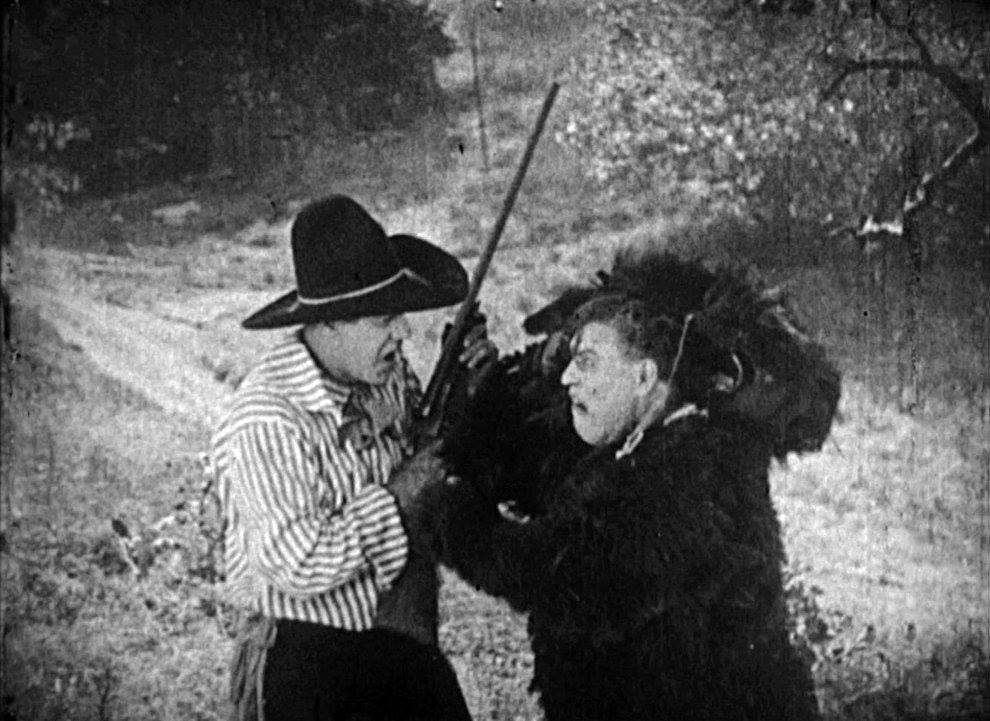
A Man’s Size Pet (1926—with
character veteran Robert McKenzie running around in a bear suit) and
‘Morning, Judge (1926), an entry in the
Carrie of the Chorus series.
(The Carrie comedies were produced by
animation kings Max and Dave Fleischer in an interesting foray into live-action
filmmaking,
Judge is a one-reel cut-down
of the original two-reeler—released in February 1938 as
Chicken Cooped.)
The only
comedy on
AP4 that wasn’t my particular meat was
Nonsense (1920), one of the early “Mermaid” comedies directed by “boy
wonder” Jack White.
Nonsense does have an amusing bit set in a dance hall: a poor girl
(Marvel Rea) who’s been seduced by the silver tongue of a cad (Frank J.
Coleman) is forced to sing for the barflies…and her sad rendition of
Home Sweet Home so moves the contingent
to tears that even an individual who’s taking one of the girls upstairs for a
little what-have-you is unable to complete the transaction, weeping as he comes
back down the stairs.
(There’s a reason
why there was an upstairs section of the
Long Branch on
Gunsmoke, folks.)
 |
| The hardest-working dog in show business. |
John Sinnott writes at
DVD Talk that
AP4 is “a bit more
hit-or-miss than the previous installments” (in fairness, he does speak highly
of the finished product) but I have to dissent: I thought the material on this
DVD was some of the strongest that I’ve witnessed in this fascinating franchise
devoted to obscure and neglected silent gems.
Accidentally Preserved Volume 4 is a must purchase for devotees
of silent cinema, and I guarantee you will not be disappointed.